







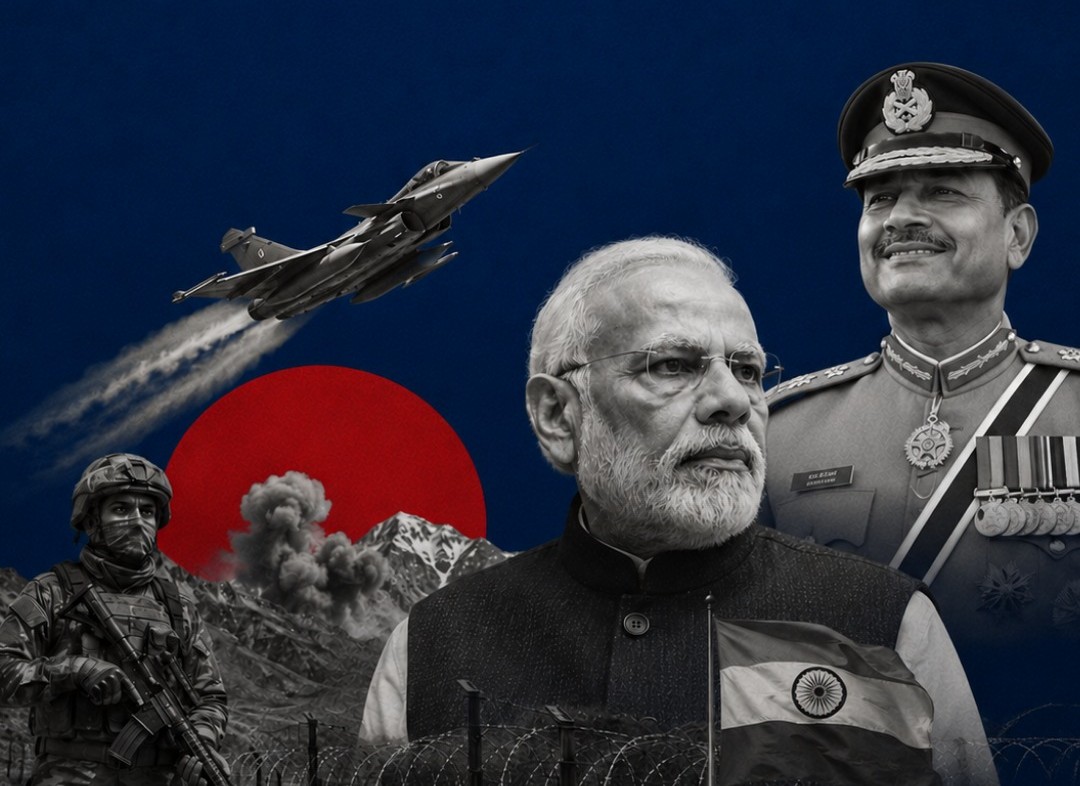
oday marks exactly one year since the first BrahMos missile crossed the border into Pakistan. This morning, Deputy Chief of Air Staff Air Marshal Awadesh Kumar Bharati addressed a press briefing marking the first anniversary, calling Operation Sindoor India’s response when its commitment to peace is perceived as weakness and its restraint is mistaken for inaction. The Indian Air Force posted a commemorative video at the precise hour the strikes were launched. PM Modi’s voice featured in the footage, declaring India would “identify, track, and punish every terrorist and their backers,” with the post reinforcing the government’s position that the operation remains open-ended.
The ceremony was immaculate. The accounting, as usual, was incomplete.
How the Ceasefire Actually Happened
Let us begin with the fact that the Modi government has most aggressively tried to erase from public memory. After a long night of talks mediated by the United States, President Trump wrote on his Truth Social platform:
“I am pleased to announce that India and Pakistan have agreed to a full and immediate ceasefire.”
That post went up before India’s own Foreign Secretary made his statement. Congress leader Jairam Ramesh pointed out this week that the first ceasefire announcement was made at 5:37 PM IST on May 10, 2025, by US Secretary of State Marco Rubio, who attributed it directly to Trump’s intervention.
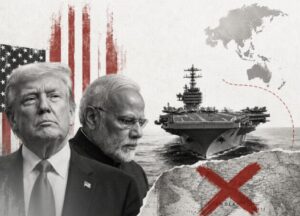
India’s official position has always been that the ceasefire was purely bilateral, struck between the two DGMOs without foreign involvement. That claim has not aged well. Since May 2025, Trump has repeatedly invoked the conflict, insisting on more than four dozen occasions that he brokered the ceasefire. Not once in twelve months has Modi publicly contradicted his “good friend” Trump on this specific claim. Not once. A Prime Minister who lectures the world on strategic autonomy cannot bring himself to tell Trump, to his face, that his version of events is wrong.
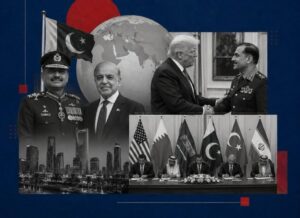
Pakistani Prime Minister Sharif stated that Trump played a “pivotal and paramount role” in the ceasefire, alongside representatives of Saudi Arabia, Turkey, Qatar, the UK, the UN, and China. Dar stated that 36 countries helped broker the truce. India insists it was bilateral. The world believes Sharif.
The Planes India Never Officially Lost
The aircraft losses of May 7, 2025, constitute one of the most extraordinary exercises in government silence in modern Indian history. Switzerland’s Centre for Military History confirmed the loss of at least one Rafale with serial number BS001, one Mirage 2000, and either a MiG-29UPG or Su-30MKI during the opening hours of the conflict. France’s own Air Force Chief confirmed seeing evidence of the Rafale’s loss. Indian intelligence had underestimated the PL-15 missile’s actual range, believing Pakistan possessed an export variant limited to 150 kilometres rather than the 200 kilometres actually achieved. Indian pilots operating Rafales believed they were beyond Pakistan’s intercept range. They were not.
Months after the operation, when India’s Air Chief Marshal finally spoke about Pakistani aircraft destroyed, he said the IAF eliminated “four to five fighter aircraft, most likely F- 16s.” Pakistan denied the claim entirely. India’s assertion, delivered three months after the fact, with no wreckage, no tail numbers, and no independent verification, was greeted with scepticism globally. Meanwhile, Pakistan released tail numbers of the Indian aircraft it claimed to have downed.
Then came the most damaging outside voice. Trump himself said publicly: “Seven brand- new, beautiful planes were shot down. They were going at it, two big nuclear powers. And I said to Prime Minister Modi and the field marshal over in Pakistan, “We’re not going to do any trade if you’re going to be fighting”.” The President of India’s most important strategic partner was, in effect, corroborating Pakistan’s version of events to the world. India issued a denial. Nobody noticed.
Pakistan’s Army Chief Became Washington’s Favourite. India Watched.
The diplomatic aftermath of Operation Sindoor is where the full scale of the failure becomes impossible to ignore. India’s stated objective was not merely to hit terrorist infrastructure but to isolate Pakistan internationally, to restore its image as a state sponsor of terror, and to build sustained pressure for accountability.
The opposite happened.
Pakistan promoted its Army Chief Asim Munir to Field Marshal on May 20, 2025. By June, Trump hosted Munir at the White House for a personal lunch, inviting him after Pakistan nominated Trump for the Nobel Peace Prize for “preventing nuclear war.” Since then, Trump has repeatedly called Munir an “exceptional man,” a “great fighter,” and “my favourite field marshal.” Pakistani officials and media reports say the two men now speak directly. As of today, the man who commanded Pakistan’s military response to Operation Sindoor is one of the most celebrated foreign officials in Washington. Congress leader Jairam Ramesh said it plainly this week: “Despite extensive diplomatic outreach by India, Pakistan did not get isolated as it had been following the Mumbai terror attack of 2008. On the contrary, its army chief has been embraced with extraordinary warmth by President Trump, and the world’s leading sponsor of cross-border terrorism has come in for praise from the US military establishment.”
That is not opposition rhetoric. That is a factual description of what happened.
Pahalgam’s Victims and Bihar’s Ballot Boxes
Twenty-six tourists were murdered in Baisaran Valley on April 22, 2025. They were identified by religion, separated from their families, and shot at close range. Their deaths are the reason Operation Sindoor happened, or so the government says.
What followed, however, was one of the most cynical deployments of national tragedy in India’s recent political history. In Bihar, a poll-bound state, Prime Minister Modi said he had delivered on his promise of avenging the terror attack: “Pakistan and the world saw the power of the sindoor of Indian daughters.” In West Bengal, he linked the operation to the cultural ritual of sindoor khela. The BJP retained Bihar with the best electoral performance the BJP-led NDA had ever recorded in the state.
The families of Pahalgam’s dead did not receive a Kargil-style review committee. They did not receive a public accounting of the intelligence failure that allowed the attack to happen in the first place, even though India’s Chief of Defence Staff General Anil Chauhan himself, speaking in Singapore on May 30, admitted that India suffered initial losses due to tactical errors. They received rally speeches.
Former External Affairs Minister Yashwant Sinha said in an interview with Kapil Sibal on May 21, 2025: “Operation Sindoor, Pulwama, Uri, everything is for elections.” Sinha served in a BJP government. His words landed differently because of it.
The Document That Does Not Exist
One year on, the ceasefire of May 10, 2025, remains what it was on the day it was struck: a military-to-military operational pause with no conditions, no written Pakistani commitment on cross-border terrorism, no verification mechanism, and no acknowledgement from Islamabad that the Pahalgam networks would be dismantled. One year on, Operation Sindoor offers a clear lesson: military success does not automatically translate into diplomatic leverage. By projecting himself as a peacemaker, Trump diluted the core issue of Pakistan’s role in cross-border terrorism and reframed the crisis as a conventional India-Pakistan standoff requiring external intervention. The Tribune India’s government celebrates today with videos, briefings, and anniversary ceremonies. What it cannot produce, and what the 26 families of Pahalgam deserve, is a single piece of paper showing what Pakistan committed to in exchange for the ceasefire India accepted. That paper does not exist. That is the real story of Operation Sindoor at one.





Leave a comment