







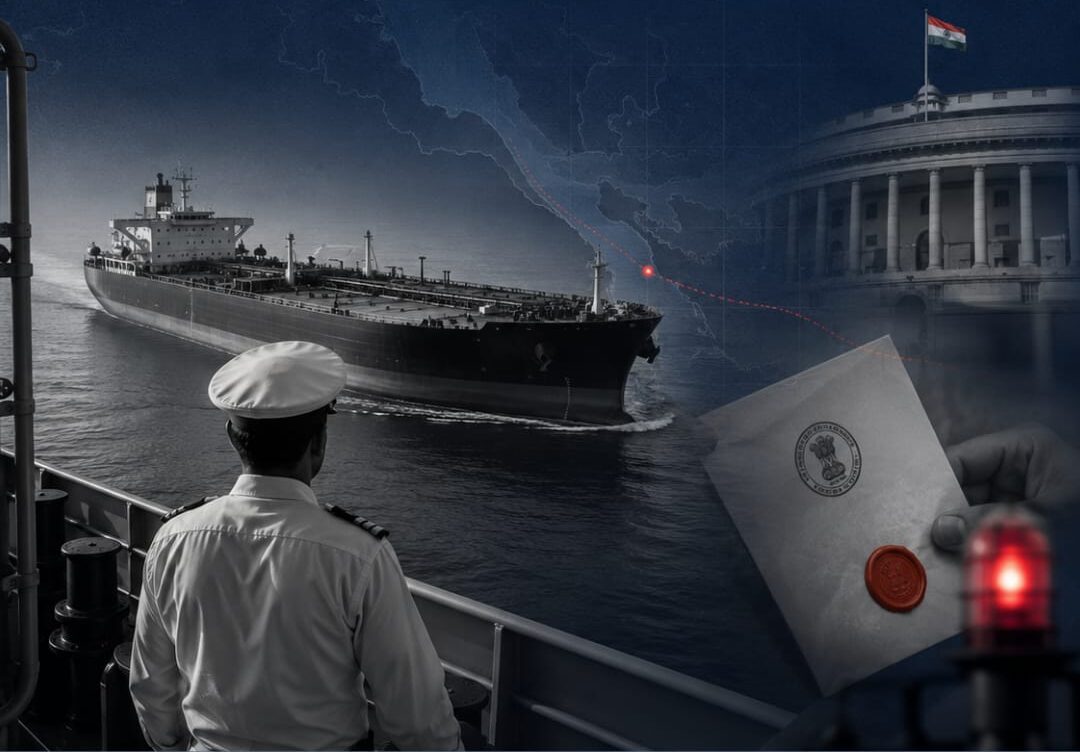
A Diplomatic Protest, Not a Policy Change
India summoned Iran’s Deputy Chief of Mission Mohammad Javad Hosseini to the Ministry of External Affairs on Monday, a day after the United Arab Emirates confirmed that Iranian cruise missiles had struck the tankers Mombasa and Al Bahiyah inside Omani territorial waters. One Indian crew member was killed. Eight others were injured, six of them Indian nationals, four in critical condition. The MEA called the incident “deeply worrisome” and urged “immediate de-escalation of tensions,” language that has by now become almost ritualistic in India’s response to a war that has been killing and endangering Indian seafarers for the better part of a year.
What the summons does not address, and what the government has shown little appetite to address in any forum, is why Indian crews keep ending up on ships sailing through one of the most contested stretches of water on the planet in the first place.
A Pattern, Not an Isolated Tragedy
Monday’s death was not an aberration. Since the Iran-Israel-US conflict widened in February, at least three Indian nationals were killed in a separate US strike on a commercial vessel in June, prompting protests in New Delhi by student groups against the killings. Tens of thousands of seafarers, a large share of them Indian, have spent months trapped in the Gulf under what the UN’s International Maritime Organization has called an “unprecedented” humanitarian situation, short on food, water and medical care while ship-owners and governments negotiated safe passage around them.
The government’s own account of its response, delivered by Prime Minister Modi to the Lok Sabha in March, emphasized that it was monitoring shipping routes to keep oil, gas and fertilizer supplies moving. That framing is precisely what has drawn criticism from those closest to the crews at risk.
“The Commodity Is More Important Than the People”
Rakesh Ranjan, South Asia regional coordinator at the Institute for Human Rights and Business, put the criticism starkly to Foreign Policy earlier this year, arguing that Indian authorities were effectively pressing ships to keep crossing the strait without adequately weighing the danger to the men aboard them. As he put it, the government appeared to treat the cargo as more important than the lives of the people carrying it, driven by domestic shortages of liquefied petroleum and natural gas rather than concern for the seafarers themselves.
Manoj Yadav, general secretary of the Forward Seamen’s Union of India, has separately described the toll on crews stuck in the Gulf, telling reporters that stranded Indian sailors were suffering unbearable conditions, in one case recounting a colleague’s body left unrefrigerated aboard ship for three days while awaiting evacuation after he died awaiting medical care.
Numbers the Government Would Rather Not Dwell On
By the International Transport Workers’ Federation’s count, Indian seafarers were the single hardest-hit nationality in the global wave of ship abandonments recorded through 2025, with 1,125 Indians left without pay or passage by year’s end. The Strait itself carries roughly a fifth of the world’s oil and LNG trade, a dependency India’s own energy security planning has done little to reduce even as the risk to the human beings who move that trade has become undeniable.
Against that backdrop, summoning a junior Iranian diplomat and issuing a statement calling for de-escalation is a gesture of protest, not a strategy for protecting Indian citizens. It registers displeasure after the fact. It does nothing to change the calculus that keeps sending Indian crews into the same waters where colleagues have already died this year.
Conclusion
New Delhi’s instinct, confronted with the death of one of its own citizens in a war zone at sea, has been to lodge a diplomatic protest and move on. That response may satisfy the demands of protocol, but it does not answer the harder question raised by seafarers’ unions and human rights advocates alike: whether the government’s energy security priorities have been allowed to outweigh the safety of the ordinary Indians it keeps sending back into harm’s way. Until that question is confronted directly, rather than deflected onto Tehran or Washington, the summons issued this week will not be the last one, and it will not be the last Indian family receiving news from the Strait of Hormuz that no government statement can undo.








Leave a comment