















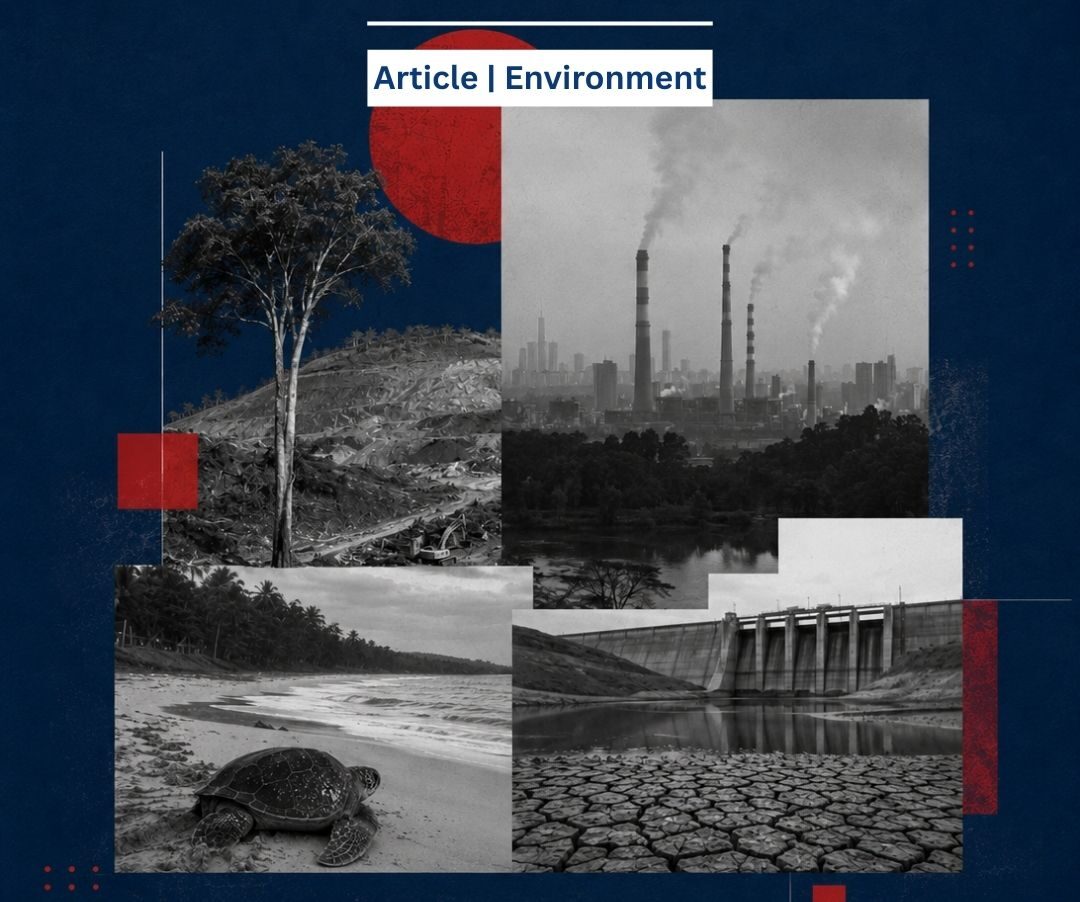
The world’s most polluted capital for the eighth consecutive year. One million trees
approved for falling on a pristine island. Reservoirs fell by 8 billion cubic metres in two weeks. And a government busy inaugurating projects that are destroying the very ecology it claims to protect.
Every June 5, India issues press releases about its commitment to the environment. Ministers give speeches. The Prime Minister tweets about clean energy. Government buildings plant saplings for cameras. And then the data arrives, from IQAir, from the Central Water Commission, from the Supreme Court’s own expert committees, from researchers who have spent careers documenting what is actually happening to India’s air, water, forests, and coastlines, and the distance between the press release India and the environmental reality India becomes impossible to ignore.
This June 5, that distance is wider than it has ever been.
India’s Air: The World Record Nobody Wants to Celebrate
New Delhi continued to rank as the most polluted capital city in the world for the eighth consecutive year, according to the IQAir World Air Quality Report 2025. Eight consecutive years. Not a bad year. Not an aberration caused by unusual weather. Eight systematic, consecutive years of being the most polluted capital city on the planet. The Diplomat
India ranked sixth among 143 countries in terms of PM2.5 pollution levels, with a national average PM2.5 concentration of 48.9 micrograms per cubic meter, almost ten times higher than the WHO’s safe limit of 5 micrograms per cubic meter.
Loni in Uttar Pradesh was the most polluted city in the world, with an annual average PM2.5 concentration of 112.5 micrograms per cubic meter, marking a nearly 23 percent rise from 2024 and exceeding the WHO guideline by over 22 times. 66 of the world’s 100 most polluted cities are in India.
Sixty-six out of one hundred. Not a regional air quality problem. A national structural failure. New Delhi recorded 82.2 micrograms per cubic meter, a three-year low, yet remains the most polluted capital in the world. India celebrated a three-year low. The WHO guideline it remains 16 times above, was not part of the celebration.
The health consequences of these numbers are not abstract. PM2.5 particles penetrate the lungs and bloodstream and are linked to cardiovascular disease, respiratory illness, and developmental damage in children. More than one billion Indians live with PM2.5 concentrations exceeding WHO safe limits. That is not a statistic. That is most of the country breathing air that international health standards classify as unsafe every day of their lives.
The Aravallis: India’s 700-Million-Year-Old Heat Shield Is Being Mined Into Dust
The Aravallis: India’s 700-Million-Year-Old Heat Shield Is Being Mined Into Dust
The Aravalli range is among the oldest geological formations on Earth, stretching 700 kilometers from Delhi through Haryana, Rajasthan, and into Gujarat. It functions as a natural barrier against Rajasthan’s desert winds, a groundwater recharge zone for the entire northwestern region, and a biodiversity corridor of irreplaceable ecological value. It is being systematically destroyed by mining, and the government’s response has been a combination of commission reports, definitional debates, and ministerial assurances that have not stopped a single mine.
A 2025 judicial committee found 2,339 square kilometers of mines in the Rajasthan portion of the Aravallis alone. A CAG report using satellite imagery found that around 34 percent of surveyed licensed mines had extended beyond their legal boundaries. The mines are not operating within their permits. They are operating beyond their permits, and the regulatory framework designed to prevent this has demonstrably failed.
In November 2025, the Supreme Court accepted a uniform definition of the Aravalli Hills, sparked controversy by potentially excluding hills below 100 meters from protection, and then took suo motu cognizance of public protests against the decision. The Supreme Court in January 2026 warned that illegal mining can lead to irreversible damage and directed the constitution of an expert committee for holistic examination of mining issues.
The government response has been ministerial reassurance. Environment Minister Bhupender Yadav reaffirmed the government’s commitment to ecological conservation in the Aravalli range, saying nearly 97 kilometers of Aravalli revenue land has been declared permanent protected forest. Ninety-seven kilometers of protected forest announcement against 2,339 square kilometers of active mines in Rajasthan alone is not conservation policy. It is press release arithmetic. Loss of the Aravallis is already boosting temperatures across Delhi and Haryana, increasing desertification risk, worsening respiratory illness from dust, and threatening the groundwater systems that millions depend on. The ancient hills are being fed into India’s construction industry, one mining lease at a time, while the government prepares management plans and the Supreme Court constitutes committees.
Great Nicobar: One Million Trees, Leatherback Turtles, and a Rs 72,000 Crore Gamble The Great Nicobar Island Development Project, worth Rs 72,000 crore, has been granted clearance for diversion of over 130 square kilometers of prehistoric tropical forest land, leading to the felling of approximately one million trees. The project, which includes an international container transshipment terminal at Galathea Bay, an international airport, a power plant, and two new greenfield coastal cities, is located on one of India’s most
ecologically sensitive islands, home to Leatherback and Olive Ridley turtle nesting beaches, endemic species found nowhere else on Earth, and coral reef systems that took millennia to form.
The environmental impact assessment that underpinned the clearances attracted sharp criticism because only one biodiversity specialist was part of the assessment team, and site access was limited. The government granted clearance anyway, citing strategic importance. The island sits adjacent to the Malacca Strait, and India’s strategic planners want a presence there. The environment ministry provided the clearance the strategic case required.
Congress leader Jairam Ramesh, writing on June 3, 2026, two days before World Environment Day, stated that ecological catastrophe in Great Nicobar appears “almost certain” and questioned why the detailed and collective concerns of independent scientists, environmentalists, and social experts remain systematically unaddressed.
The government’s defense is that a high-powered committee is embedded in the project to ensure ecology is not adversely affected. The same government that has presided over 2,339 square kilometers of illegal mines in the Aravallis is asking the public to trust a high- powered committee to protect Great Nicobar’s leatherback turtles.
India’s Water: Approaching Bankruptcy
Data from the Central Water Commission indicates that water levels in 166 monitored reservoirs fell by nearly 8 billion cubic meters in just two weeks between April 30 and May 14, 2026, with 13 major reservoirs dropping below 50 percent of their normal capacity.
Research by the Council on Energy, Environment and Water warns that 11 of India’s 15 major river basins are approaching a state of severe water stress. India supports nearly 18 percent of the global population with only 4 percent of the world’s freshwater, leaving approximately 60 crore people facing high to extreme water stress.
The groundwater picture is even more alarming. India extracts around 247 billion cubic meters of groundwater annually, a figure that rivals the combined extraction of the United States and China. The Central Ground Water Board’s 2025 compilation classifies 26 percent of India’s total groundwater blocks as over-exploited, critical, or semi-critical. In Punjab, groundwater extraction exceeds recharge by 150 percent. The state that feeds India is drinking its own aquifer dry.
A study found that about 450 cubic kilometers of groundwater was lost in northern India during 2002 to 2021. The World Bank had estimated that 60 percent of India’s groundwater blocks would be in a critical condition by 2025. That year has now arrived. Himalayan snowfall, which feeds the rivers that recharge these aquifers, was 23.6 percent below normal levels between November 2024 and March 2025. As glaciers retreat under climate change, the seasonal river flows that India has built its agricultural and urban water systems around will become increasingly unreliable. The convergence of groundwater depletion, glacial retreat, and reservoir decline is not a future risk scenario. It is the present condition.
The Forest Cover Deception
India regularly cites its forest cover statistics as evidence of environmental progress. The India State of Forest Report claims modest increases in green cover. What these statistics include, and what they exclude, is where the deception lives. Plantation monocultures, commercial eucalyptus and bamboo stands, and urban green spaces are counted as forest. The dense, biodiverse natural forests being felled for infrastructure, mining, and industrial projects are replaced, on paper, by plantation credits that bear no ecological equivalence. The Environmental Impact Assessment process, which is supposed to prevent exactly the kind of damage being done to Great Nicobar and the Aravallis, has been systematically weakened over the past decade. Timelines have been shortened. Public consultation requirements have been diluted. Strategic and defense projects receive expedited clearance. The result is an environmental governance framework that processes approvals efficiently and protects ecosystems poorly.
The Climate Commitment Gap
India’s government regularly invokes its renewable energy targets at international climate forums. It has committed to 500 gigawatts of non-fossil fuel capacity by 2030. Solar installations have expanded. Wind energy has grown. These are genuine achievements that deserve acknowledgment.
They do not offset the approval of one million tree fellings in Great Nicobar. They do not restore 2,339 square kilometers of mined Aravallis. They do not recharge the aquifers being drained at 150 percent of natural recharge rates in Punjab. They do not clean air that is ten times above WHO safe limits. Climate ambition and ecological destruction can coexist in the same government. In India in 2026, they do.
Conclusion
World Environment Day is June 5. India is the world’s most polluted major country by number of cities in the global top 100. Its most ancient mountain range is being fed into construction sites. Its most biodiverse island is being cleared for a port whose economic feasibility independent analysts question. Its reservoirs are falling, its aquifers are depleting, and its rivers are shrinking.
The government will issue statements today about India’s green commitments. Ministers will plant saplings. The Prime Minister’s office will share photographs of solar panels and electric buses. All of these things will be true, and none of them will address what the IQAir report, the Central Water Commission data, the Supreme Court’s Aravalli committees, and the scientists protesting Great Nicobar are all saying simultaneously.
India’s environment does not have much to celebrate today. The people who breathe its air, drink its water, and depend on its rivers, forests, and aquifers do not have much to celebrate either. The press releases will not mention that.











Leave a comment