




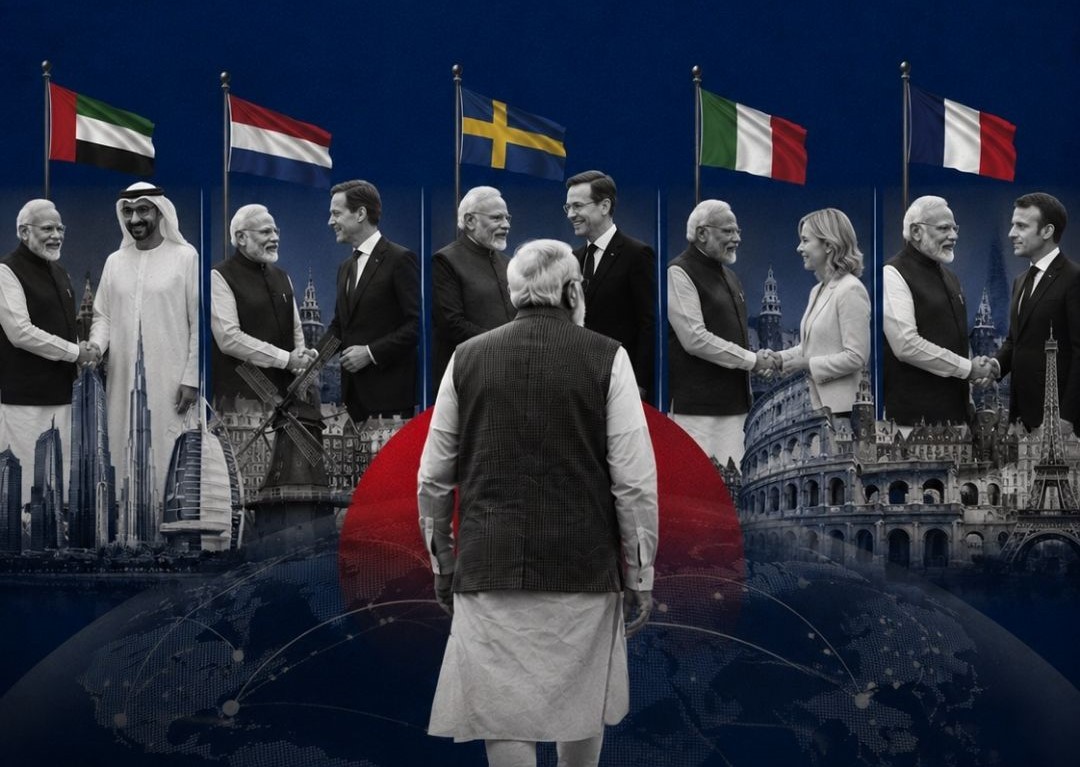
The Prime Minister visited UAE, the Netherlands, Sweden, Norway, and Italy from May 15 to 20 while asking Indians to cancel foreign travel. What was gained, what was lost, and what was never on the agenda.
Prime Minister Narendra Modi returned to New Delhi on May 20, 2026, after a six-day, five-nation tour covering the UAE, the Netherlands, Sweden, Norway, and Italy. The Ministry of External Affairs issued press notes describing agreements, strategic partnerships, investment pledges, and bilateral upgrades. The government’s media apparatus produced photographs of escort jets, award ceremonies, and warm embraces with foreign leaders. The Prime Minister’s social media accounts generated content at a pace that would exhaust most communications teams.
What the press notes did not produce was an honest accounting of what the tour actually cost, what it actually delivered, and what problems it conspicuously failed to address. That accounting is what follows.
The UAE Stop: Agreements That Solve Yesterday’s Problem
Prime Minister Modi flew into Abu Dhabi on May 15, 2026, his eighth visit to the UAE in 12 years, and emerged with a basketful of agreements: a framework for a Strategic Defence Partnership, an MoU with Abu Dhabi National Oil Company for storing up to 30 million barrels in India’s strategic petroleum reserves, a long-term LPG supply deal, and a pledge of $5 billion in Emirati investment.
The government presented these as energy security achievements. They deserve more careful examination.
India’s bilateral trade with the UAE reached $101.25 billion in FY 2025-26. India exported $37.36 billion. It imported $63.89 billion. The resulting trade deficit of $26.53 billion is not a marginal imbalance. It is structural and has been growing. A $5 billion investment pledge from the UAE, against a $26.53 billion annual trade deficit with the same country, is not a rebalancing. It is a press release number.
The strategic petroleum reserve MOU, promising storage of up to 30 million barrels, also requires context. India’s strategic crude reserves were only 64 percent full when the West Asia crisis struck in February. ADNOC remains the only foreign entity storing crude oil in India’s underground strategic reserves. The new MoU deepens an existing arrangement that already existed and did not prevent India from entering the crisis underprepared. Signing a deeper version of the same underprepared arrangement is not energy security reform.
Critics and opposition figures in India criticised the prime minister for overlooking the country’s worsening economic crisis in favour of highly energy-intensive election rallies and roadshows. Since March, Indians have been demonstrating against LPG costs, calling on the government to address shortages that have resulted in job loss, business closures, and rising prices of basic commodities.
The deeper strategic problem with the UAE stop, however, is the defence framework signed on May 15. India signed a strategic defence framework with the UAE on May 15, 2026, two days after Netanyahu’s secret visit to the UAE was revealed to the world. Any Indian military technology that reaches the UAE enters a security ecosystem that now includes Israel. Any intelligence-sharing arrangement with Abu Dhabi is, in practice, an arrangement that could be accessed or influenced by Tel Aviv. India’s defence planners cannot be unaware of this.
India is simultaneously attempting to rebuild credibility with Iran, whose Foreign Minister was in Delhi for the BRICS meeting the day before Modi flew to Abu Dhabi. At that BRICS meeting, Iranian FM Araghchi slammed the UAE for being “directly involved” in US-Israeli attacks on Iran. India flew its Prime Minister to sign a defence framework with the UAE twenty-four hours after Iran publicly named the UAE as a co-belligerent in the conflict. Tehran noticed. Every BRICS member at the Delhi table noticed. The message India sent about whose side it is on in the Gulf conflict was communicated not through diplomatic statements but through flight schedules and signing ceremonies.
The Netherlands: 17 Deals, But the One That Matters Is Missing
India and the Netherlands signed 17 deals during Modi’s visit, including a new Roadmap for Strategic Partnership covering defence, security, innovation, green hydrogen, semiconductors, and a Strategic Partnership on Water.
The Netherlands is India’s fourth-largest investor with a cumulative FDI of $55.6 billion. Bilateral trade stood at $27.8 billion in 2024-25. The relationship has genuine substance and the 17 deals reflect real bilateral depth across multiple sectors.
The deal that was not signed, and whose absence was not mentioned in any press note, is ASML access. The Netherlands is home to ASML, the only company in the world that manufactures extreme ultraviolet lithography machines, the equipment without which advanced semiconductor manufacturing is impossible. India’s semiconductor ambitions, central to its industrial policy, depend on access to ASML machines. The Netherlands, under sustained US pressure, has tightened export controls on advanced semiconductor equipment to countries with Chinese manufacturing exposure. India, with its complex relationship with Chinese supply chains, faces questions about those controls.
The visit produced a semiconductor cooperation framework. It did not produce an ASML export commitment. The difference between those two outcomes is the difference between a press note and a factory. India’s semiconductor policy needs a factory.
Sweden: An Award Ceremony When India Needed a Different Kind of Conversation
In Sweden, European Commission President Ursula von der Leyen said at the European Round Table for Industry: “It has only been a few months since you hosted me in New Delhi for our ground-breaking EU-India summit. We succeeded indeed in concluding our landmark trade agreement – we call it the mother of all deals. We are committed to signing the agreement by the end of the year and making it fully operational at record speed.”
India and Sweden elevated their ties to a Strategic Partnership with a commitment to double economic exchange in the next five years. The EU-India trade deal, if it materializes as described, would be genuinely significant, representing the conclusion of negotiations that have been ongoing for over fifteen years. The commitment to sign by the end of the year deserves monitoring. EU-India trade deal timelines have a history of not being honored.
Sweden also gave Modi the Royal Order of Polar Star Commander Grand Cross, its highest civilian honour. This is the award that Sanjay Raut pointed to when he noted that Modi “will complete the century in getting awards” while telling citizens not to travel abroad. The award ceremony received extensive domestic coverage. The question of what concrete commitments India extracted in exchange for the diplomatic warmth the award represents received considerably less.
Norway: First Visit in 43 Years, a Journalist’s Question, and Global Embarrassment
Modi visited Norway after 43 years, the first Indian Prime Minister to do so in that time. The visit was framed as historic. What made it genuinely historic, though not in the way the government intended, was a question from a Norwegian journalist at a press interaction.
The journalist asked Prime Minister Modi directly about India’s press freedom record, specifically about India’s ranking of 159th out of 180 countries on Reporters Without Borders’ Press Freedom Index, about journalists imprisoned under UAPA, and about the systematic blocking of critical content under India’s three-hour takedown rules. The question, asked on Norwegian soil, in front of Norwegian media, put India’s press suppression architecture on the world stage in a way that no opposition press conference in India had managed. Modi did not answer it directly. His non-answer was itself an answer, and it was reported across European media with the kind of coverage that South Block’s press management infrastructure is specifically designed to prevent.
Norway’s Nobel Peace Prize Committee is headquartered in Oslo. Norwegian political culture places press freedom at the centre of democratic legitimacy. Bringing a government that has jailed journalists, blocked 2,300 social media accounts in a year, and introduced the world’s shortest content takedown window to Oslo for a first-ever Prime Ministerial visit was always going to produce exactly this moment. The 43-year absence should have generated 43 years worth of catch-up agenda. The visit’s most memorable outcome was a question the Prime Minister could not answer.
Italy: Photo Ops With Meloni, Melody Toffee Diplomacy, and an IMEC That Cannot Move
Italy-India ties were upgraded to a Special Strategic Partnership. The government cited the India-Middle East-Europe Economic Corridor as an area of cooperation, with Italy positioned as a potential European anchor for the corridor. Prime Minister Modi’s meeting with Italian Prime Minister Giorgia Meloni produced photographs that circulated widely on Indian social media, accompanied by a detail that became its own small diplomatic news cycle: Modi gifted Meloni a box of Melody toffees, the Indian candy. The gift was presented as an example of cultural warmth and personal diplomacy. Italian media covered it as a curiosity. Indian opposition social media covered it as a metaphor for a foreign policy that prioritizes optics over outcomes.
IMEC was announced at the G20 in New Delhi in September 2023 with considerable fanfare. The West Asia war has effectively frozen IMEC’s Gulf component. A corridor that passes through a region at war cannot be operationalized on any projected timeline. Upgrading Italy’s ties to a Special Strategic Partnership is a diplomatic gesture. It does not resolve the fundamental problem that IMEC’s most critical segment is currently impassable. The agreement to pursue IMEC cooperation with Italy is an agreement to pursue something whose operational feasibility has been suspended by a war India has declined to criticise. The Melody toffee photographs will outlast the IMEC timeline in public memory.
The Austerity Hypocrisy That Framed the Entire Tour
The tour occurred in the context of Modi’s seven voluntary appeals to Indian citizens, asking them to curtail foreign travel, cut gold purchases, work from home, and reduce consumption. These appeals were issued because the West Asia crisis is causing genuine economic hardship: WPI inflation at a three-year high, the rupee at a record low, cooking gas prices surging, and LPG shortages affecting households across the country.
The Prime Minister who issued those appeals then departed on a six-day, five-nation tour that included award ceremonies, diaspora events, industry roundtables, and a defence framework signing with a country Iran had named as a co-belligerent the day before. The tour was not a security emergency. It was not a crisis negotiation. It was a diplomatic itinerary that could have been condensed, postponed, or reconfigured, given the domestic economic pressures it coincided with.
The argument that Modi’s foreign visits generate economic returns for India is not entirely wrong. The UAE deals, the Netherlands partnerships, the EU trade deal trajectory, and the Nordic relationships all have genuine value. The problem is not that foreign diplomacy is worthless. The problem is that a Prime Minister who asks citizens to sacrifice must demonstrate that he applies the same standard to himself. The royal escort jets in Sweden and the award ceremony optics communicate something specific to the 40,000 workers who had to riot in Noida to get a wage increase, to the students protesting NEET paper leaks, and to the families still waiting for Pahalgam compensation.
What the Tour Didn’t Do
The five-nation tour did not secure any statement on the West Asia conflict that would give India diplomatic leverage with Iran. It did not address the rupee’s deterioration against major European currencies. It did not produce an ASML commitment. It did not resolve the fundamental contradiction between India’s Israel alliance and its need for Iranian goodwill. It did not generate any visible movement on the Iran tanker access that India has been negotiating through backchannels. It did not create a framework for the Ganges treaty renewal or any other South Asian issue. And it did not include any visit to Manipur, where two children were killed in a rocket attack, or Bundelkhand, where tribal women are lying on funeral pyres.
Those omissions are not incidental. They are the gap between the India being presented to foreign governments and the India existing for its own citizens.
Conclusion
Modi’s five-nation tour produced real agreements, genuine bilateral upgrades, and a continuation of India’s European engagement strategy. It also produced an award, several escort jet photographs, and a defence framework with a country that is on the opposite side of the war, whose economic consequences India is asking its citizens to bear through austerity.
The tour was not a failure by the standards of routine diplomatic management. It was inadequate by the standards of the moment India is actually in: an economy ranked sixth by the IMF, a currency at a record low, a West Asia crisis that India cannot influence because it aligned too closely with the aggressor, and a domestic situation in which citizens are being asked to sacrifice by a government that is not practicing what it preaches.
Key outcomes included agreements with the UAE for LPG supply and crude storage, 17 deals with the Netherlands, elevation of ties with Sweden and Italy, and Modi’s participation in the India-Nordic Summit. These are real. They are also insufficient for the scale of what India faces. And insufficient, presented as triumph, is the most dangerous kind of diplomatic communication a government can practice.





Leave a comment