













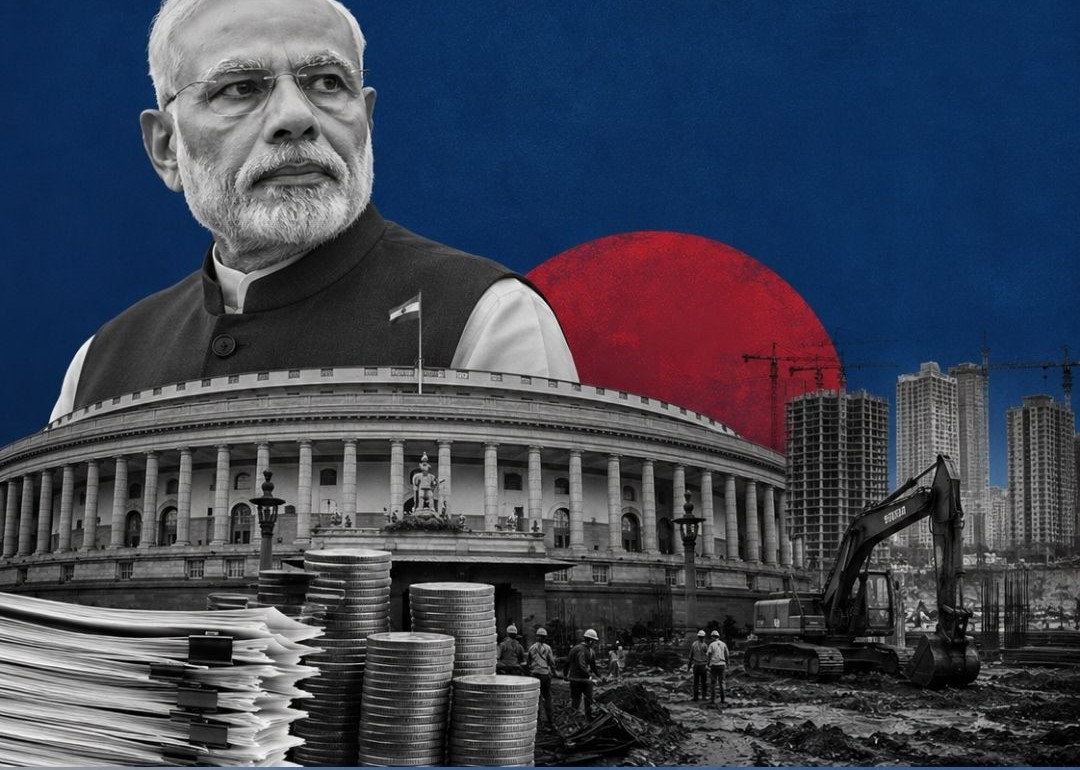
Modi’s six flagship urban schemes have collectively spent 21 percent of their allocated funds. A parliamentary standing committee says there was no realistic planning. The government says the figures are wrong. The figures are from the government.
India’s parliamentary standing committee on urban development has done something that India’s prime-time television panels have largely declined to do: it has looked at the actual numbers behind Modi’s most celebrated flagship schemes and published what it found. What it found is that six of the Prime Minister’s highest-profile national programs, schemes that have been inaugurated with fanfare, named after the Prime Minister, and cited in every election speech as evidence of transformative governance, have collectively spent an average of just 21 percent of the funds allocated to them.
Of Rs 36,500 crore allocated across six major urban infrastructure initiatives, approximately Rs 7,800 crore has been spent. The committee’s report states that the Ministry of Housing and Urban Affairs had “not made realistic projections or proper planning” and that the programs suffer from “slack implementation” alongside a lack of proper funding. The government’s response was to say the figures are wrong. It did not say what the correct figures are.
What Each Scheme Was Promised and What It Delivered
The numbers across all six schemes tell the same story in different sectoral languages. Swachh Bharat, the Clean India Mission, Modi’s most recognizable domestic brand, received Rs 5,800 crore in released funds. It spent Rs 2,200 crore. A scheme whose stated purpose is to end open defecation through toilet construction and clean streets has spent 38 percent of its released allocation. The open defecation figures in rural and peri-urban India, documented by independent surveyors including research teams associated with the Bill and Melinda Gates Foundation, have consistently shown that toilet construction and toilet use are not the same metric. Many constructed toilets remain unused. The spending figures suggest the construction itself was incomplete.
The Smart Cities Mission, designed to develop 100 cities across the country as technology- enabled urban centers, received Rs 9,700 crore and spent Rs 182 crore. That is not a misprint. Rs 182 crore spent of Rs 9,700 crore released, less than 2 percent utilization on a scheme that was supposed to transform a hundred Indian cities into global benchmarks of urban management. The Smart Cities Mission has a dedicated project management unit structure, city-level special purpose vehicles, and a ministry-level monitoring framework. All of that infrastructure produced Rs 182 crore in actual expenditure.
AMRUT, the Atal Mission for Rejuvenation and Urban Transformation, which targets water supply, sewerage, and drainage infrastructure in urban areas, received Rs 8,400 crore and spent Rs 2,400 crore. Pradhan Mantri Awas Yojana, the housing for all scheme that promised affordable homes for India’s urban poor, received Rs 9,700 crore and spent Rs 2,000 crore. The Deendayal Antyodaya Yojana, the livelihoods mission targeting poor urban youth through skill training, received Rs 1,500 crore and spent Rs 848 crore. And the Heritage City Development and Augmentation Yojana, which aims to preserve the heritage character of India’s historic cities, received Rs 248 crore and spent Rs 32.6 crore.
Across all six, the pattern is identical. Announcements are made. Funds are allocated and technically released to states. The money does not move into actual construction, training, or service delivery at anything resembling the promised scale.
The Certificate Problem Nobody Wants to Explain
The government’s defence of the low spending figures rests on a technical claim: funds are only considered officially spent once all construction work is completed and utilization certificates are submitted. Project managers and state governments have sent back utilization certificates claiming they have spent the money, the government says, but the process of recognizing that expenditure formally can take up to two years.
This explanation, offered by ministry spokesperson Rajeev Jain, contains its own indictment. If project managers are submitting utilization certificates for work that has been “completed or started,” as Jain’s own description acknowledges, and if the process of verifying and recognizing that expenditure takes two years, then the monitoring architecture for Rs 36,500 crore of public money is operating on a two-year lag. A government that does not know within two years whether its flagship schemes have spent their allocated funds has not built a governance system. It has built a paperwork system. Jaijit Bhattacharya, a consultant and adjunct professor at IIT Delhi, offered the more honest assessment: “One cannot pass a diktat forcing people to use toilets. It has to be through persuasion, and that takes time.” This is correct as far as it goes. But it does not explain the Smart Cities Mission spending Rs 182 crore of Rs 9,700 crore on city improvement projects, which require neither persuasion nor behavior change, only construction contracts and functioning project management.
The Centre-State Blame Architecture
When flagship schemes underperform, the standard government response is to point at states. The central government releases funds. States are supposed to implement. When implementation fails, the central government can claim it fulfilled its obligation by releasing the money while attributing failure to state-level execution gaps.
This architecture is particularly convenient for a government that has spent considerable energy accusing opposition-governed states of obstructing central schemes for political reasons. The parliamentary committee, whose report does not have the luxury of partisan framing because it operates under parliamentary rules of evidence, found that the problem was not primarily state obstruction. It found that the ministry itself had “not made realistic projections or proper planning.” That finding locates the failure at the central level, in the ministry that designed the schemes, set the targets, and released the funds without ensuring the conditions for their utilization existed.
Pinaki Misra, an opposition lawmaker and leader of the urban affairs standing committee, described the government’s response to the report as “trotting out the usual excuses by blaming bureaucratic delays in accounting for spent funds.” He called it “an age-old gambit when the Centre doesn’t want to release funds because they don’t have funds.”
That last claim, that the allocation figures represent political ambition rather than actual available resources, would explain the utilization pattern more comprehensively than any bureaucratic lag story. A government that announces Rs 9,700 crore for Smart Cities and Rs 9,700 crore for PMAY simultaneously may not have intended both allocations to be fully drawn down. The announcement is the product. The spending is secondary.
What These Schemes Were Actually For
The parliamentary committee’s report is focused on implementation failure. The deeper question it implicitly raises is about the purpose of schemes whose announcement value clearly exceeds their implementation value.
Swachh Bharat was Modi’s first and most personal flagship. It generated a global public relations campaign, international media coverage, and a United Nations recognition. It also generated a term, “toilet diplomacy,” to describe the gap between constructed
infrastructure and behavior change. The scheme’s announcement created the political narrative of a Prime Minister personally committed to sanitation. The 38 percent spending utilization suggests the announcement was the primary output.
Smart Cities was presented as India’s answer to the challenge of urbanization, a scheme that would make Indian cities globally competitive. One hundred cities were named. Mission documents were published. Chief Ministers were photographed at launch events. Rs 182 crore was spent. The announcement of one hundred smart cities was itself the policy achievement. The cities remain largely as they were.
PMAY’s promise of housing for all, particularly for urban poor families living in informal settlements, represents one of the most morally serious commitments in the entire scheme portfolio. India’s urban housing deficit runs into tens of millions of units. The families living in slums, on pavements, and in illegal structures in India’s cities are among its most vulnerable citizens. Spending Rs 2,000 crore of Rs 9,700 crore allocated to house them is not a bureaucratic lag. It is a governance failure with human consequences that the committee’s figures, however accurate or disputed, cannot fully capture.
Conclusion
A parliamentary standing committee has found that Modi’s six top urban infrastructure schemes spent 21 percent of their allocated funds. The ministry says the figures are wrong. The committee says the ministry made no realistic projections. The government says cooperation between centre and states takes time. The opposition says the money was never really there to begin with.
What is not in dispute is the gap between the announcement and the reality: Rs 36,500 crore promised, Rs 7,800 crore delivered, and a government whose first response to its own Parliament’s findings is to question the arithmetic rather than explain the outcomes.
Smart cities have not become smart. Clean India has not ended open defecation. Housing for all has not housed the poor. Heritage cities are not preserved. Urban livelihoods remain precarious. And the parliamentary committee that documented this has been told its figures are wrong by the ministry whose figures it used.
This is what accountability looks like when the institution designed to provide it functions, and what happens when the government being held accountable treats its own
Parliament’s findings as a problem of public relations rather than a call for honest examination.










Leave a comment