




An opinion on voter-roll revisions, Muslim disenfranchisement and the transformation of Indian democracy
The Bharatiya Janata Party’s (BJP) sweeping victory in West Bengal has altered India’s political landscape in dramatic fashion. For decades, Bengal stood as one of the last major barriers against the BJP’s expansionist political project. That wall has now fallen.
But beyond the scale of the BJP’s triumph lies a deeper institutional question: whether the election reflected the principles of equal participation and democratic legitimacy that India has historically claimed as the foundation of its republic.
The controversy surrounding the election is not simply about who won power in West Bengal. It is about whether electoral processes themselves are being reshaped in ways that structurally disadvantage vulnerable communities particularly Muslims under the language of administrative reform and national security.
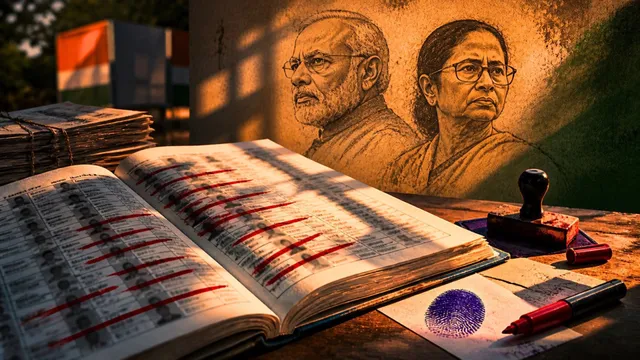
At the centre of this controversy is the “Special Intensive Revision” (SIR) of voter rolls carried out before the election. Officially described as an administrative effort to remove duplicate and fraudulent entries, the exercise resulted in millions of voters being flagged, scrutinized or removed from electoral rolls. Critics argue that the process disproportionately affected Muslims, migrant workers and poorer communities particularly in constituencies where the BJP had historically struggled.
For many Muslims in Bengal, the issue is no longer simply about party politics. It is about belonging.
Electoral Revision or Political Filtering?
Muslims in West Bengal make up nearly 27 percent of the population and are concentrated in several border districts. For years, political rhetoric from sections of the BJP has linked Bengali Muslims with “illegal infiltration” from Bangladesh, even though the vast majority are Indian citizens with deep historical roots in the state.
The language used during the election campaign intensified those fears.
Terms like “infiltrator,” “outsider,” and “demographic threat” have increasingly entered mainstream political discourse. While framed as national security concerns, many Muslims view these narratives as deliberate attempts to cast suspicion on an entire community.
Analytically, the significance of the voter-roll revision lies in its asymmetrical impact.
Electoral reforms are not inherently anti-democratic. Democracies routinely revise voter rolls to remove duplicate entries, deceased citizens or fraudulent registrations. The problem emerges when the social burden of verification falls disproportionately on communities already facing economic insecurity, documentation gaps and political suspicion.
In Bengal, Muslims, migrant labourers and poorer rural populations were structurally more vulnerable to exclusion because they are more likely to lack stable documentation, permanent addresses or consistent bureaucratic records.
The voter-roll revision process amplified this anxiety.
People who had voted for years suddenly found themselves asked to produce additional documents proving their citizenship or residence. In poorer households where paperwork is often incomplete, inconsistent or damaged this became an enormous burden.
Women were particularly vulnerable.
Many older Muslim women lacked birth certificates or formal school records. Others faced discrepancies because their surnames changed after marriage. In rural districts, even small spelling differences between Aadhaar cards, ration cards and voter IDs reportedly triggered scrutiny.
For migrant laborers working outside Bengal, the timing proved devastating. Thousands were unable to return home during verification windows, leaving them vulnerable to deletion from voter lists.
Disenfranchisement as Political Psychology
The consequences of disenfranchisement are not only electoral; they are psychological and constitutional.
Democracy functions not merely through ballots and institutions but through the perception of equal citizenship. Once citizens begin to feel that participation itself is conditional, trust in democratic systems starts to erode.
Voting in India has long represented more than a constitutional right. For marginalised communities, it has symbolised recognition and equal citizenship within the republic. The act of standing in line and casting a ballot carried emotional and political significance.
When citizens are suddenly asked to “prove” they deserve that right, it changes the relationship between the state and the individual.
Among many Muslims in Bengal, the fear is not merely about one election. It is about the gradual normalisation of exclusion.
This fear is shaped by recent history.
The National Register of Citizens (NRC) exercise in Assam left nearly two million people facing uncertainty over their citizenship status. Detention centres, deportation debates and repeated references to “illegal immigrants” created a climate in which many Muslims began to fear bureaucratic invisibility.
Against that backdrop, Bengal’s voter-roll revision felt less like a neutral administrative process and more like another stage in a broader political project.
The Democratic Shift in Burden of Proof
One of the most alarming aspects of the controversy is the reversal of democratic assumptions.
In a healthy democracy, the state carries the burden of ensuring citizens can participate in elections. Under the SIR process, critics argue that this burden shifted into ordinary people themselves.
Citizens who had voted repeatedly over decades were effectively required to re-establish their eligibility under tight deadlines.
Supporters of the exercise argue that cleaning voter rolls is necessary for electoral integrity and preventing fraud. That concern is not illegitimate. Every democracy must maintain accurate electoral records.
However, when such exercises disproportionately affect vulnerable populations, they risk undermining confidence in democracy itself.
If millions of citizens believe they are being selectively targeted, then even technically legal processes can appear politically weaponised.
That perception matters.
Democracies survive not only through institutions but through public trust in those institutions.
Majoritarian Democracy and the Muslim Question
The Bengal result also reflects the growing dominance of majoritarian politics in India.
The BJP’s rise has been built on a powerful blend of Hindu nationalism, welfare politics, centralised leadership and cultural messaging. For many supporters, the party represents national pride, political stability and resistance to dynastic or regional politics.
But critics argue that this model increasingly sidelines minorities.
In several states, Muslims already face social and political marginalisation despite constituting large populations. Representation in legislatures has declined. Hate speech incidents have risen. Economic boycotts, bulldozer demolitions and communal rhetoric have become recurring controversies.
Against this backdrop, the erosion of voting access carries especially grave implications.
When a minority community begins to feel both politically underrepresented and administratively vulnerable, democratic alienation deepens.
What Bengal Reveals About Indian Democracy?
The Bengal election may ultimately be remembered not only for the BJP’s historic victory but for what it revealed about the evolving nature of Indian democracy.
India has long prided itself on being the world’s largest democracy, a nation where universal adult suffrage survived despite poverty, diversity and immense social complexity.
That democratic achievement rested on a simple principle: every citizen’s vote carries equal value.
If electoral processes begin to systematically disadvantage specific communities, that principle weakens.
The question facing India now is larger than Bengal or any single election.
Can a democracy remain truly democratic if large sections of its population feel permanently suspected, excluded or politically disposable?






Leave a comment