





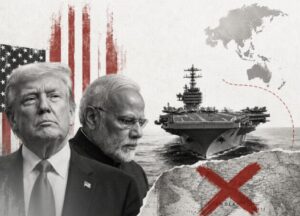

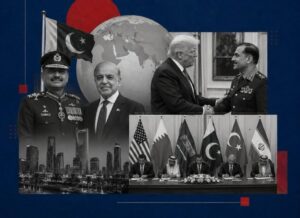

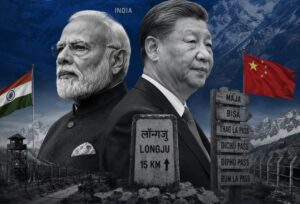
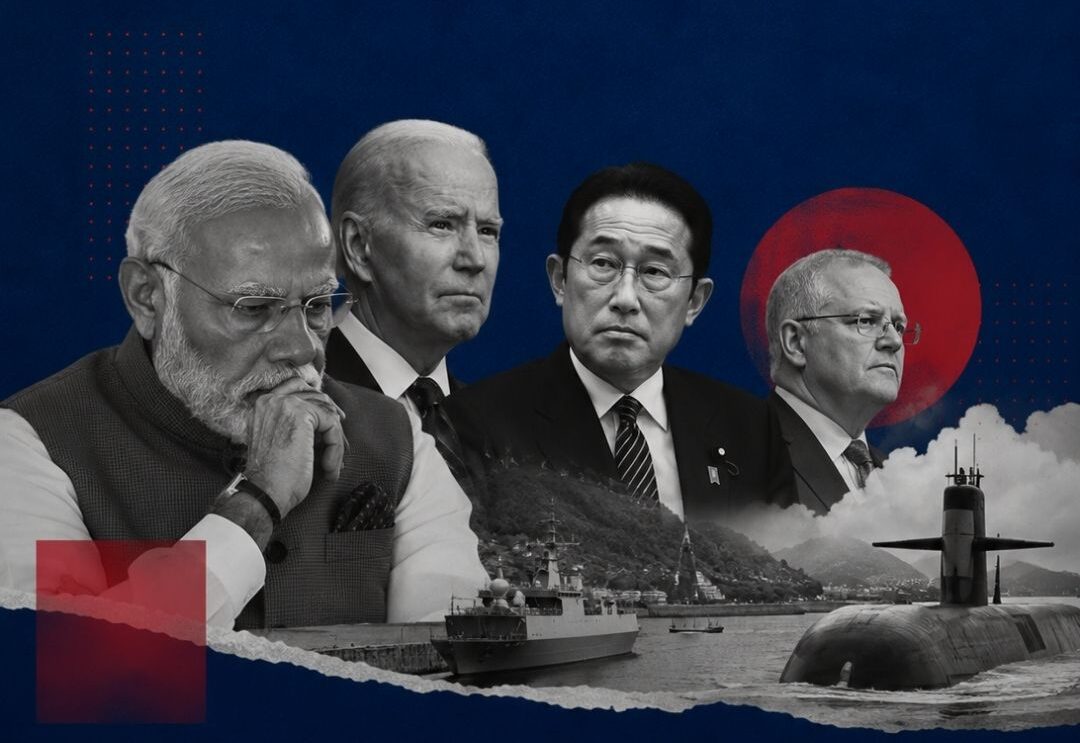
A little ritual occurs each meeting of the Quadrilateral Security Dialogue. Washington, Tokyo and Canberra discuss deterring China, without a moment’s hesitation. Consultations are the subject of discussion in New Delhi. It does not use the term ‘quadrilateral’ not even once in its official statements and addresses, even when questioned directly in the parliament. India has been dubbed by analysts as the weakest link, not due to a lack of ability, but a lack of conviction in the grouping. There’s a stinging ‘no shit’ to the label, but it’s hard to argue.
It isn’t a new lesson to be learnt, but it’s something more serious than it is usually taken, as it could be an indicator of a structural change in India’s thinking about its security. India’s Indo Pacific policy is essentially ‘evasive balancing’ — balancing against China but making it very difficult to make that balancing apparent — as the scholar, Rajesh Rajagopalan, has pointed out. Rajesh calls India’s strategy as evasive balancing, balancing China while telling Beijing it is not being balanced against. The Quad is the starkest of all the instances of this paradox, and India continues to flounder at every instance.
A coalition built and then dragged
Consider the timeline. The first meeting of the Quad took place in 2007, but the group disbanded in a year, and sat idle for 10 years largely due to Chinese opposition. It was resurrected in 2017 and the four countries jointly gave a readout. Interestingly, India’s version did not even mention the word ‘quadrilateral’. This was no mistake. It was policy. New Delhi has followed the latter trend with each meeting, leaving out any mention of its true purpose.
Compare with India’s own commentary on bilateral defence relations. The treaties and agreements it signed, one decade later, were the “milestones” of LEMOA and COMCASA with Washington.
After a decade of hesitation, it signed the treaties and agreements, LEMOA and COMCASA, with Washington, which were called “milestones. Has more military drills with the U.S. than any other nation. It has strengthened its “special strategic and global partnership” with Japan, and boosted cooperation between its navies, albeit unevenly, with Australia. In both bilateral tracks, India is making a step, albeit slow, towards a convergence around the shared issue that is never mentioned–the concern.
In a multi-lateral setting, in one common seat all four countries sit together, and India finds itself a new non-aligned India.
The instinct beneath the inconsistency
What’s inside this asymmetry? Bilateral relationships are manageable, adjustable and most importantly, denied. A drill with the navy with Japan is a common thing. But a defense logistics deal with Washington can be said to be a matter of sovereign choice, not alignment. Yet an institutionalized four-country security dialogue can be a lot harder to hide as anything else than a group of the concerned, focused on one country. Plausible denial is possible with bilateral relations and India can do so. It can’t be used with the Quad. So, it is active enough to secure the security benefits, but passive enough to not be readable – and threatening – to Beijing. This is a balancing act that’s elusive – India seeks the deterrent effect from partnership without the reputational and diplomatic consequences of admitting it’s balancing. This arrangement as predicted by Rajagopalan’s framework does not satisfy anybody: If it’s strategic ambiguity, it’s not strategic ambiguity as long as it fools no one, it’s just a press release.
Beijing isn’t fooled, and neither are the partners
The best proof of the failure of China’s side of the strategy is the Chinese themselves. Beijing has been saying that the Quad is a “politicized and exclusionary” bloc, whether or not India included such caveats in its statements. If the rhetorical softening had resulted in a de-escalation of the situation, then one would expect that there would have been some de-escalation of the situation by India, such as not pushing so hard on the border, being more flexible on India’s Nuclear Suppliers Group bid, and not giving blanket approval to the China-Pakistan Economic Corridor through Indian claimed territory. None of this has come to pass. India paid a security price for its ambiguity it is not even being credited for. In the meantime, the other side of the ledger is more silent but true. Partners estimate their own commitments taking into account the likelihood that India will keep its promises. A grouping is only as believable as its most hesitant partner, and reluctance multiplies: If India doesn’t commit to institutionalizing the Quad, the more willing other nations will become to question why they should be more adventurous than New Delhi is. In Australia’s case, enthusiasm turned to disillusionment when there wasn’t a firm commitment from a partner to the first Quad anniversary iteration. India’s foot-dragging may turn out to be a self-fulfilling prophecy of why it is a shaky turkey.
The trap of trying to have both
All this is not the fault of India, for there is nothing lacking in the Indian spirit of ambition. India has been prepared to change not only their doctrine, but also their approach, in order to broaden its relations with Washington, to court Tokyo, to court Canberra. It has refused to acknowledge that these moves don’t add up to a balancing coalition. It may have been a good idea in a time when India’s strength was weak enough that it didn’t matter and reassurance was free. It doesn’t seem to make much sense now when India’s own naval modernization is largely underfunded, its air force lacks squadrons and its borders are woefully inadequate when compared with the magnificent infrastructure of China. To guarantee a reassurance strategy that Beijing hasn’t taken it upon itself to make a strong case for, India cannot afford to defuse the one asymmetric that it has — collective deterrence.
India does not have to give up its careful diplomacy with China or rush to make Quad alliance a reality. That should end the scam of half measures for just half the benefits, however. If New Delhi is going to balance — and by their own self-evaluation, it already is — it should say so blatantly enough that their partners can use that as a blueprint and their opponent can at least pay attention to it. But the other way, appearing at the Quad and claiming it isn’t a “Quad,” is not precaution. It’s the least strong type of commitment to make.






Leave a comment