












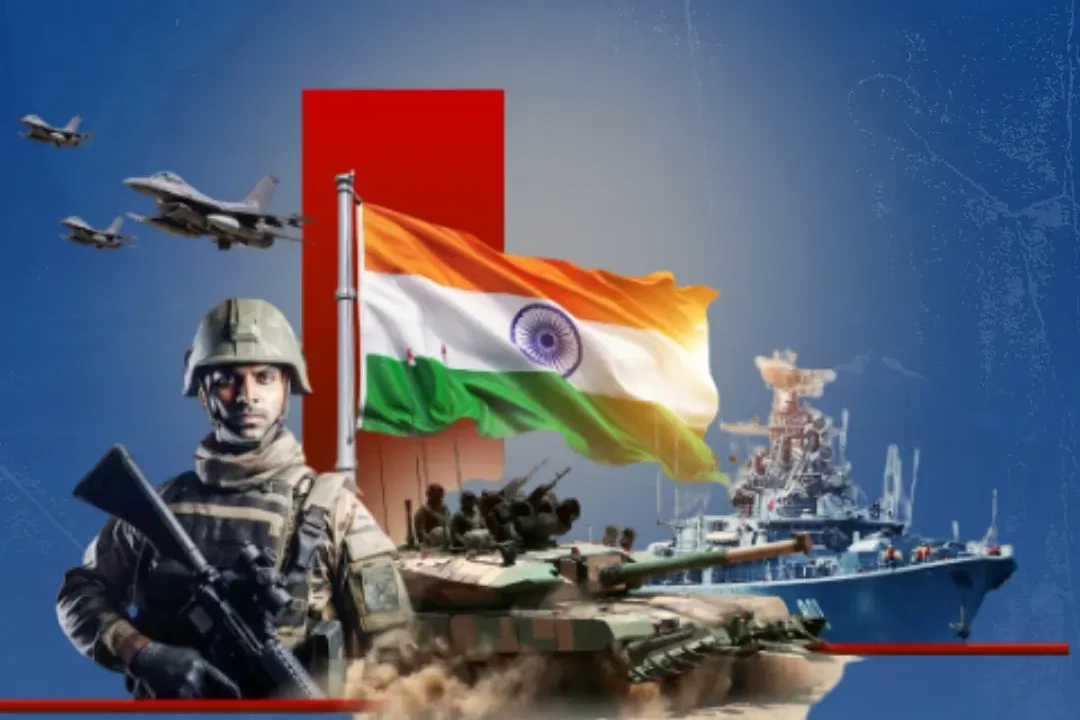
In the wake of the global shift toward “Contactless Warfare” typified by the prolonged Russia-Ukraine conflict and the drone-saturated battlefields of West Asia India finds itself at a fiscal and strategic crossroads. While the headline figures of India’s defense budget suggest a global titan in the making, a forensic audit of the 2026-27 budgetary allocations reveals a troubling paradox: India is spending more to maintain its existing structure than it is to build a modern, lethal war machine. This article dissects the “Troubled Times” facing Indian defense, highlighting how accounting maneuvers, pension liabilities, and domestic production delays are hollowing out the nation’s actual combat readiness.
Misleading Headline About Trillion Rupee Budget
In response to increased tensions in 2025, the Indian government announced a defense budget in early 2026. However, a large budget does not mean that the country is prepared. Budget increases can also indicate a lack of strategic planning. In the 2024-25 financial year, the government announced total spending of 6.36 trillion rupees. Comparatively, the 2025-26 budget estimates and 2026-27 spending projections continue to increase, but the Real Defense Expenditure (excluding pensions) is decreasing. This indicates that the government is not as prepared as the defense budget would suggest.
The Defense Spectrum Charge Scam
One of the main criticisms of the 2025-26 budget is the 361.31 billion rupee allocation for defense spectrum charges. In the past, the defense spectrum has been used without charge. By “paying” the Ministry of Defence (MoD) for a spectrum, the government has been able to artificially inflate defense spending. Once this internal transfer is removed, the increase in defense expenditure is not even 10%. This amount is highly inadequate considering current military inflation, and the rapid devaluation of the Rupee as compared to the Dollar (the currency of procurement).
The Anatomy of a Stagnant Budget (2024–2026)
| Budget Head | 2024-25 (Actuals) | 2025-26 (Revised) | Real Growth Analysis |
| Total Defense Outlay | ₹6.36 Trillion | ₹7.20 Trillion | ~13% nominal growth |
| Defense Pensions | ₹1.58 Trillion | ₹1.75 Trillion | 24% of the total budget |
| Establishment (Salaries) | ₹3.19 Trillion | ₹3.40 Trillion | Non-lethal “maintenance” cost |
| Capital Outlay (Weapons) | ₹1.60 Trillion | ₹1.85 Trillion | Effective growth <10% after spectrum adj. |
The “Shadow” Procurement: The S-400 and Transparency
The most contentious element of recent defense funding is the utilization of the Transfer to Technology in National Security Fund (TNSF). In the budgets for 2025-26 and 2026-27, a total of ₹414.3 billion (~$4.6 billion) was allocated through the Ministry of Finance’s Department of Economic Affairs (DEA) instead of the Ministry of Defence.
What is the reason for the absence of transparency?
Strategic analysts propose that this “off-budget” maneuvering represents a desperate effort to circumvent the implications of CAATSA (Countering America’s Adversaries Through Sanctions Act) concerning Russian military equipment, particularly the S-400 Triumf air defense systems.
The government conceals the direct pathway of military procurement by allocating funds into a DEA-regulated “Security Fund.” Although this may constitute an astute diplomatic solution, it establishes a perilous precedent for parliamentary oversight. The procurement of nearly $5 billion in lethal equipment through “Civil” or “Economic Affairs” accounts obscures the actual cost of India’s defense, rendering it incomprehensible for the public and potentially even the Auditor General.
The “Atmanirbhar” dilemma: Domestic Setbacks
The “Self-Reliant” (Atmanirbhar Bharat) initiative is fundamental to India’s contemporary defense policy. Nonetheless, an increasing disparity exists between political discourse and the actual conditions on the battlefield. The LCA Tejas program, designed to serve as the foundation of the IAF, has emerged as a representation of industrial stagnation.
The Tejas Confrontation
Notwithstanding a contract for 97 LCA Mk1A jets valued at ₹623.7 billion in September 2025, the state-owned Hindustan Aeronautics Limited (HAL) has encountered difficulties with delivery schedules.
- The Engine Crisis: India has invested decades in the development of the “Kaveri” aero-engine. It continues to be a failure. Thus, the “indigenous” Tejas is equipped with American GE F404 and F414 engines.
- The Trust Deficit: A Tejas aircraft crash at the Dubai Air Show in November 2025 reverberated throughout the Indian Air Force. Concerns regarding reliability have resulted in HAL asserting that aircraft are “ready,” yet the Air Force remains reluctant to incorporate them into active squadrons.
Capability Gap – Indigenous vs. Imported
| Platform | Source | Cost (Approx) | Status |
| LCA Tejas Mk1A | HAL (India) | ₹6,400 Cr/unit | Significant delays; 36% foreign parts |
| Rafale (Ready-to-fly) | Dassault (France) | ₹24,000 Cr/unit | Massive cost; zero tech transfer |
| S-400 Triumf | Almaz-Antey (Russia) | ₹40,000 Cr/total | Delivery delayed by Ukraine war |
| Stealth Drones | Various/Domestic | Undisclosed | Years behind China’s Wing Loong series |
The “Ready-to-Fly” Crisis: Purchasing Our Escape from Adversity
Due to the inadequacy of domestic production (HAL/DRDO) in fulfilling the IAF’s minimum squadron strength (currently at 30-31, while a requirement of 42 exists), India is compelled to engage in “Panic Procurement.” In April 2025, India finalized a $7.41 billion agreement for 26 Rafale aircraft. By early 2026, the government announced the acquisition of an additional 114 Rafale jets at an exorbitant cost of ₹3.25 trillion ($40 billion).
The Critique of Reliance on “Off-the-Shelf” Solutions
This constitutes a financial catastrophe. India is currently incurring an “urgency premium” to France due to its failure to modernize HAL’s production lines five years ago. Moreover, these foreign platforms fail to establish a domestic ecosystem, resulting in a prolonged reliance on foreign components and software updates. India is essentially acquiring “black boxes” that it cannot alter or repair during a comprehensive embargo.
Contemporary Warfare: The Absence of Connection
The conflicts in Ukraine and Iran-Israel have demonstrated that mass is being supplanted by precision. A multitude of 20,000 drones can incapacitate a $50 million tank. India’s defense budget, nonetheless, is predominantly allocated to personnel expenditures.
Approximately 60% of the total defense budget is allocated to “Manpower,” encompassing pensions and salaries.
Lethal Technology: Approximately 25-28% remains allocated for “Capital Outlay” (procurement of actual weaponry).
Conversely, contemporary military forces such as those of China and the United States are actively transitioning to AI-integrated battle management, loitering munitions, and cyber-electronic warfare. India’s investment in these specialized yet critical domains is overshadowed by the burden of an antiquated, labor-intensive military framework.
Is a Paper Tiger Relevant in a Technological Landscape?
Subhash Chandra Garg’s analysis indicates that India’s defense budget is “weakened.” The government is managing three insurmountable challenges:
- Fiscal Deficit: Endeavoring to maintain a minimal overall budget to satisfy international credit agencies.
- Modernization: Requiring trillions to substitute obsolete Soviet-era fleets.
- Indigenization: Rejecting foreign purchases to project self-reliance, despite an inability to timely produce domestic alternatives.
The outcome is a concession that pleases no one. The IAF is diminishing, the Navy is endeavoring to match China’s blue-water expansion, and the Army is still awaiting fundamental modern infantry equipment.









Leave a comment