










India’s first-quarter GDP figures for 2026-27 arrived exactly as governments like their numbers to arrive: large, clean, and impossible to argue with in a headline. Real GDP up 7.8 per cent. Manufacturing up 9.2 per cent. Investment up nearly 12 per cent. New Delhi wasted no time presenting this as vindication, proof that the world’s most-hyped economy is finally delivering on its own mythology.
But numbers this convenient deserve suspicion, not applause.
Start with what the government would rather you didn’t notice. Nominal GDP for the same quarter last year, Q1 2025-26, has quietly been revised downward from roughly ₹86 lakh crore to ₹80 lakh crore. For the first half of the year, the revision balloons to around ₹11 lakh crore. That is not a rounding error. That is an economy’s official size shifting by trillions of rupees, with no meaningful public reconciliation of how or why.
This is not the first time India’s statistical apparatus has bent conveniently in the government’s favour. The 2015 GDP series and its disputed back-series recalculation. The employment survey of 2017-18, delayed until after it had lost its power to embarrass. The Consumer Expenditure Survey of the same year, shelved entirely once its findings proved inconvenient. Resignations from the National Statistical Commission. Credibility, once spent, does not simply return because a new number is bigger.
Even granting the 7.8 per cent figure at face value, a considerable concession, the more damning questions begin, not end, there. Growth measures aggregate production. It says nothing about who actually captured the gains.
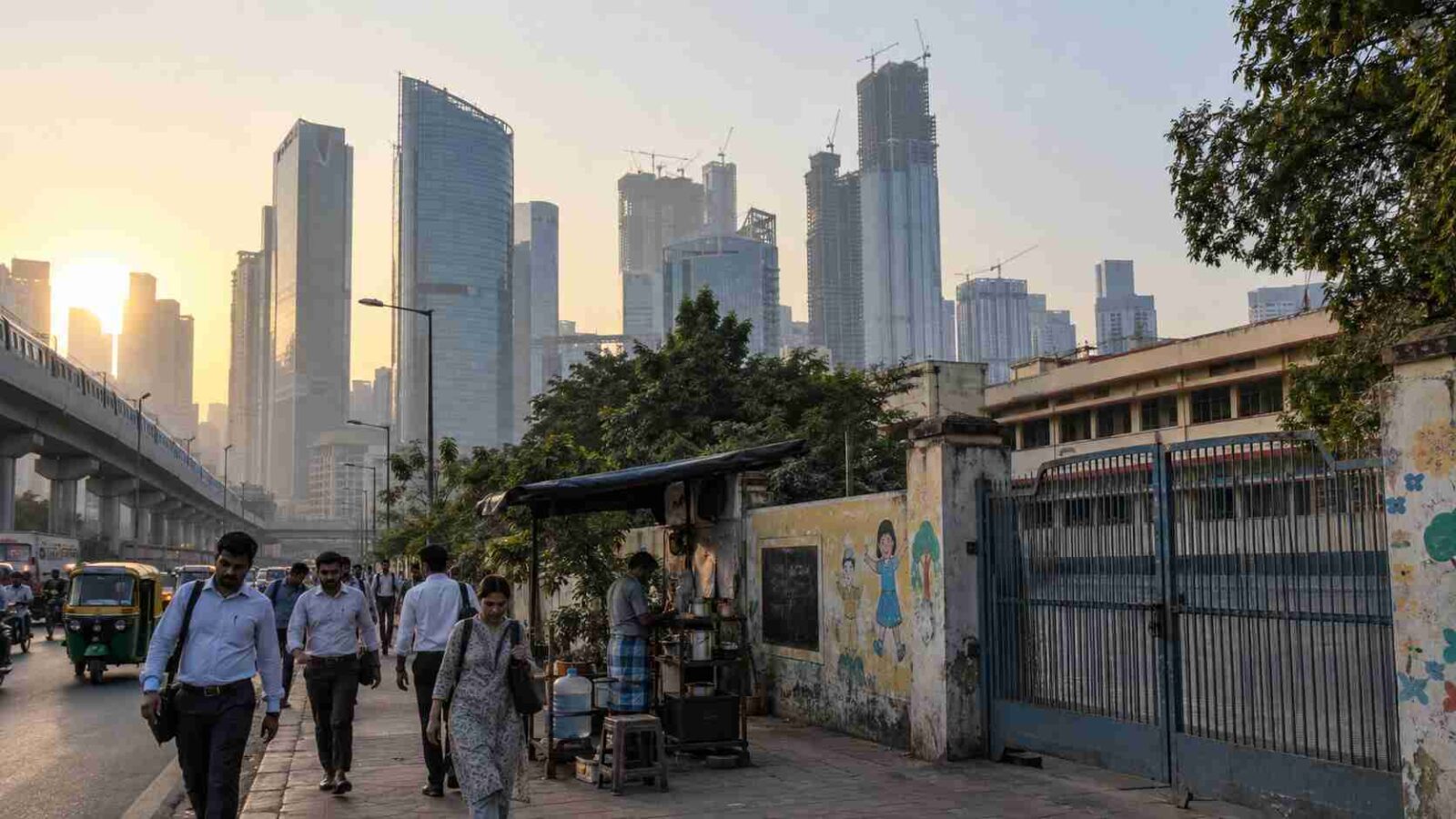
Consider what India has chosen not to invest in while celebrating its GDP. Combined government spending on education has sat frozen at roughly 2.7 per cent of GDP for years, even as growth accelerates. The number of government schools has fallen from 11.07 lakh to 10.13 lakh in a decade, a retreat dressed up as “rationalisation,” borne disproportionately by poorer children and girls for whom distance is not an inconvenience but a barrier. Nearly 8.7 crore young Indians aged 15 to 29 are neither studying, working, nor training, a demographic dividend curdling into a demographic warning, in the very country that markets its youth as its greatest asset.
The employment data tells its own story of precarity: 56.2 per cent of Indian workers self-employed, only 23.6 per cent in regular salaried work, and 20.2 per cent casual. This is not a labour market generating security. It is one generating survival.
And then there is the wealth. India’s richest 10 per cent hold roughly 65 per cent of national wealth. The top 1 per cent alone hold 40 per cent. The bottom half of the country owns just 6.4 per cent. When ownership is concentrated this severely, growth does not trickle, it pools, at the top, by design of the very policies being celebrated as pro-growth.
Even the poverty numbers are curated theatre. Under the World Bank’s revised methodology, roughly 5 per cent of Indians fall below the extreme $3-a-day line, a figure tailor-made for triumphant press releases. But move the threshold to $4.20, the line for a lower-middle-income country, and nearly 24 per cent of Indians, 34 crore people, are poor. Move it again, to $8.30, and the number is 82 per cent, 118 crore people. Same country. Same data. Wildly different story, depending entirely on which threshold the government chooses to spotlight.
Roads get inaugurated. Airports get photographed. Trains get flagged off with fanfare. Nutrition, primary education, and preventive healthcare produce no ribbon-cutting moment, so they are starved of both funding and attention, even though they are the actual infrastructure of a functioning society.
The real scandal is not whether 7.8 per cent is technically accurate. It is that India has built an entire political economy around a number that tells you everything about production and nothing about people. Growth, in the end, is only worth asking for if it produces jobs, dignity, and security. Absent that, it is simply a statistic performing prosperity for a government that needs one.







Leave a comment