




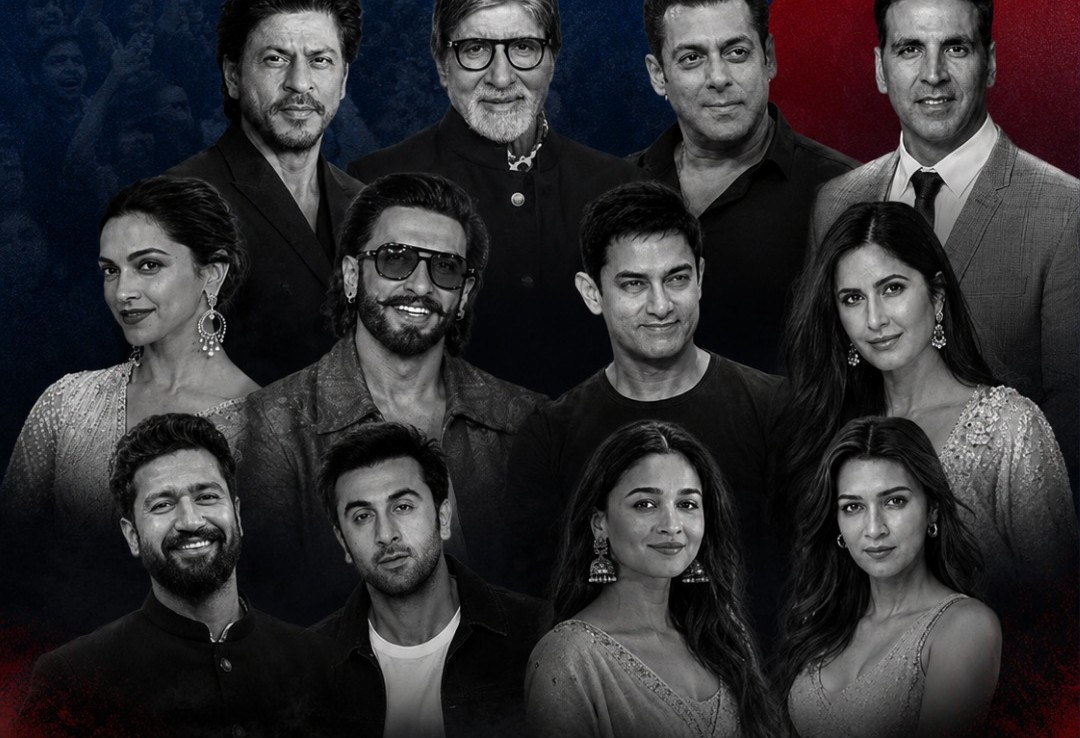
Whenever India blows up – on the issue of NEET paper leaks, the Citizenship Amendment Act, farmers on the highways or #Metoo testimonies, there is always a pattern. A few actors stand out and speak up. Shabana Azmi appears on the scene. Some rant on the controversy. Sonakshi Sinha uploads a video on YouTube. And the industry’s top guns – Shah Rukh Khan, Salman Khan, Aamir Khan, Ranveer Singh and Deepika Padukone remain mum.
We’re tempted to take this as a sign of cowardice, of indifference, of simply the cold hard logic of brand management. All three of the explanations are correct. However, there is a communication theory from the 1970s that can account for this trend in a surprising way: not only does silence become more and more prominent – more and more pronounced, even more sinister – when celebrity faces a controversy, it also works to make the controversy more intense.
Spiral of Silence
The Spiral of Silence theory was developed in 1974 by German political scientist Elisabeth Noelle-Neumann to account for a public opinion research problem: People often underestimate how popular their opinions are, and that underestimation influences their willingness to speak their opinions or not. The basis of her argument was rather straightforward. People have a “quasi-statistical sense” – a sense for the climate of opinion of their surroundings. People are more likely to self-censor when they feel they are in the minority or when they think that they might be isolated if they share their opinion. They are more likely to speak out if they think their perspective is in favor or at least safe. Most important, it does not really matter if they are right or wrong. Rather, it is fear of isolation – the fear that Noelle-Neumann deemed to be “almost as strong as any material incentive.”
The mechanism self-feeds. The more the perceived majority talks, the more the perceived minority becomes silent. How much more silence would be born if silence should be heard. One word leads to another! As time passes, one side of the argument seems to be the only one that takes over the public sphere, not necessarily because of the majority opinion, but because it’s the opinion people feel comfortable voicing in public.
Noelle-Neumann was discussing the choice of ordinary people to stand or sit silent in a dinner party or before a pollster. In the modern Indian movie star, however, who is part of several hundred million people and has a bank of endorsements and a movie schedule, the “climate of opinion” is not a dinner party.
Celebrities’ Fear of Isolation
The instinct might be to assume megastars are exempt from the fear of isolation that governs ordinary people – after all, what does Shah Rukh Khan have to fear that a college student doesn’t? But Noelle-Neumann’s framework suggests the opposite. Isolation, for a public figure whose entire livelihood depends on being loved by the widest possible audience, is not a social discomfort. It’s an economic event. A boycotted film. A cancelled endorsement. A trending hashtag calling for a ban. The 1990s backlash that both Khans experienced when they took political positions – boycotts, effigies, threats to family – was, in Spiral of Silence terms, a brutally effective demonstration of what happens when a public figure is perceived to be on the “wrong” side of the climate of opinion.
That demonstration effect doesn’t fade. It becomes institutional memory. Every actor who has watched a colleague get burned in effigy for a stray comment recalibrates their own threshold for risk. Deepika Padukone didn’t say a single political word at JNU in 2020 – she simply stood in a room – and the controversy still consumed her film’s release cycle for weeks. That is the spiral operating at full strength: even silent presence was punished, which teaches every other star watching that even silence isn’t safe enough – only absence is.
Social Media as the Accelerant
The “climate of opinion” was a slow-moving, mediated phenomenon in an era of three TV stations and a few newspapers, when Noelle-Neumann formulated her theory. That climate has now become a real, second-by-second referendum, as the “the majority view” is instantly and brutally proxied by quote-tweet or trending hashtags – whether they’re representative of anything or not. Coordinated accounts can, and can use, appear to stir up a lot of anger in the public in a matter of hours. If a star is considering commenting on NEET or the CAA, the climate of opinion is no longer deduced over time, through newspapers and talk, it’s conjured up instantaneously, and is proportional to the volume of noise that is made online by the loudest mobiliser. This means the spiral is tighter and faster than anything that Noelle-Neumann ever envisioned, and it hits public individuals with the most to lose the hardest.
Aamir Khan’s slow, even legalistic disclaimer, separating himself from comparisons with Sonam Wangchuk is a telling example. He was not hired on to a political job, but rather was “re-hired” on to a political job because of his association, in the public’s eyes, with an old film role. Even this indirect, involuntary connection was enough for a walk-back to be done publicly. Now when accidentally coming into contact with a cause requires damage control, the rational measure of any star who has a career span of more than one state, language and political constituency is to reduce exposure to the very minimum.
The Exceptions Are Not the Rule
Noelle-Neumann herself pointed out that no matter how the climate is, a small circle of “hard core” people will continue to speak their beliefs, and they have bigger values than what people say. These are the hard core – Shabana Azmi, Naseeruddin Shah, Prakash Raj and Anurag Kashyap. They’re the exception because they’re willing to take the heat – they seem to be immune to the idea that isolation is a price to pay over the long haul – and that’s why it’s not a tactic but a personal shrug. The rest of the industry takes a punch in the mouth and, if anything, feels that their punishment is the gospel truth that it’s better to be quiet.
False Assumptions of Consensus
People don’t have to be quiet for the danger to be real, as Noelle-Neumann put it – it is the danger of the spiral. Well, it’s because the public debate as a result of this is problematic because it appears as if there is a consensus when there isn’t, or that a fringe stance is actually common when it is not. If the nation’s largest cultural icons shun the public arena of debate over a broken examination system and institutional accountability, the public sphere is not apolitical in their absence – it’s more silent, less broad, and less defiant of those who are willing to shout. As the original article pointed out, “silence” does not mean that there is no position. In Spiral of Silence, it’s the most popular one but it doesn’t say that it’s the most popular one.




Leave a comment