




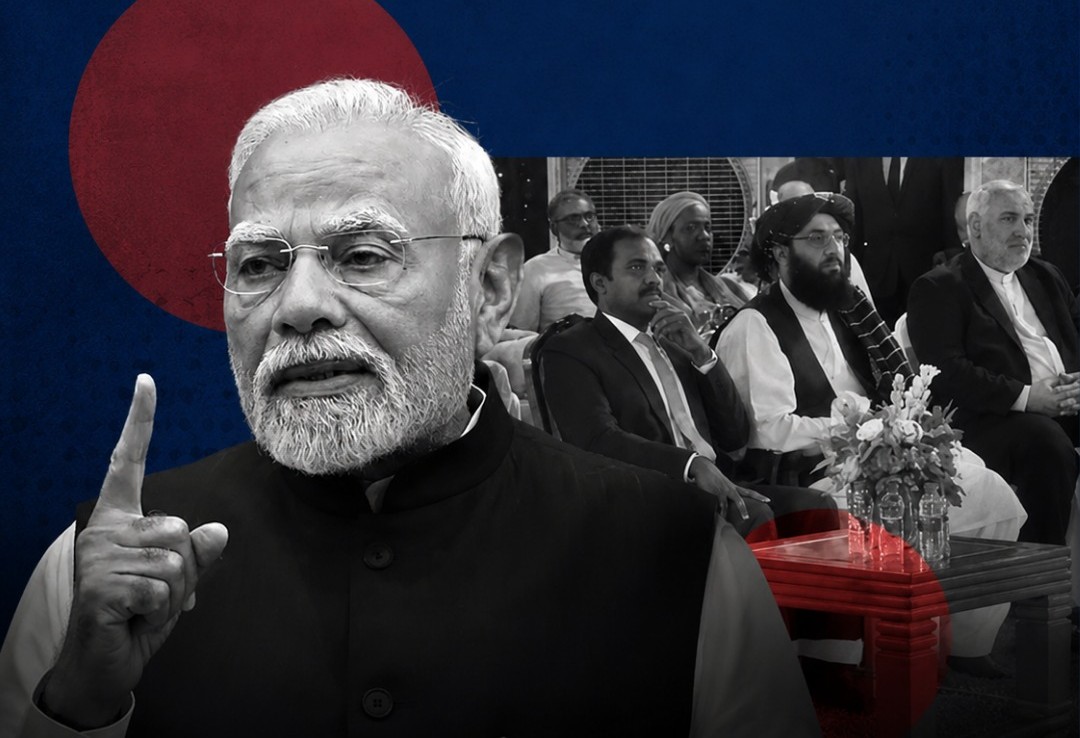
The Afghan embassy in New Delhi organized a party on Monday. It was “Victory Day” – the Taliban’s version of the name for the day of the fall of Kabul in 2021. Taliban-appointed chargé d’affaires Mufti Noor Ahmad Noor was standing under the movement’s white flag, and reiterated that the two countries have a deepening bond. Not only did an Indian foreign ministry official attend, he also spoke candidly about India’s foreign policy stance. He was the chief guest of honour.
Hold this image for a bit. Five years ago, this flag was the symbol of the violent end of a two-decade-old India republic being helped build. On Monday, it flew in a building on Indian land, convened with the government’s own help.
Much of the reporting of India’s Taliban pivot has been on the hypocrisy, a self-described pluralist democracy snuggling up to a party that is based on gender and ethnic apartheid. That’s a good criticism. However, it’s a minimalist approach to the bigger issue. This is not merely a cycle of values, which are in contrast. It’s a betrayal and a very particular one of people who had given in favor of India at great cost.
With whom India was on the side of? Whom India is on the side of?
In the twenty years between 2001 and 2021, there was no passivity on the part of India towards Afghanistan. India had no passive attitude towards Afghanistan during the last twenty years, from 2001 to 2021. It sided with one of the parties in a civil war. It supported the Northern Alliance and the subsequent NATO-backed government it gave rise to which was largely composed of Tajik, Uzbek, and Hazara who regarded Taliban as an existential threat and India as a real ally against them. India built Afghanistan’s parliament building, roads, dams and power lines. It awarded thousands of scholarships to students from Afghanistan, primarily among the very communities that it is seeking to recruit for its own army.
The Taliban, on the other hand, did not consider India as neutral. It attacked the Indian diplomatic premises and a guest house frequented by the Indian nationals between the year 2009 and 2013 resulting in the death of several persons. It is no simple error that has been rectified over time. It was a hatred that stemmed from India’s siding with one side, which the Taliban were well aware of.
That’s why the current pivot is more than just a diplomatic shift. India doesn’t give olive branches to strangers when it is engaged in talks with the Taliban now. It is opening the door to a community whose government is currently led by the Haqqani Network, which have direct affiliation to perpetrators of years of violence against India and against the very Afghans who stood by India when it needed them.
An Alliance of Convenience
All this is not due to the Taliban’s moderation. It’s actually not the actual situation changed; it is Pakistan that changed. The conflict between Islamabad and the Taliban has been open for the past year with cross-border attacks, a bombing in Kandahar, hundreds of attacks that have been recorded by Tehreek-e-Taliban Pakistan (TTP) militants based in Afghanistan and a Pakistani air strike in Khost that reportedly killed a woman and nine children. India’s strategic establishment is a useful Taliban, an angry one, because it’s a lever against a hostile foe whom India has fought four wars with.
It’s a sound strategic sense by itself. Regimes that state dislike, they do talk. When states have an interest, they do talk to regimes they dislike. The unique aspect of the Indian take on this is the price it is demanding, and who is shouldered by that price. It’s not New Delhi’s diplomats who are going to take the onus of this alignment. It’s Tajik, Uzbek, and Hazara Afghans, who see the nation that has supported them, hosting receptions for the nation that is destroying them, it’s Afghan women.
The proof is in the pudding, the evidence that India’s true priorities lie elsewhere is not hard to discern. In 2021, India conducted an evacuation of Afghans, separating them into religious groups, with Hindus and Sikhs being evacuated while Muslim allies were mostly left behind. Since then, one Afghan women parliamentarian who is seeking asylum has been deported. Students in possession of letters of admission to Indian universities were refused visas, even if they were already enrolled in their courses in Afghanistan. Students who already had letters of admission to Indian universities were not granted visas. These developments can’t be considered merely administrative results. They are choices and they are telling you outright that the “friendship” that India is now offering the Taliban was never theirs for the taking by the Afghans, for whom it has been a privilege.
A Bet on Sand
Apart from the moral consideration, it’s not a good strategy. Pakistan and Taliban have always quarreled before and every time when the necessity was felt, they have been able to reconcile themselves. Backchannel communication between them began in the wake of the worst fighting in this year and led to a ceasefire in October in Istanbul. The Haqqani Network, which has infiltrated the current government has shared history as individuals and generations with Pakistanis. Politics isn’t a game of betting on Afghanistan because at no point in its history has it been a permanent solution. A bet and a bet that will likely not win in the region’s experience.
How loyalty would manifest, and what it meant. How loyalty would be expressed, what it would mean.
There is a form of engagement without having to leave behind those that have trusted India the most. Afghan women who have been barred from studying at home are eligible to receive scholarships. Long term visas, regardless of religious affiliation, for persecuted communities – Hazara, Tajik, Muslim and non-Muslims. The pressure from the public, on the Taliban for their human rights violations against ethnic minorities, with the same assurance India shows against the human rights violations of others. None of this would preclude discussions with the Taliban when on occasion it is in the interests of the parties. It would just be an indication that they weren’t doing it at the cost of all those people who once stood by India and hoped that it meant something.
Instead, a chief guest was sent from New Delhi, to celebrate the day of the end of the world of the former allies. The decision will be etched in the memories of the Afghans who were once fond of the belief that India is different, not of the Taliban, who knew that was their expectation.






Leave a comment