











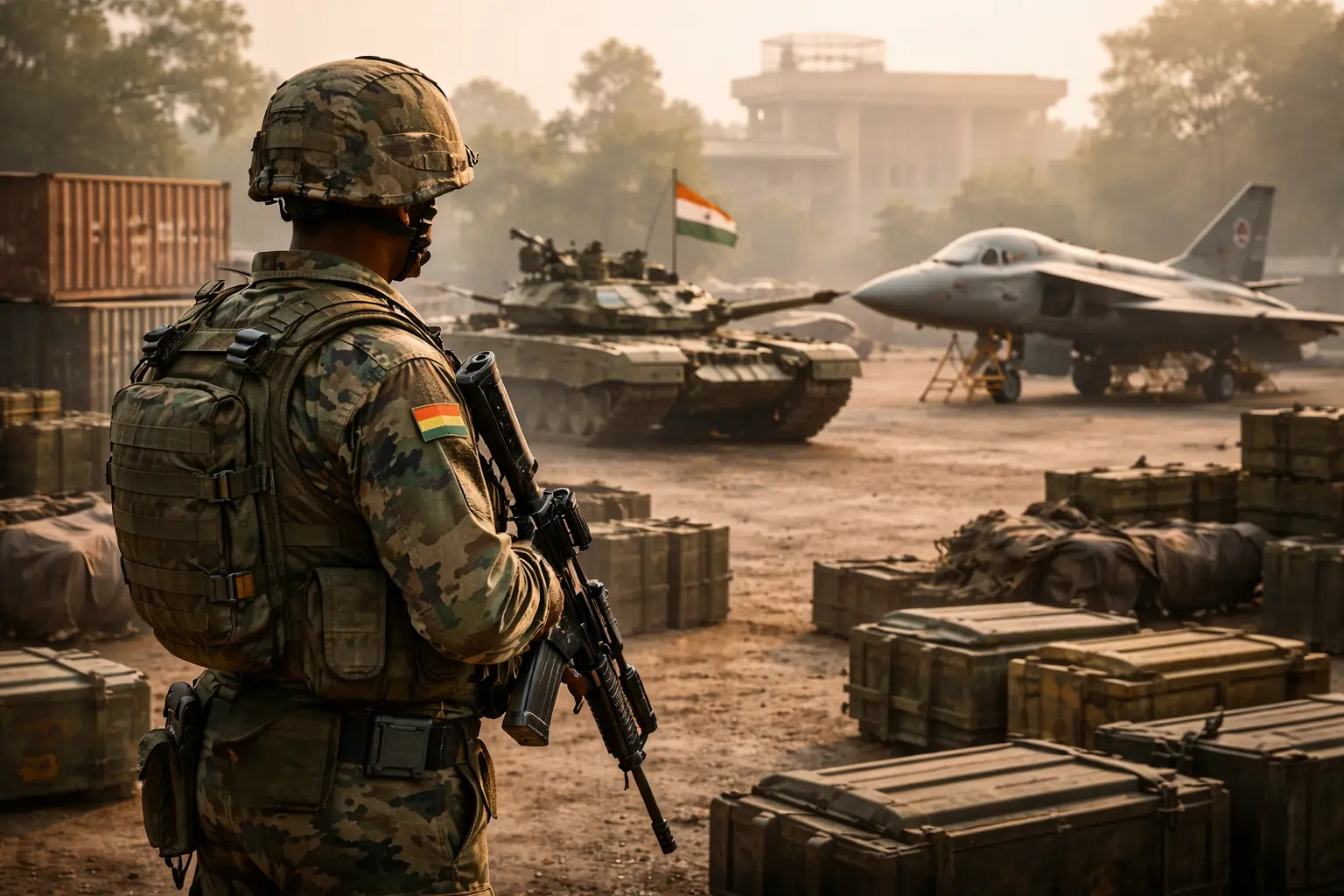
For a nation that claims to be a rising global power with Atmanirbhar Bharat (self‑reliant India) as a flagship policy, the reality of India’s defense procurement and military readiness tells a far more troubling story. Behind the grand slogans lies a procurement system characterized by chronic delays, cost overruns, corruption allegations, operational shortfalls, and weak accountability mechanisms an amalgam that deeply undermines India’s strategic autonomy and national security.
Delays: Procurement Paralysis Over Preparedness
The most glaring symptom of dysfunction is the routine failure to meet procurement timelines even for contracts labelled emergency. According to the Comptroller and Auditor General (CAG) in its latest audit (Report No. 28 of 2025), 72% of Indian Army emergency procurement contracts examined were delivered late, despite special waivers intended to speed up acquisitions in the aftermath of the 2020 Galwan clash. Only 28% of contracts examined were delivered within one year, and in 17% of cases, delivery was not completed even by late 2023 well past extended deadlines. These gap filling, fast-tracked contracts are designed to be put in place for operational gaps in communication on the battlefield, radars, anti-tank missiles, portable secure terminals, drones, etc. However, systems designed to bypass typical bureaucratic obstacles have become bureaucratic confusions. This is not just an administrative failure; there are real consequences on the battlefield. When emergency procurement systems fail, frontline troops may have to wait months, if not years, for the equipment. This happens within an environment of vulnerability while strategic competitors are quickly modernizing.
A Culture of Missed Timelines: From Air Chiefs to Parliamentary Auditor
The pattern of delay is not limited to emergency procurement. Military leadership is cognizant of this systemic issue. In May 2025, Indian Air Force Chief Air Marshal A. P. Singh noted that the concept of timelines is dead within the Indian defense procurement ecosystem, remarking on the paradox of contracts being signed but delivery rarely if ever occurs on time. This level of directness in defense of failure is unprecedented in defense circles in India and speaks volumes to the lack of rigor and depth in the system. The procurement systems have become operationally irrelevant, and barren of any accountability or performance outcomes from the operational shortfalls that they were meant to address.
Financial Costs and Economic Tension
Procurement delays stress the defense budget even further. India’s defense allocation has hit an all-time high (e.g budget provisions in 2026-27 is ₹ 7.85 lakh crore) but a large chunk goes into revenue expenditure like pensions, salaries, and sustainment which leaves little for modernization. In essence, administrative and recurrent costs push equipment acquisition to the periphery. On the other hand, reports and analyses by watchdogs suggest that a large part of the allocated budget goes unspent due to delays that are procedural. When the budget remains unspent, it just lapses and goes back to the exchequer which is also an inefficiency that further constrains the military’s buying power.
Corruption and Abuse Allegations: Systemic, Not Isolated
Most damaging to the public confidence is the ever-present sense of corruption not only in conspicuous contract scandals but also in the routine procurement and army processes.
The Indian defense sector has had some of the most infamous scandals recently, with cases like the AgustaWestland VVIP helicopters scandal with irregularities of ₹3,600 crore, to ongoing controversies around the multibillion-dollar Rafale fighter plane controversy. These deals have raised questions regarding transparency, prices, and the role of politics involved. (Note: specific reporting detail not hyperlinked but is well documented in Parliamentary and Investigative reporting.
Everyday Corruption and Misconduct
More recently, the public conversation, and also litigation, have revealed corruption, some internal to the Indian army. In early April 2026, the Delhi High Court left to the Central Bureau of Investigation (CBI), the Comptroller and Auditor General of India (CAG), and the Government of India, a request by a Lieutenant Colonel still in the service, systemic corruption in the army procurement under the Annual Contingent Grant, raising suspicions about the financial irregularities concerning the provision of essential goods and services.
In other reports, a Ministry of Defence officer has been charge sheeted by the CBI for soliciting a bribe of ₹50 lakh for the clearance of flights for defense exports a most exceptional allegation of corruption even in the export of defense goods. These cases, regrettably, may only be the first signs of a collapse of ethical standards, oversight, and accountability where the defense of the nation requires the highest standards of integrity.
Domestic Industry and Quality Issues: Hollow Self-Reliance
India’s Atmanirbhar Bharat is a assertion aimed at reducing reliance on foreign arms imports. Results on the ground, however, have been less than satisfactory. The truth is, defense imports continue, and domestic initiatives have not progressed. Criticism directed at the private sector arises, in part, from the environment surrounding domestic defense participation, which is quite uninviting. This is also a consequence of complex, inconsistent, and ambiguous government procurement regulations, and of the maldistribution, or total absence, of trade or demand signals. Combined with the procurement of indigenous defense technologies delays, the private sector is left with few options, and tends to walk away from the prospect of defense participation.
Operational Impact: Capability Gaps and Strategic Risk
All of the issues above will obviously impact India’s military readiness, and will continue to do so for a very long time. Strategic analysts continue to warn about the low fighter squadron strength of the Indian armed forces, as this is very likely to become a constraint in the event of a multi-front conflict. The longer procurement delays continue, the longer obsolete and ageing equipment will remain in service. This is a strategic disadvantage in a world were surrounded by rapidly advancing technologies.
Failures of Accountability and Constraints of Institutions
The weaknesses of the CAG concerning the oversight of the contracting process show that there is a lack of clarity of the procedures that are required to be put in place concerning reporting delays to the Defence Acquisition Council concerning emergencies of AHB contracts and procurements of over emergencies of AHB contracts and emergencies.
While auditors, analysts and other third parties have reported that compliance to the procurement deviation culture is very weak and that the order is broken, the procurement deviation culture reports compliance and therefore weakens the procurement deviation culture and procurement culture.
The policy goals of systemic change, such as the tightening of system timelines, the application of systemic penalties for systemic delays, the improvement of systemic transparency and the abolition of corruption, the improvement of the procurement system for domestic substitution, and the improvement of substitution systems, will remain the same goals in a set of SOI formats that are not centre stage.
India’s internal security and defense procurement systems are experiencing the full spectrum of inefficiencies, from systemic stalling, breaches of ethics, failures in structural governance, and failures in accountability.
India cannot afford a procurement system, considering that regional competitors in the geopolitical landscape are developing and modernizing their capabilities rapidly. A procurement system that is developing, modernizing, and developing in a very rapid manner cannot afford the time to be delayed as a persistent iterative system.








Leave a comment