








India’s digital space is undergoing a quiet but significant transformation. What began as a regulatory effort to control misinformation and unlawful content is increasingly being seen as a broader attempt to reshape how speech itself functions online.
The Ministry of Home Affairs (MHA) recently told a parliamentary panel that security agencies rely only on open-source intelligence (OSINT), insisting that no private data is accessed and therefore no privacy is violated. This claim comes at a time when the government is simultaneously tightening its grip on social media through new rules, including a controversial three-hour takedown mandate. The contrast between official assurances and ground realities is where the real debate lies.
The Architecture Being Built Around You
In February 2026, India’s government amended its IT Rules to require social media companies to remove “unlawful content” within three hours of being notified. The previous window was 36 hours. According to Reuters, this is now the shortest content takedown window prescribed by any government anywhere in the world.
Three hours. No notice to the creator. No explanation required. No judicial review before removal. A government officer flags content, the platform receives an order, and your post disappears before most people in your time zone have finished their morning tea.
Akash Karmakar, a technology law partner at Panag & Babu, told Reuters directly: “It’s practically impossible for social media firms to remove content in three hours. This assumes no ability to resist compliance.” That last phrase is not incidental. It is the design. A compliance window so tight that platforms cannot legally evaluate whether the content actually violates any law before removing it. The practical result is that platforms remove first and ask questions never, because the alternative is personal criminal liability for their Indian employees under the existing IT Rules.
What Is Actually Being Removed
The government says these powers exist to combat fake news, hate speech, and deepfakes. The record of what is actually being removed tells a different story.
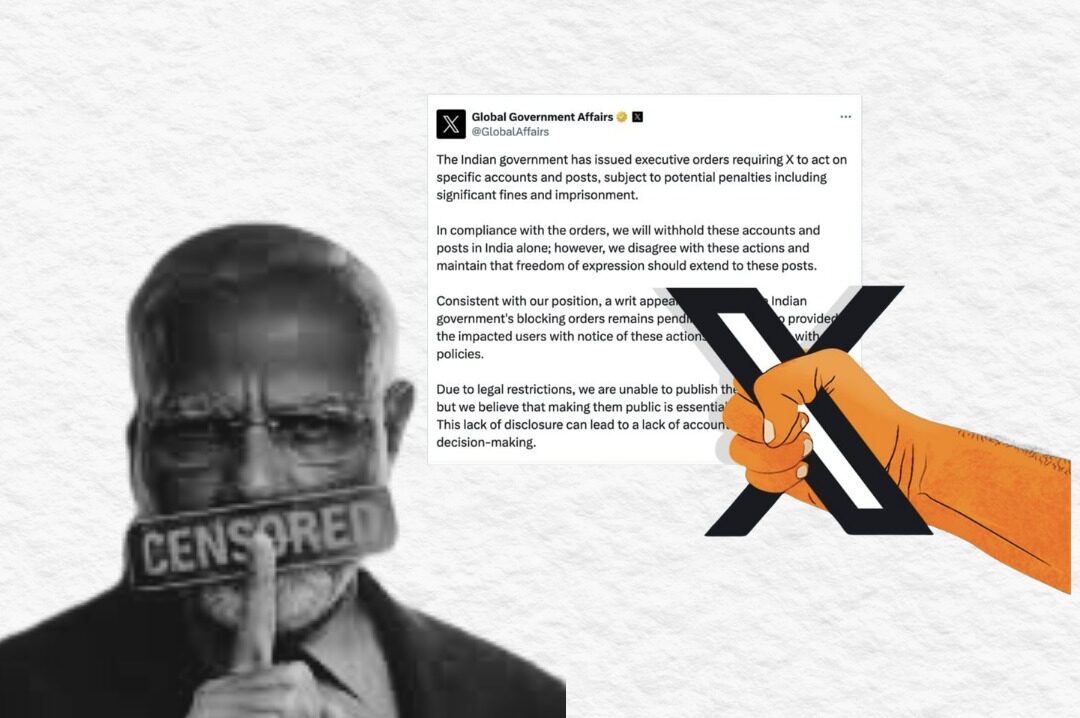
In March 2026, X blocked approximately a dozen accounts on orders issued under Section 69A of the IT Act. Most were known for satirical posts about the government. Kumar Nayan, whose account had 242,000 followers, received no prior notice and no explanation. His account was restored only after a court order. Ten posts remain blocked pending government review. The BBC reviewed those posts. Every single one either mocked Prime Minister Modi or criticized the BJP government.
A *50 crore defamation case was filed against a content creator for using a published article that exposed a sitting minister. A comedian’s reel lampooning Modi’s visible delight when meeting foreign leaders was pulled. Another reel showing Modi wearing Israel’s Knesset medal alongside an Indian man wearing a cooking gas cylinder around his neck, commentary on the gas shortage caused by the West Asia crisis, was removed.
According to data obtained through an RTI request and reported by The Indian Express, more than 2,300 blocking orders were sent to 19 platforms between October 2024 and October 2025 through the Home Ministry’s Sahyog portal alone. Meta restricted more than 28,000 pieces of content in India in just the first six months of 2025 following government requests, according to the company’s own transparency report.
During the India-Pakistan military escalation last year, the government ordered X to block 2,355 accounts, including accounts belonging to international news organizations like Reuters. More than 28,000 URLs were blocked in 2024 alone, according to platform transparency data cited by France 24.
Now They Want More
The three-hour rule and the Sahyog portal are not the ceiling. They are checkpoints on a longer road.
Draft amendments published in late March 2026 propose extending the government’s regulatory framework to anyone who posts content related to “news and current affairs,” including influencers, podcasters, and ordinary citizens. A stand-up comic making a joke about a government policy. A college student explaining her attendance sheet. All potentially subject to the same “code of ethics” currently applied to registered news publishers, enforced not by courts but by an inter-departmental government committee with the power to order apologies, content changes, or removal.
The proposed rules would also decentralize takedown authority, granting blocking powers to multiple ministries simultaneously, including Defence, Home Affairs, Foreign Affairs, and Information and Broadcasting. Previously, this authority sat primarily with the IT Ministry. Now any of several ministries can independently order content removed, with no requirement to disclose which ministry issued the order or why.
Digital rights activist Nikhil Pahwa, writing with Apar Gupta of the Internet Freedom Foundation in the Times of India, described what is being constructed as an “infrastructure for mass censorship,” built piece by piece, amendment by amendment, portal by portal, until the architecture is complete and the door is closed.
“Someone in some government ministry will wake up one morning, see a tweet or YouTube video they don’t like and take an order to remove it,” Pahwa told France 24. “There’s no rule for releasing that information.” No transparency. No accountability. No way for a citizen to know which arm of government silenced them or why.
Meanwhile, The MHA Says Privacy Is Never Violated
Into this landscape steps the Ministry of Home Affairs, which recently told a parliamentary panel that security agencies rely exclusively on open-source intelligence drawn from publicly available social media, and that therefore “privacy is never violated.”
The parliamentary document presented to that panel reveals that authorized security agencies scrape social media posts, YouTube videos, Facebook posts, hashtags and trends, matrimonial and dating platform profiles, and dark web marketplaces. The MHA’s position is that because this data was technically public, collecting it systematically into government intelligence databases violates nothing.
The Supreme Court of India, in the 2017 Puttaswamy judgment, recognized privacy as a fundamental right under Article 21. The distinction between data being publicly accessible and data being systematically scraped, cross-referenced, stored, and used for intelligence purposes by state agencies is the entire basis of modern privacy law. The MHA’S formulation collapses that distinction entirely and calls the result compliance with constitutional rights.
Meanwhile, the US government’s own 2026 National Trade Estimate Report stated plainly that American companies operating in India have faced an “increasing number of takedown requests for content and user accounts related to issues that appear politically motivated.” Those are the words of a U.S. trade document, not an opposition press release.
In America, nine million people marched in protest without tear gas. In India in 2026, a college girl cannot post a reel about attendance registers without it disappearing within hours.
The Ministry of Home Affairs says privacy is never violated. The U.S.government says the takedowns are politically motivated. Two thousand three hundred blocking orders say the infrastructure is already operational. And the proposed new rules say it is only going to expand.
This is not about which party you support. It is about whether, in a country of 1.4 billion people that calls itself the world’s largest democracy, a citizen can post what they witnessed at a government event without the post being erased before dinner.
Right now, the answer is no. And the government is working to make sure it stays that way.







Leave a comment