


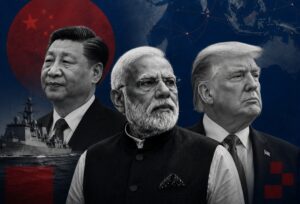
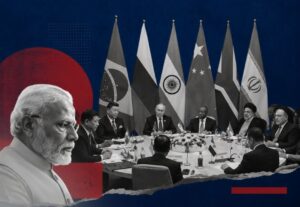

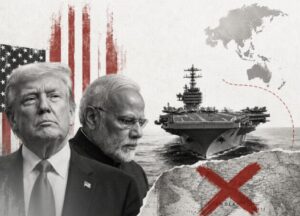

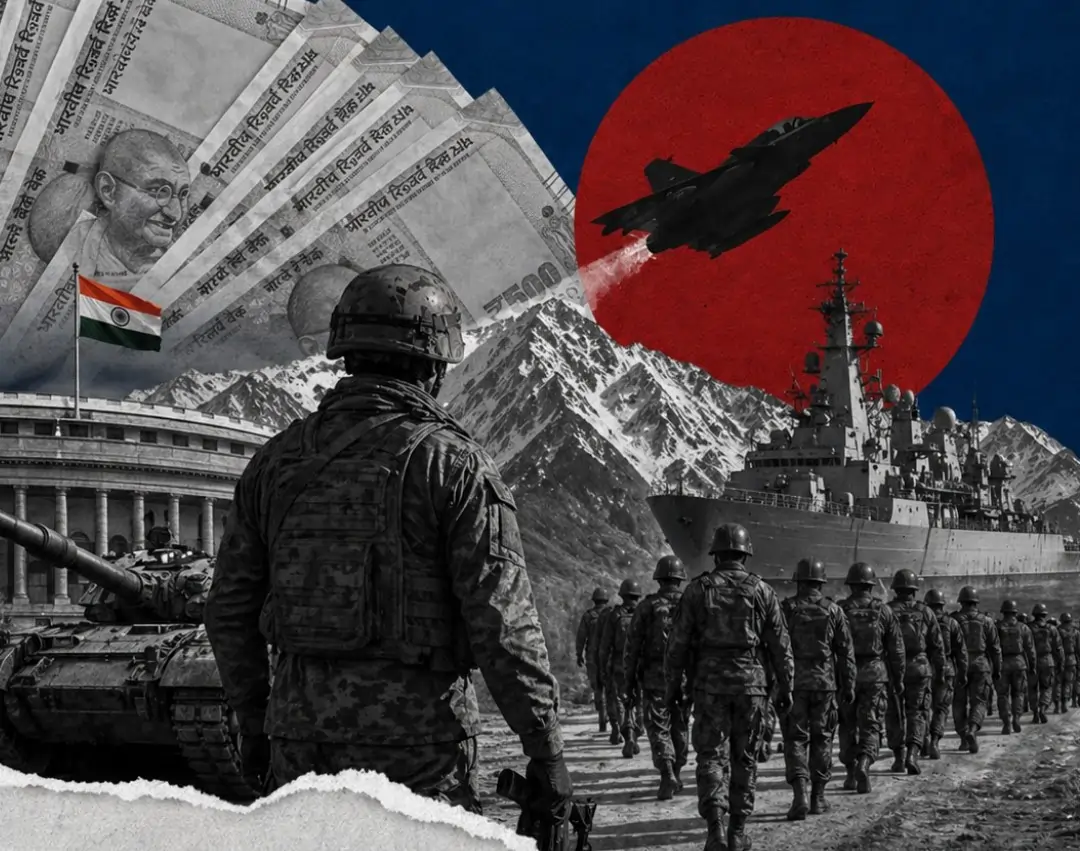
On April 28, 2026, the Stockholm International Peace Research Institute released its annual global military expenditure report. India featured prominently. India spent $92.1 billion on defence in 2025, an 8.9 percent increase over the previous year, making it the world’s fifth largest military spender behind the United States, China, Russia, and Germany, accounting for 3.2 percent of total global military expenditure.
The government will present this number as proof of strength. It is also proof of a question that deserves a direct answer: after decades of being among the world’s largest defence spenders and arms importers, why does India keep getting caught strategically unprepared?
The Numbers in Full
Global military expenditure reached $2,887 billion in 2025, a 2.9 percent rise from 2024, equaling 2.5 percent of global GDP, the highest share since 2009. India sits in distinguished company at fifth place. The top three military spenders, the United States, China, and Russia, spent a combined $1,480 billion, or 51 percent of the global total.
China remained second globally with $336 billion, having raised military spending for the 31st consecutive year. Pakistan increased spending by 11 percent to $11.9 billion, ranking 31st among the 40 countries SIPRI tracked.
India, therefore, spends nearly eight times what Pakistan spends on defence. It spends more than the entire GDP of many nations. And yet, in the year this spending reached $92 billion, India experienced the Pahalgam attack that killed twenty-six tourists one kilometre from an army base, launched Operation Sindoor, and then watched another terrorist attack kill thirteen people in the national capital months later. The ratio of spending to security outcomes requires examination that no government press release will provide.
The Budget Surge and What Drove It
On February 1, 2026, India raised its defence allocation sharply. The Union Budget for 2026- 27 set aside Rs 7.85 lakh crore for defence, a more than 15 percent increase, with Rs 2.19 lakh crore as capital outlay for fighter jets, transport aircraft, helicopters, warships, submarines, artillery guns, smart weapons, missiles, rockets, drones, and unmanned systems.
The trigger was Operation Sindoor. When India launched Operation Sindoor against Pakistan, the armed forces made a raft of emergency procurements to stay battle-ready. Emergency procurement is the most expensive and least efficient way to acquire military hardware. It means paying premium prices under time pressure, accepting whatever is available rather than what is optimal, and bypassing the competitive processes that theoretically ensure value for public money.
That India needed emergency procurement during an active military operation, after decades of being among the world’s largest defence spenders, is not a testament to decisive action. It is an admission that the routine procurement process has failed to maintain readiness. A country that spends $92 billion a year on defence should not be scrambling to buy equipment when a crisis arrives.
Pakistan’s $11.9 Billion and What It Actually Bought
Here is the comparison that should embarrass every Indian defence planner. Pakistan spent $11.9 billion on defence in 2025, ranking 31st globally, an 11 percent increase over the previous year. India outspends Pakistan on defence by a ratio of nearly eight to one. India’s single-year defence budget increase of 8.9 percent alone is larger than Pakistan’s entire annual military expenditure.
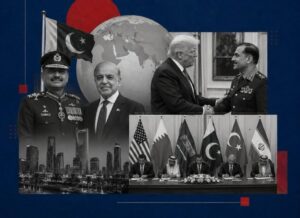
And yet, in 2026, it was Pakistan, not India, that mediated between the United States and Iran. It was Pakistan’s Army Chief Field Marshal Asim Munir, not India’s defence establishment, that Washington trusted to carry sensitive ceasefire proposals to Tehran. It was Islamabad, not New Delhi, that Iran’s Foreign Minister publicly thanked by name. Pakistan, spending one-eighth of what India spends, punched so far above its military budget in diplomatic and strategic outcomes that the comparison becomes a verdict on what defence spending without strategic clarity actually produces. Pakistan also extracted a 21 percent interim wage hike for its workers through sustained protest pressure in the same period that India’s Noida factory workers faced tear gas for demanding the same. It managed to position itself as a peace broker while fighting the TTP on its western border simultaneously. None of this required $92 billion. It required relationships, flexibility, and the willingness to show up when it mattered, none of which are purchased through arms import agreements with France and Israel..
The Import Dependency That Does Not Improve
India remains the world’s second largest importer of military hardware, accounting for 8.2 percent of global weapon imports. This figure sits in direct contradiction to every Make in India announcement, every Aatmanirbhar Bharat defence speech, and every government claim about building domestic defence manufacturing capability.
The import share has shifted in origin, if not in scale. Russia’s share of Indian arms imports fell from 70 percent in 2011-15 to 51 percent in 2016-20 to 40 percent in 2021-25. India has increasingly turned to France, Israel, and the United States.
Diversification of suppliers is strategically sensible. Remaining the world’s second largest arms importer after decades of indigenous defence manufacturing initiatives is strategically embarrassing. Every rupee spent importing weapons that India’s own defence industrial base could theoretically produce is a rupee that does not build long-term self- sufficiency and a relationship of dependence that any supplier country can leverage in a bilateral dispute.
The Israel relationship is worth examining specifically in this context. India has deepened its arms relationship with Israel substantially over the past decade, with Israel becoming a top-three supplier of military hardware. That deepening occurred simultaneously with the diplomatic alignment that, as the 2026 Gulf crisis demonstrated, cost India its credibility with Iran and its ability to participate in regional diplomacy. India is paying for Israeli weapons with Israeli-calibrated foreign policy positions. Whether that exchange represents value for Indian citizens is a question the defence ministry will not answer.
The China Gap That Rs 7.85 Lakh Crore Cannot Close
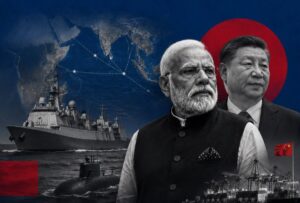
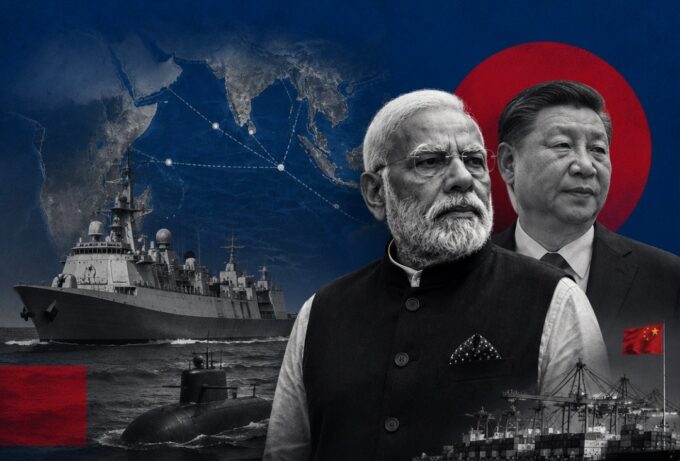
China spent $336 billion on defence in 2025. India spent $92 billion. China outspends India on defence by a ratio of nearly four to one. China has also been raising spending for 31 consecutive years, meaning the absolute gap in cumulative investment in military capability is vastly larger than any single year comparison suggests.
The Galwan clash of 2020, in which twenty Indian soldiers were killed in hand-to-hand combat, and China made territorial gains that India has never fully recovered, occurred when India was already among the world’s top five military spenders. The subsequent buffer zones, the patrolling restrictions, the Chinese infrastructure construction in disputed areas all of this happened while India spent enormous sums on defence. Spending money is not the same as building capability. It is certainly not the same as building the specific capability needed to deter a specific adversary in a specific geography. India’s defence expenditure has consistently prioritized platforms, hardware, and the optics of technological modernization over the unglamorous business of logistics, maintenance, soldier welfare, and the operational readiness that determines outcomes in actual conflict.
What $92 Billion Should Buy
India’s defence budget of Rs 7.85 lakh crore for 2026-27 exceeds the country’s entire trade deficit with China. It exceeds the combined annual remittances of the Indian diaspora. It is a sum of public money so large that its efficient deployment should produce unambiguous security outcomes.
Instead, India has an army that entered Operation Sindoor requiring emergency procurement. It has a border with China, where the status quo has shifted to Beijing’s advantage despite years of high spending. It has a Kashmir where twenty-six tourists were killed one kilometre from an army installation. It has a capital city where thirteen people died in a terrorist attack months after a military operation was declared successful.
Former Comptroller and Auditor General reports have repeatedly flagged concerns about defence procurement delays, equipment shortfalls, and ammunition reserves that fall below prescribed minimum holdings. The CAG’s 2023 report noted critical deficiencies in ammunition stocks for sustained conflict. These findings are published, noted briefly in specialist publications, and then set aside while the budget allocation headline grows another 15 percent.
Conclusion
India is the world’s fifth-largest military spender. It is also the world’s second-largest arms importer. It has the fourth-largest active military force. And it has, in the past twelve
months, experienced a mass casualty terror attack at a heavily guarded tourist site, launched an emergency-procurement-dependent military operation, been diplomatically sidelined in the region’s most significant crisis, and watched China consolidate gains on its northern border that high spending has not reversed.
Meanwhile, Pakistan, spending one-eighth of India’s defence budget, brokered a regional ceasefire, earned public gratitude from Tehran, and positioned itself as a trusted diplomatic actor in the world’s most consequential crisis of 2026.
The SIPRI report is a data point, not a verdict. But the gap between what India spends on defence and what that spending produces in terms of actual security, territorial integrity, and diplomatic leverage is a gap that no budget press release addresses and no chest- thumping speech closes.
The question is not whether India should spend on defence. Of course it should. The question is whether Rs 7.85 lakh crore, managed by the same procurement system that required emergency buying during an active operation, overseen by the same political establishment that chose alignment with Israel over diplomatic flexibility in the Gulf, directed by the same strategic culture that confused presence with influence in every regional forum it joined, will produce different outcomes than the last decade of equivalent spending produced.
The SIPRI data says India is spending more than ever. Everything else says it is getting less than it should.






Leave a comment