






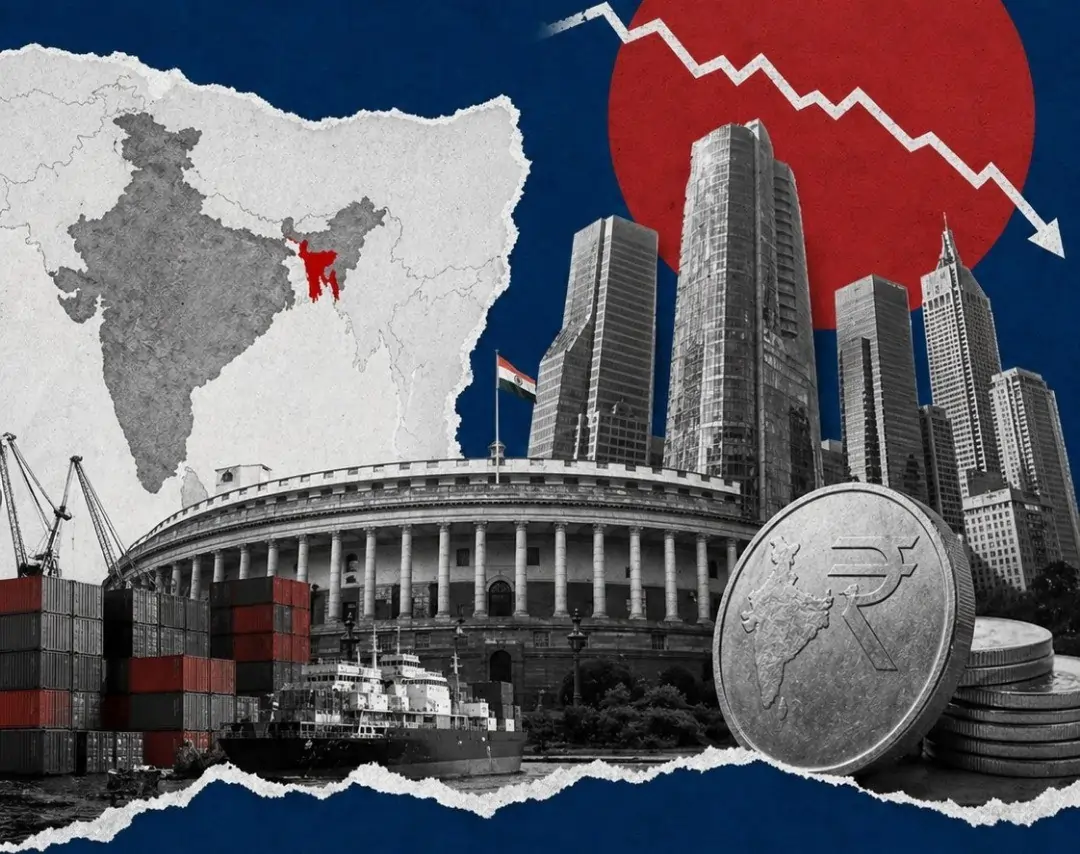
The IMF’s April 2026 World Economic Outlook places India sixth globally. Bangladesh has overtaken India in per capita income. The rupee is Asia’s worst-performing major currency. And the base year used to calculate our GDP has not been updated since 2011.
For three years, the Modi government celebrated two economic milestones with considerable fanfare. India overtook the United Kingdom to become the world’s fifth-largest economy in 2022. It overtook Japan to become the fourth largest in 2025. Both achievements were announced at rallies, cited in campaign speeches, and presented to Indian citizens as proof that the economy was not just growing but arriving at a historic destination.
The IMF’s April 2026 World Economic Outlook has quietly dismantled both claims. India is now the world’s sixth-largest economy, with a nominal GDP of approximately $4.15 trillion. It sits behind the United States, China, Germany, Japan, at $4.38 trillion, and the United Kingdom at $4.26 trillion. The two countries that India had publicly celebrated overtaking have both overtaken India again. And the government, which was voluble when the rankings moved in its favor, has had considerably less to say now that they have moved the other way.
Two Reasons. Both Damaging.
The IMF calculates nominal GDP rankings by converting each country’s output in local currency into US dollars. When a currency weakens, the same domestic economic activity translates into fewer dollars and therefore a lower nominal ranking globally. The rupee has fallen approximately 9 percent against the dollar in the past year alone. It is currently at a record low and is the worst-performing major currency in Asia. That depreciation alone accounts for a significant portion of India’s ranking decline.
But the currency story, damaging as it is, is not the complete explanation. The second reason is more structurally uncomfortable. India has been calculating its real GDP using 2011-12 as its base year. Base year pricing in GDP calculations is used to strip out inflation, ensuring that economic growth reflects actual increases in output rather than simply higher prices. Using a 14-year-old base year means India has been measuring its economy against price levels from 2011-12, a period when the structure of the Indian economy, its services sector, its digital economy, its consumption patterns, looked entirely different from today. The result is a GDP measurement that systematically overstates real growth by failing to account for how the economy’s composition has changed.
Several economists, including former Chief Economic Adviser Arvind Subramanian, have raised concerns about the reliability of India’s GDP estimates for years. The base year problem is not a new discovery. It is a long-flagged methodological issue that the government has repeatedly deferred addressing. The IMF’s rankings now make visible what that deferral has cost in credibility.
The Bangladesh Moment India Cannot Explain Away
The ranking slip is embarrassing. The per capita comparison is a different kind of reckoning entirely.
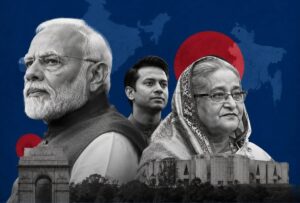
According to the IMF’s April 2026 projections, Bangladesh’s per capita GDP in nominal terms is approximately $2,911 in 2026. India’s is approximately $2,812. Bangladesh has marginally overtaken India in per capita income by roughly $99.
The government and its media defenders will immediately reach for qualifications. The gap is narrow. It is temporary. India is expected to reclaim the lead in 2027 with a projected per capita income of $3,074 against Bangladesh’s $3,048. In purchasing power parity terms, which adjust for the cost of living, India remains comfortably ahead at approximately $12,800 against Bangladesh’s $10,950.
All of these qualifications are technically accurate. None of them addresses the political and symbolic weight of what has happened. India, which has spent a decade presenting itself as a rising superpower, an economy on the verge of becoming the world’s third largest, the flagship of the Global South, has been overtaken in per capita income, however temporarily and narrowly, by a country it routinely dismissed as a smaller, poorer neighbor. Bangladesh, which is still recovering from political transition after Sheikh Hasina’s fall in 2024, which faces its own structural challenges, which the Indian government has at times treated with a degree of condescension that its own economic data never fully justified, has crossed India on this measure in 2026.
The reasons are not mysterious. Bangladesh’s garment export sector has maintained strong dollar earnings. Its population growth has been slower than India’s, meaning per capita calculations divide a respectable economic output among fewer people. And India’s rupee depreciation has compressed its dollar-denominated per capita figure at precisely the wrong moment.
What the Growth Rate Hides
The IMF projects India’s real GDP growth at 6.5 percent for 2026, revised slightly upward, driven by domestic demand and the fact that US tariffs on Indian goods have proven less punishing than initially feared. India remains among the fastest-growing major economies globally. South Asia as a region is projected to grow at approximately 6 percent in 2026, making it the fastest-growing emerging market region in the world, anchored primarily by India.
These are genuine positives and deserve acknowledgment. But they also require context that government statements consistently omit.
Real GDP growth of 6.5 percent in an economy with 40 percent graduate unemployment, where 11 million graduates between 20 and 29 cannot find permanent salaried jobs, where manufacturing contributes the same 17 percent of GDP it contributed in the 1990s despite a decade of Make in India initiatives, is growth that is not reaching the people who need it most. An economy can grow at 6.5 percent and simultaneously produce the conditions documented in the Azim Premji University’s State of Working India report. Both things are true. Citing the growth rate without acknowledging what it is failing to distribute is not economic analysis. It is political messaging dressed in IMF citations.
Compare the regional picture. Bangladesh grows at 4.7 percent. Pakistan at 3.6 percent. Nepal at 3 percent. Bhutan at 7.5 percent. India leads the region in growth rate. It has also just been overtaken by Bangladesh in per capita income, which means its superior growth rate is not translating into superior living standard improvement for the average Indian relative to the average Bangladeshi. That gap between growth rate and distributional outcome is the real story the IMF data contains.
The Currency Crisis Nobody Is Discussing
The rupee’s 9 percent decline in a single year, making it Asia’s worst performing major currency, is not an autonomous market event. It reflects India’s import dependence, its current account pressure from high energy costs following the West Asia conflict, and the broader deterioration in India’s trade balance driven by the China import dependency that the government simultaneously claims to be reducing while the trade deficit with Beijing continues to widen.
India’s trade deficit with China exceeded India’s entire defence budget in recent data, a number that is simultaneously a trade statistic and a strategic assessment. A country that spends $92 billion on defence against China while running a trade deficit larger than that defence budget with the same adversary is not pursuing a coherent strategic economic policy. The rupee’s weakness is partly the market’s assessment of that incoherence.
The Base Year Problem the Government Must Now Fix
The 2026 census is underway. India’s GDP base year needs updating from 2011-12 to the current reference period. The longer this is deferred, the more India’s economic statistics diverge from reality, and the more embarrassing the eventual correction will be when it arrives in a context like this, an IMF ranking moment, where the gap between claimed and measured economic size becomes publicly visible.
The National Statistical Office has been discussing base year revision for years. It has not happened. Every year of deferral adds to the accumulated measurement error and to the credibility deficit that India’s economic data carries in international comparisons. The IMF ranking is a symptom of that deficit arriving in the most public possible forum.
India is the world’s sixth-largest economy by IMF measurement. It has been overtaken in per capita income by Bangladesh. Its currency is Asia’s worst performer. Its GDP methodology uses a base year from 2011. Its growth rate is real and significant, and it is not reaching the eleven million unemployed graduates, the tribal farmers lying on funeral pyres in Bundelkhand, or the forty thousand factory workers in Noida who needed a violent protest to extract a 21 percent wage increase that should have come through routine policy.
The government celebrated loudly when India overtook the UK and Japan. The IMF has now recorded that both have overtaken India again. The same government has been considerably quieter about that development.
In a democracy, the citizens whose living standards the economic data is supposed to reflect deserve to understand both the celebration and the reversal. They deserve an explanation for why the rupee has fallen 9 percent in a year. They deserve to know when the GDP base year will be updated. They deserve to understand why Bangladesh, with one- fifth of India’s economy and none of India’s superpower ambitions, briefly crossed India in per capita income in 2026.
They are unlikely to receive those explanations unprompted. That is what platforms like this one exist to provide.








Leave a comment