





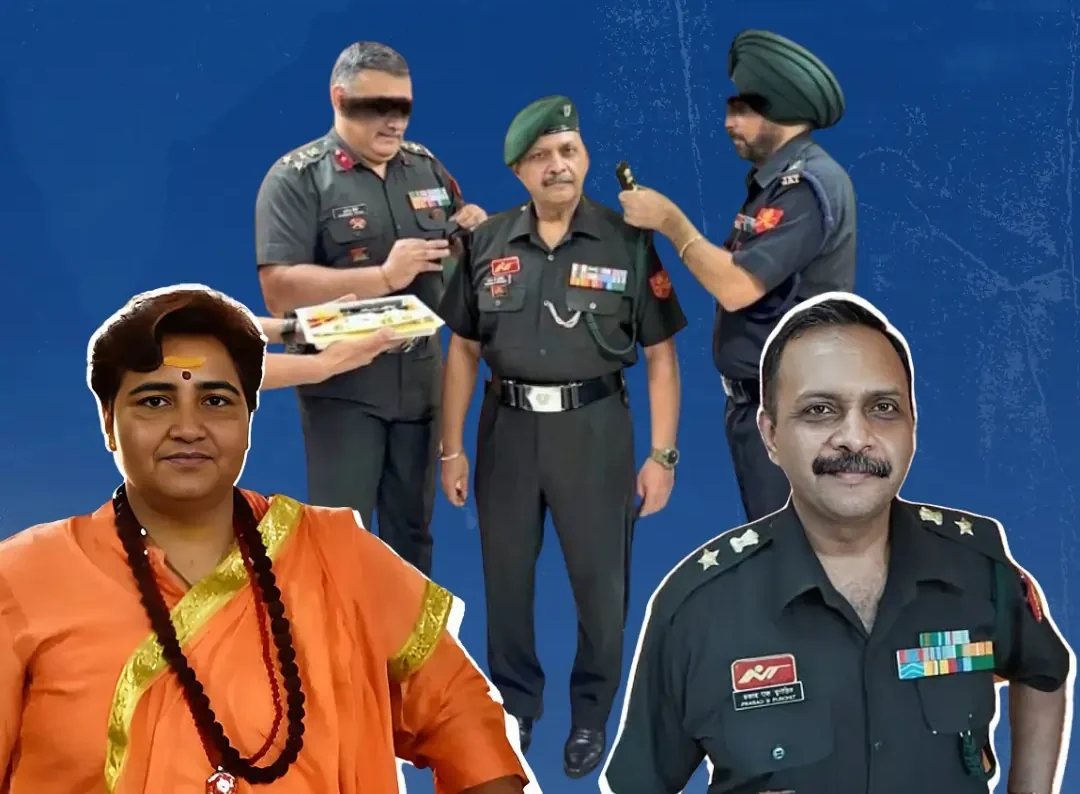
If the Malegaon case was truly resolved, then why did the Indian Army delay Purohit’s promotion for nearly two decades? Why did it take so long for an officer, acquitted of serious charges, to regain his career momentum? Can a military institution that claims to uphold justice and discipline allow politics and partisan narratives to influence promotions and reputations? These questions cast doubt on the Army’s integrity and raise serious concerns about whether justice is truly served or whether it bends to political winds.
Politics Took Over the Judicial Proceedings
From the start, the Malegaon case has not been considered an ordinary criminal investigation. The first charges, filed in 2009, gained traction during the Congress‑led UPA government. After 2014 when the political powers shifted to Narendra Modi and the BJP, the case began to be described as part of an ideological battle on the so-called ‘anti-Hindu establishment’ and protectors of Indian Civilization.
In studies on Hindu nationalism and Indian politics, Christophe Jaffrelot, has demonstrated how the BJP and its ideological ecosystem attempt to reframe and repurpose the narratives of the ‘security and Justice’ in a way that suits their political designs. In The Hindu Nationalist Movement and Indian Politics and other writings, Jaffrelot does an analysis of the intersection of political projects and narratives of law and violence. In the BJP’s reaction to the case, it was evident that framing in that manner, where complicity is assumed based on identity politics, is a prominent feature.
Instead of letting the courts and investigative agencies function independently, the BJP contended that the very notion of ‘saffron terror’ was a myth created by secular elites to delegitimise Hindu nationalist outfits. After the 2025 acquittals, senior BJP officials used the judgement as a political weapon and not as an opportunity to reflect on the shortcomings of the investigative and judicial processes. This is not a reasonable approach to the legal processes, it is political opportunism.
Modi’s BJP Turned a Court Verdict Into a Political Propaganda
In a statutory democracy, verdicts be they convicting or acquitting should be respected by all players in the political domain, and should not be subject to celebratory or contemptuous reaction. In Modi’s India, BJP’s post-acquittal stances went further than respecting the verdicts; they interpreted them as being justified in pursuing a whole political ideological project.
Key leaders of the BJP proactively and publicly stated that the acquittal was a testimony to their claims that investigations during the Congress tenure were politically motivated to persecute Hindu organizations. Partisan political statements as well as media reports of the case described it as a “Hindu conspiracy” and not an absence of evidence case. This type of a narrative diverts attention away from the failure of the evidence to support the allegations, and towards the question of who was politically correct or not. This is a dangerous conflation of law and politics.
The political scientists have to some extent addressed the need to protect the rule of law from the political narratives that corrupt legal reasoning. Amar argues that “legal legitimacy is distinct from political legitimacy” in the case of India too, as the absence of distinction between law and political propaganda, and treating legal outcomes as political victories, is dangerous.
Indian Army’s Institutional Response Was Weak and Politically Tethered
The Indian Army has a long walk of pride in its institutional independence and professional ethos. Given this, the treatment of Purohit’s case stands out. The fact that Purohit’s promotion to the rank of Brigadier came after a long, almost a decade’s, of suspension and being stagnated at a lower rank is justifiable legally but is lacking from an institutional point of view.
What explains the 17-year delay in resolving a case that primarily concerns a serious criminal investigation and considerable evidential shortcomings? Was the Army’s administrative delay simply bureaucratic stagnation or was it affected by the case’s surrounding politics?
Suhasini Haidar, an investigative journalist specializing in conflict, security, and civil-military relations, argues that the Army’s administrative delays are a serious threat to the Army’s professional autonomy. Haidar argues that when bureaucratic inertia becomes the norm and officers are promoted or transferred based on the political climate rather than their service records, the Army loses its professional autonomy. The perception that personnel decisions within the military are influenced by politics undermines the integrity of the entire institution and the soldiers it comprises.
What complicates this saga, turning it into more than simply a legal battle, is the political framing that has been alluded to by authors, scholars, and commentators, including Haidar and P. Sainath. The latter has critiqued the framing of India’s internal politics and security concerns in the binary of \u201cIslamic terrorism,\u201d as well as the Malegaon case, where the accused are Hindu nationalists, while the focus is largely on the absence of investigative accountability.
Christophe Jaffrelot, in his extensive research on Hindutva, politics, and nationalism, has analyzed how ideologies shape the narratives around violence and justice in India. He argues that in a situation where politics is pervasive, the truth is often the first casualty.
Roy has suggested that there has been imposition and usage of state power to manage and control the narratives of terror and dissent and political opposition, and that the Modi years have intensified the merging of political identity with patriotism and justice.
Although these writers do not talk about the Malegaon case exclusively, their criticism of the BJP in Indian political culture explains why the case became more about mythology rather than about the implementation of laws.
The real issue is not just one verdict, it is the state of democracy.
The Malegaon case should have been about evidence, and the investigators, the courts, and the judges, and whether conclusions and assessments were made in evidence. Instead, the case became about the control of the narrative, the ownership of the story, the definition of patriotism, and control of justice.
Any government that transforms a legal judgment into partisan triumphalism with respect to the story of the nation and its identity undermines people’s trust in the system. The Indian Supreme Court has made it clear that justice is not only about winning cases, it is also about the perception of legitimate and impartial decision-making.
If the BJP government and Modi see legal victories as an opportunity to crush their opponents, and if the Indian Army seems to be subsuming its processes into the political narrative, it further erodes the promise of neutrality and democratic accountability.
Governance must Respect the Law, Not the Law as a Weapon
The resolution, legally speaking, of the Malegaon case, pivots and showcases an entire theatre of dysfunctions, particularly with respect to the entanglements of justice and politics in contemporary India. When the ruling party regards a legal outcome as a case of partisan vindication and when the functioning of institutions seems to be politically orchestrated, democracy is in peril.
For India to sustain itself as a pluralistic, constitutional democracy, the politics of narrative triumph must be abandoned. Instead, the rule of law should be untethered from the whims of political gravity and applied equally to the governance structures, functions of the state, the military, and the judiciary.






Leave a comment