









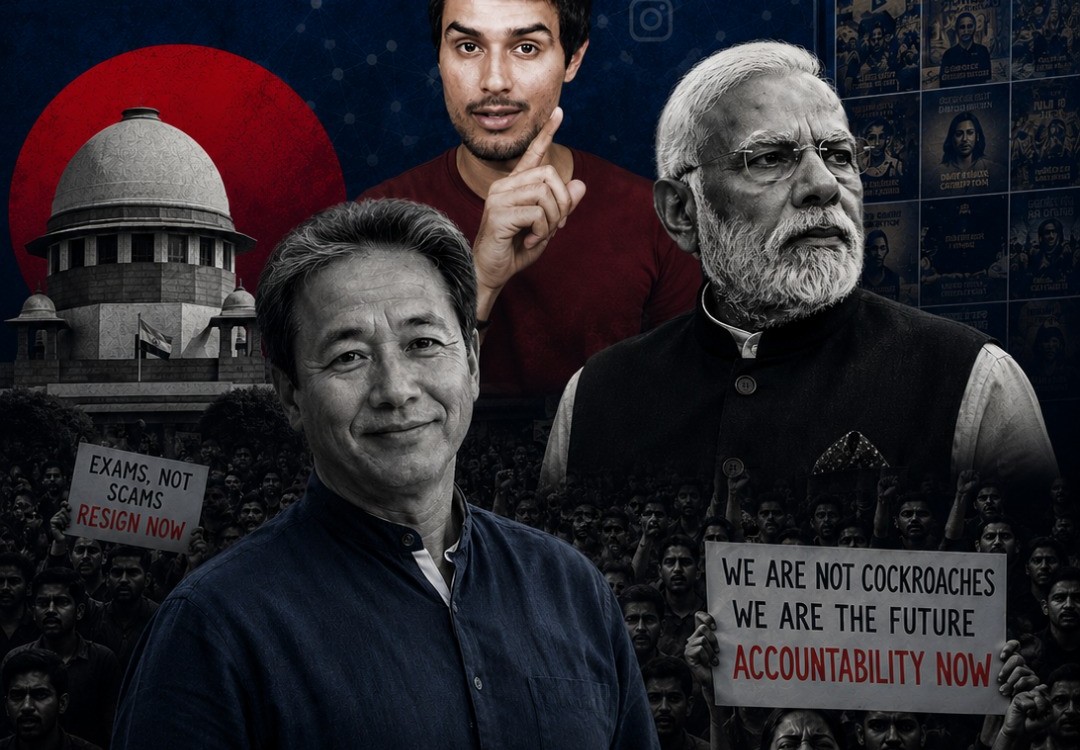
Supreme Court judge, on the other hand, got provoked by a courtroom discussion and hurled the epithet ‘parasite’ and ‘cockroach’ at the jobless youth of India. In a few weeks, the slur had turned into the name of a movement, the number of followers on Instagram had surpassed the ruling party and thousands of young Indians were sitting at the Jantar Mantar demanding the resignation of the education minister. When a 30-year-old, who returned from the US, formed a satirical ‘party’ called the Cockroach Janta Party, and made the Modi government visibly shaken up, it was after a decade of efforts. The Modi government was visibly shaken up after a decade of efforts by a ‘party’ called the Cockroach Janta Party, a satirical party formed by a 30 year old who had returned from the US.
It’s not just a tale of one nifty meme. It is a tale of how youth cultures, which mostly grew up with electronics, have, in loose organizations, challenged key aspects of mainstream political life in a manner that the traditional opposition parties are still largely unable to. And mass communication scholarship has a term for this process.
The Logic of Connective Action
In 2012, political scientists W. Lance Bennett and Alexandra Segerberg offered an explanation for a pattern for which older theories of social movements were unable to account: large protests that never engaged in formal organization, lacked a leadership, and had no membership. It was known as the Logic of Collective Action, as opposed to the older Logic of Collective Action, which would require movements to have well-developed organizations, a common ideology, and coordinated resources in order to mobilise people. With connective action, it’s different.
Rather than parties or unions recruiting around a set platform, individuals “post” “personalized action frames” – content that is easy to share, emotionally gripping, and frequently funny, which others personalize and repost in their own words. The content is the structure. The social media platforms take over the institutional tools needed to summon people onto the streets. The two central ideas of Bennett and Segerberg’s were that this makes organizing more affordable and, more importantly, changes who can launch a movement and how quickly it can spread as virality replaces infrastructure.
Connective Infrastructure
The Cockroach Janta Party almost scores a perfect 10. It was not a manifesto or a founding conference, it was just a sarcastic post, “what if all cockroaches came together? No party office, no membership drive in the normal sense of the word. The joke was, on the contrary, infinitely remixable: anyone who was frustrated with being unemployed, by getting their exams leaked or by being called “lazy” and “chronically online” could take the cockroach as a personal identity marker, without any ideological screening. That looseness is the reason so many people signed up to the movement’s Instagram feed in a matter of weeks, a figure reportedly topping 20 million – years of the established parties to build.
That looseness is what’s made the movement’s Instagram following so big, reportedly reaching 20 million people within weeks, instead of years. This is also how the government’s first attempt to thwart the party’s social media accounts on national security grounds mostly flopped. Unlike normal action movements, there are no headquarters to storm or leaders to arrest and gag, the “organization” exists physically at the same time in millions of individual accounts. When one node is removed, the network is hardly affected.
Majoritarian Politics vs Connective Action
Majoritarian political projects are usually based on dominating the main narrative with disciplined messaging, broadcast media that resonates with them and the power to ‘otherize’ dissent as an outside force or marginal concern. Connective action structurally withstands all 3. The message is not one, but millions of variations on a theme, so there is no single message to discipline, just as there is no single message from the Lord. There isn’t a broadcaster that you can lean on anymore, as the audience has moved to other platforms outside of the gatekeepers. And a movement with no leadership is not easy to delegitimize, even when attacked by one leader – as governments tried to do in attempts to label the Cockroach movement as ‘opposition-led’ as soon as its sit-ins began to take the involvement of Congress leaders.
That is a point that must be based on fact, not fiction. That is, when an existing opposition party makes its presence felt in a connective-action movement, the two logics begin to merge, and the question of whether the “leaderless, apolitical” nature of connective-action movements endures upon contact with formal politics is well warranted. For the government, the protests could be mishandled as partisan opportunism and not student’s grievances, and as they point out, policy measures – pledges of examination system changes, government statements promising a dialogue – indicate the government isn’t deaf to the concerns of students. It’s not clear whether the demands of the Cockroach movement will actually be fulfilled or if the movement will simply fade away like so many viral ones.
Disruption Is Real
It’s not so much if a movement is successful, it’s the reason why it is so difficult to ignore it in the first place. If a government is based on message discipline, it has no way of reacting to a joke it can’t arrest, can’t cut off, can’t brand properly, because the joke is none of their own, and everybody’s. So far, whether it means policy shift, electoral fallout or just another viral moment that sinks into the depths of the monsoon, that’s another story. The way that in India, the youth took an insult from a judge and made it a national reckoning, however, is for now a perfect example of how connective action changes the terms under which the majoritarian politics must play out.








Leave a comment