







“Pity the nation that needs to jail those who ask for justice, while communal killers, mass murderers, corporate scamsters, looters, rapists, and those who prey on the poorest of the poor, roam free.” (Arundhati Roy, October 2010)
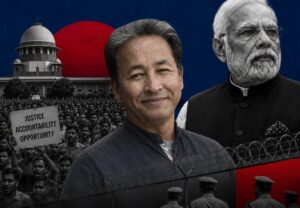
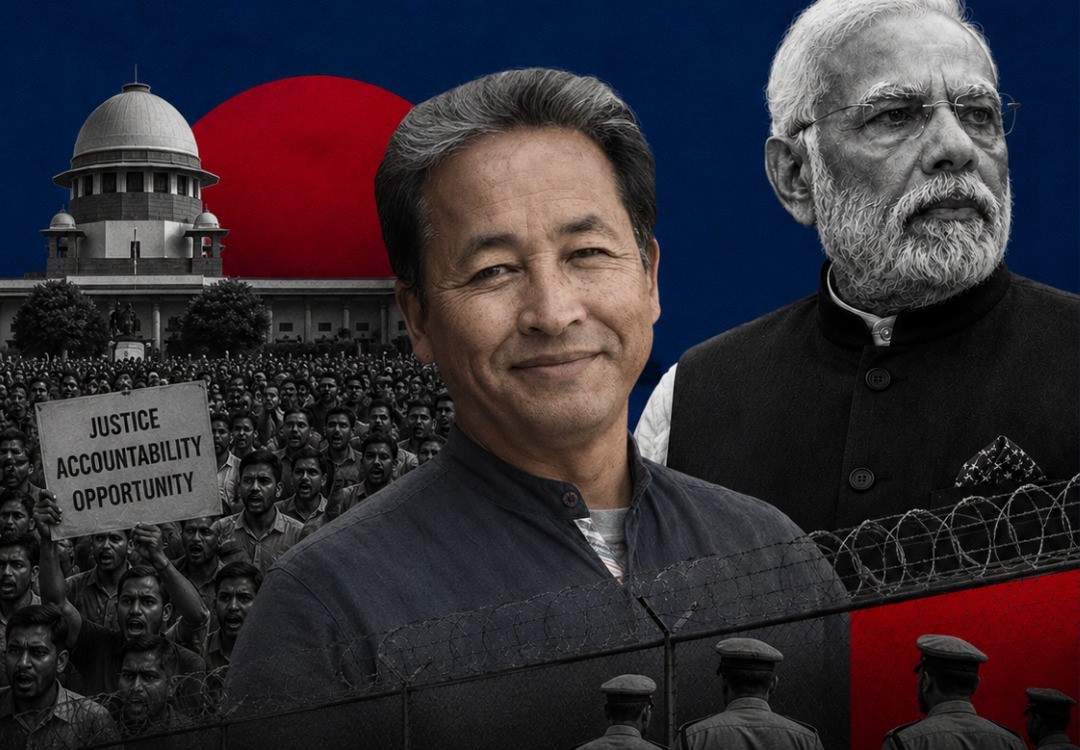
India is the largest democracy of the world. But its government’s reaction to a scrappy, viral protest movement indicates a state much more at ease in putting out fires than answering them. Police forced Sonam Wangchuk, an educator-activist, to go to a hospital in the custody of police, when he was at Jantar Mantar on a hunger strike for 20 days. The party he joined, the Cockroach Janta Party (CJP), has only just been formed, being only two months old. It’s the latest in a long series of episodes of the Modi government’s closing space for critique.
Cockroach Movement’s Birth
The Cockroach Janta Party came into existence in May when a judge in the Supreme Court likened the jobless young people in India to cockroaches and parasites. Instead of being taken aback and outraged, the comment became a rallying cry: young people took the insult as a chip on their shoulders, organizing around grievances over the lack of accountability and opportunity that were reinforced, in their minds, by the comparison. When the group staged its sit-in at Jantar Mantar, their demands had become much firmer, they called for the resignation of Education Minister Dharmendra Pradhan for the university entrance examination scam which had sparked countrywide protest, and demanded accountability for the failure of the system of competitive examinations in India. Some protesters have now taken it upon themselves to demand the resignation of Modi.
Police Crackdown on CJP Protests
Wangchuk, 59, is a popular educationalist and scientist who participated in the CJP protest with an indefinite hunger strike. He was removed at the protest site by police in plain clothes, wearing white sheets to cover the police’s actions; a tactic that has been criticized as part of the state’s “exactly how” knowledge of the removal. Police in Delhi said that it was a medical order and happened because of the minor disturbances during the operation. In a statement, CJP founder Abhijeet Dipke, who initiated his own hunger strike following Wangchuk’s removal, said the activist had been taken ‘without his consent’ and claimed that he had been beaten by police. Wangchuk, who was admitted to Safdarjung Hospital, was described by doctors there as being “weak and slightly dehydrated” after the prolonged fast, which had been under the doctor’s supervision and his vital signs were being closely monitored.
Following this, the security was increased at the hospital and the protest area; barricades and checkpoints were set up. Congress spokesperson Pawan Khera stated that the crackdown was a “taste of the government’s love for the political over the constitutional” and signaled a worrying instance of “Parliament country” that is supposed to be a democratic model. Later, Chief Justice Surya Kant claimed that his initial comment on cockroaches was misplaced, but by then the sentiment that had sprouted from it, and the actions of the state to it, had grown beyond his control.
Not an Isolated Event
The CJP crackdown is not the only one. It comes in the backdrop of a bigger trend, where the BJP ruled government views criticism as a threat, not a normal part of democratic life. The recent ban by the Administration in Jammu and Kashmir on 25 books on the Kashmir issue by Kashmiri authors for allegedly “excitement of secessionism” is actually an attempt to remove the Kashmiri identity rather than protect national security, the authors have said. The ban came in response to some unusually strong criticism of the government’s response to a deadly militant attack on tourists in the region.
The same incident triggered legal prosecution of The Wire news channel for which Modi supporters had complained and Assam police quote a vaguely worded clause of the colonial-era sedition law which was suspended from use by the Supreme Court in 2023 due to its misuse. The Supreme Court had to intervene directly to safeguard Wire journalists from arrest, as it eventually did for political analyst Sanjay Kumar, who was charged with defamation and forgery charges a day after admitting to a mistake in his election data reporting.
Over 400 criminal cases on journalists from 2012 to 2022 reveals that these vague laws defamation, sedition and public order had been used to crack down primarily on criticism of government officials, and that the number had increased since the BJP came into power in 2014. It seems as though it is religious minorities who are particularly at risk here: After Kashmir, Assam’s BJP chief minister had claimed that the arrest of 97 for their “anti-national” posts on social media was targeting “anti-national” elements, and the reporting showed that the vast majority of those arrested were Muslims.
Even the loudest voices of the country’s literary stalwarts have not been spared. However, fourteen years later, the same author, Arundhati Roy, is now under prosecution under the stringent Unlawful Activities (Prevention) Act, which is widely regarded as a political move, and not for the discovery of new evidence.
The common thread between Wangchuk’s treatment and the CJP, the book bans and the cases that are on the fringes of the sedition act, and the revived prosecution of Roy is that the state’s initial response to criticism is containment, not engagement. Anti-leaks and accountability protest is not a national security issue per se. But it was dealt the same backlash; plainclothes arrest, hospitalization without the author’s consent, and a security cordon, that the government has given journalists, writers and academics.
In some instances, however, India’s courts have stood up against this, affirming the rights of journalists and rejecting politically motivated complaints. Judicial intervention afterwards is a poor substitute for a government that will only tolerate disagreement in the first place. Until this happens, the next round of arrests, whenever they happen, whether of a hunger-striking activist or a line from a novel written decades ago, will seem to be one more page in the same unfinished book: a democracy which speaks about pluralism, but is constantly reducing the number of voices that disagree with it.
Modi’s Electoral Authoritarianism
Since this was not a pure democracy, but rather a regime that retains the form of democracy, regular elections, a nominally independent judiciary, a free press, but hollows out these institutions in terms of substance, political scientists have tended to classify Modi’s India as a country of “competitive authoritarianism” (Rahul Mukhurjee) or “electoral autocracy”. Elections are still held and opposition can challenge them, but the balance of power is decidedly skewed in favor of the incumbent, with opposition voices being suppressed by dominating media narratives and by the selective use of investigative agencies (CBI, ED) against them and the reduction of checks on executive power.
It is a process of what scholars such as Ashutosh Varshney and the V-Dem Institute have called “democratic backsliding,” which is an incremental creep of authoritarianism, rather than a sudden ‘rupture. Key indicators are: use of general laws against dissent (sedition, UAPA), majoritarian nationalisms, which equate criticism of the state with disloyalty to the nation, erosion of federalism and intimidation of independent media and civil society.
It is important to note that it is a description as yet contested, not a fait accompli; BJP supporters and some academics assert that India’s relatively high electoral turnaround, the counteroffensive in specific instances by the judiciary and an active civil society undermines the characterization of the country as authoritarian.




Leave a comment