




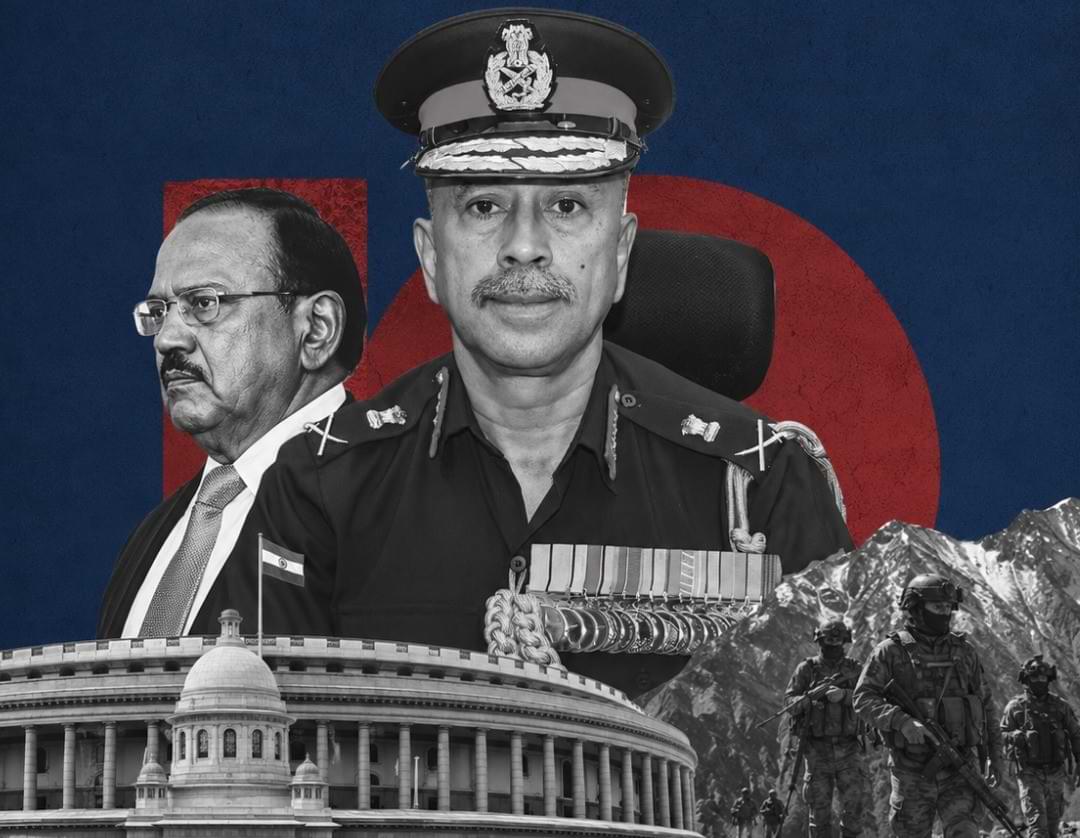
On May 30, 2026, General Anil Chauhan completes his tenure as India’s Chief of Defence Staff. His successor has been named: Lieutenant General NS Raja Subramani, retired, currently serving as Military Adviser at the National Security Council Secretariat under National Security Adviser Ajit Doval. He will become India’s third CDS and Secretary of the Department of Military Affairs.
The announcement from the Ministry of Defence describes Subramani as a Garhwal Rifles officer with over four decades of service, decorated with the PVSM, AVSM, SM, and VSM. He has commanded formations on the Western and Northern fronts, served as Vice Chief of Army Staff, as GOC-in-C Central Command, and since September 2025 as Military Adviser at the NSCS. By any objective measure, this is a distinguished career.
It is also, by now, a recognizable political architecture. And that architecture deserves examination regardless of the individual’s credentials.
The NSCS Pipeline: How Doval’s Office Became India’s CDS Waiting Room
The most significant fact about Subramani’s appointment is not his service record. It is where he was parked before the appointment came through.
General Anil Chauhan, India’s second CDS, was serving as Military Adviser at the National Security Council Secretariat under Ajit Doval when he was retired from retirement and elevated to the most powerful uniformed position in the country. Lieutenant General NS Raja Subramani, India’s third CDS, was serving as Military Adviser at the National Security Council Secretariat under Ajit Doval when he was promoted and elevated to the same position.
Two successive CDSS. The same office. The same man above them. The same trajectory from Doval’s advisory desk to the tri-services apex. This is not a coincidence that requires elaborate explanation. It is a pipeline, and it runs directly from South Block’s most powerful civilian through the NSCS to the CDS chair.
Subramani served as Vice Chief of Army Staff from July 2024 to July 2025, approximately twelve months, before being moved laterally to the NSCS as Military Adviser in September 2025. In the arithmetic of military careers, that lateral transfer was not a promotion. It was a holding position. Nine months later, the same officer bypasses every serving four-star chief, the Army Chief, the Navy Chief, the Air Force Chief, and assumes the most powerful uniformed position in India. This is not a career arc. It is a retrieval operation.
The 2016 Template: When Seniority Became Optional
To understand how India arrived at this point, you have to go back to December 2016. The Modi government appointed General Bipin Rawat as the 27th Chief of Army Staff, superseding two more senior Lieutenant Generals: Praveen Bakshi, then GOC-in-C Eastern Command, and PM Hariz, then GOC-in-C Southern Command. Superseding two senior generals in a single appointment was unprecedented in post-independence Indian military history. The message it sent to every officer in uniform was unambiguous: seniority is a convention, not a guarantee, and the government will supersede it when it chooses to. That template, established in 2016, has governed every major military appointment since. When General Rawat died in a helicopter crash in December 2021, the CDS position sat vacant for nine months while the government searched for the right successor. The vacancy itself was a statement: the position would not be filled by the next most senior officer. It would be filled when the government identified the right person.
The right person turned out to be Anil Chauhan, a retired three-star officer who had never been a four-star chief of any service. To accommodate this choice, the government issued a notification on June 7, 2022, rewriting the eligibility criteria for the CDS position to include retired three-star officers below 62 years of age. The rules were changed to fit the preferred candidate. The preferred candidate was then appointed. His tenure was subsequently extended by executive fiat in September 2025, setting aside whatever fixed-term convention might have constrained a politically inconvenient exit date.
Subramani’s appointment follows the same playbook verbatim. Retired. Three-star. Parked at NSCS. Retrieved. Elevated. The only difference is that this time, the government did not need to rewrite the eligibility rules because the previous rewrite already covered him.
The Army’s Monopoly on India’s Most Tri-Service Position
The CDS post was created in 2019 with a specific mandate: to integrate India’s Army, Navy, and Air Force into a unified joint command structure, to end inter-service rivalry, and to create theatre commands that would allow seamless joint operations. The position was conceived explicitly as a tri-service office representing all three services equally.
All three CDSs have been Army officers. Rawat, Army. Chauhan, Army. Subramani, Army. The Indian Navy and Indian Air Force, whose distinct and increasingly critical strategic roles have been demonstrated in every recent conflict assessment, have been systematically excluded from the most powerful uniformed position in the country. Three appointments. Three Army officers. Six years. Not a single Navy or Air Force officer has been considered, or if considered, selected.
This is not tri-service integration. This is Army dominance of a post theoretically designed to transcend service parochialism. Navy and Air Force veterans have said this in private and occasionally in public. The concern is not merely institutional pride. It is strategic. An Army officer with an Army officer’s institutional instincts, training, and conceptual framework brings a specific lens to questions that require a genuinely joint perspective. When all three CDSS share that lens, the integration position was designed to achieve is structurally compromised before the first theatre command meeting.
The Pahadi Lobby: Geography, Proximity, and Power
Ajit Doval is from Pauri Garhwal in Uttarakhand. General Bipin Rawat was from Pauri Garhwal. General Anil Chauhan is from Pauri Garhwal. Lieutenant General NS Raja Subramani is a Garhwal Rifles officer with deep roots in the same geography. The Garhwal Rifles is a regiment whose recruitment base is Uttarakhand’s hill districts. Three successive CDSS connected to the same regional military tradition, two of them directly to the same district as the NSA, which has been the most powerful civilian in India’s security establishment for a decade, is a pattern that exists in the documented record, not in conspiracy theory.
Whether geographical proximity translates into political loyalty, ideological alignment, or simply a shared institutional culture that the current government finds comfortable is a question the evidence cannot definitively answer. What it can answer is that the pattern exists and that it has been consistent across multiple appointments.
Theatre Commands: Three CDSS, Six Years, Zero Progress
The most damaging indictment of India’s CDS appointments is not about who was chosen. It is about what has been achieved. The central mandate of the CDS position was to create integrated theatre commands, bringing Army, Navy, and Air Force units under unified operational structures for the first time. This reform was announced, debated, scheduled, and repeatedly delayed across three CDS tenures.
Three CDSS. Six years. India still has no operational theatre command.
The office that was supposed to drive India’s most significant military structural reform since independence has been consumed by the politics of its own appointments. Rules rewritten. Tenures extended. Offices used as waiting rooms. The actual work of integration, the difficult, bureaucratically unglamorous, inter-service negotiation required to build theatre commands against institutional resistance from all three services, has not happened.
Operation Sindoor demonstrated what the absence of integrated theatre commands costs in practice. The intelligence failure over the PL-15E missile range, the over-centralisation of command that slowed decision cycles, the reactive information operations that ceded the narrative to Pakistan in the first hours: these were not failures of individual officers. They were structural failures of an integration process that three CDSs have discussed and not implemented.
Subramani inherits a position with enormous formal authority and a track record of unmet structural reform under both his predecessors. Whether his NSCS experience, his operational background on the China and Pakistan fronts, and his close proximity to the NSA translate into the political capital needed to force through theatre commands against inter-service resistance is the only question about his appointment that actually matters for India’s security.
Conclusion
India’s third Chief of Defence Staff will be sworn in when General Chauhan’s tenure ends on May 30, 2026. The armed forces press briefing on Operation Sindoor’s first anniversary, held in Jaipur on May 7, featured military officials celebrating precision, professional competence, and institutional integrity. Those are the values the CDS position is supposed to embody and protect.
The process that produced this appointment embodies something different. It embodies executive discretion over institutional process, political proximity over transparent seniority, a pipeline from one civilian’s office to the country’s top uniformed position, and an Army monopoly on a post designed to represent three services equally.
Lieutenant General Subramani deserves the opportunity to prove that the appointment process does not define his tenure. India deserves an honest reckoning with the fact that the process itself has now become a documented pattern, one that has been applied consistently, deliberately, and with increasing institutional confidence since December 2016.
The saffronization of India’s military is not a slur anymore. It is a sequence of appointments. And sequences, unlike individual decisions, have directions.






Leave a comment