




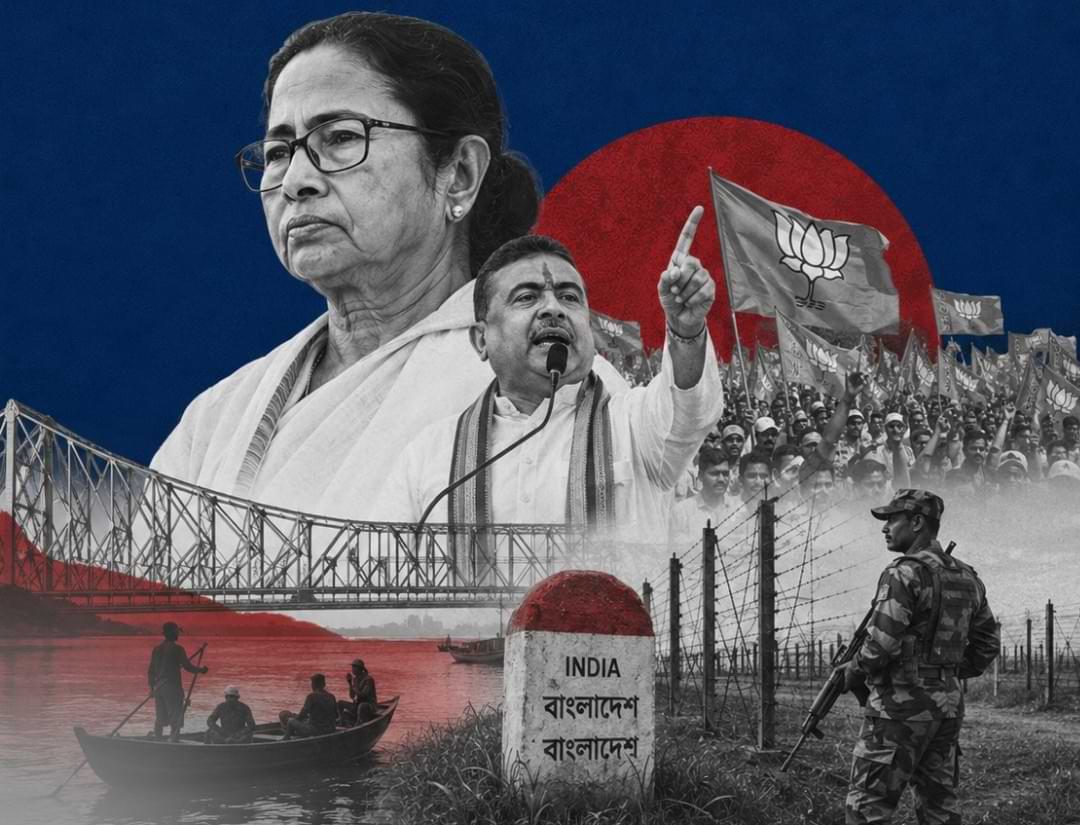
206-seat Bengal landslide has completed India’s saffron encirclement of Bangladesh. The incoming Chief Minister called for teaching Bangladesh a lesson “like Israel taught Gaza.” Dhaka’s foreign policy has no answer for what comes next.
On May 4, 2026, the story West Bengal had told itself for seventy-five years died in a vote count. The land of Tagore, Vivekananda, Amartya Sen, and coffee-house Marxism gave over 200 seats to the Bharatiya Janata Party. TMC collapsed to roughly 80. Mamata Banerjee lost her own Bhabanipur constituency to Suvendu Adhikari by at least 15,000 votes. The bhadralok secular self-image of Bengal, carefully constructed over a century and maintained for fifteen years of Mamata’s rule, has been replaced by the saffron flag.
For India’s domestic politics, this is historic. For Bangladesh, it is an emergency that Dhaka’s foreign policy establishment has not yet begun to process with the seriousness it deserves.
The Saffron Encirclement of Bangladesh Is Now Complete
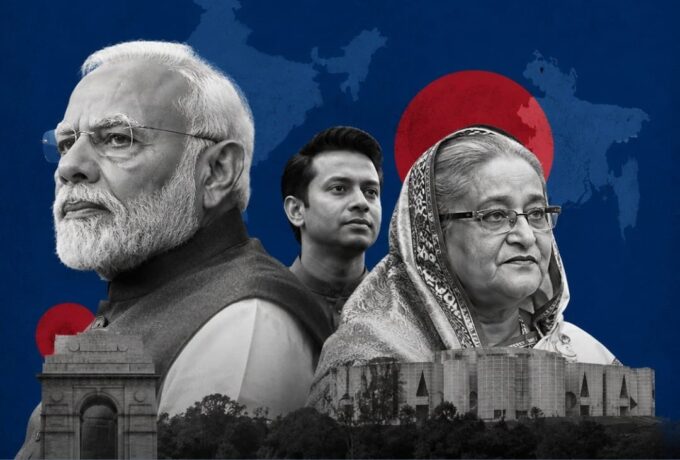
Look at a map. Bangladesh shares a 4,096-kilometre border with India. That border is now, in its entirety, governed by the BJP or BJP-aligned administrations. Tripura: BJP. Assam: Himanta Biswa Sarma, who campaigned in West Bengal for Adhikari and publicly spoke of pushing individuals across the border into Bangladesh, a remark that prompted Dhaka to summon India’s acting High Commissioner on April 30. Four days after that summons, Bengal voted on precisely that rhetoric and delivered the BJP its greatest state-level victory. The summons appears to have goaded the politics it sought to restrain.
West Bengal was the last state on Bangladesh’s border where a non-BJP government maintained some institutional empathy for the complexities of cross-border life, the traders, patients, students, and cultural connections that have made the Dhaka-Kolkata corridor economically significant for both sides. That buffer is gone. The question Dhaka must now answer is not whether the encirclement has happened. It has. The question is what Bangladesh does next in a strategic environment that has fundamentally changed.
How the Citadel Fell: Three Factors Bangladesh Must Understand
The Bengal result was not an accident of democratic sentiment. It was produced by a specific combination of institutional decisions, resource deployment, and political strategy that Dhaka must understand clearly, because the same machinery will now govern its most important bilateral relationship.
First, the Special Intensive Revision deleted approximately 90 lakh voters, roughly 12 percent of the total Bengal electorate, with a disproportionate impact on Muslim communities. As Bangladeshi analyst Shahab Enam Khan wrote, TMC’s most reliable electoral base “was emptied before the first ballot was cast.” Adhikari publicly assured that the SIR targeted only “Bangladeshi infiltrators,” a category whose definition, as Khan observed, “appears to expand with every rally.” The political logic of this framing connects directly to Bangladesh: the “Bangladeshi infiltrator” is not a security assessment. It is an electoral product, manufactured and deployed for domestic political use, with Bangladesh as the named threat.
Second, approximately 2,400 companies of Central Armed Police Forces were deployed across Bengal, what Khan describes as “probably the largest paramilitary footprint in any state election in Indian history.” This deployment, supplemented by the NIA’s debut in a state election, dismantled TMC’s booth-level organizational apparatus. The result was a 93 percent turnout that broke decisively for BJP. The forces that protected this result will withdraw. The political reality they produced will remain.
Third, years of anti-incumbency produced by genuine TMC governance failures, the SSC teachers’ recruitment scandal, stalled industrialization, and a welfare-dependent economy that generated “Lakshmir Bhandar” coupons but few private sector jobs, left Mamata’s record politically indefensible. Into that vacuum, BJP stepped with its national security narrative, and the post-Hasina collapse of Bangladesh-India relations provided the final element: a specific, named external threat that could explain Bengal’s economic difficulties and justify the border posture.
Suvendu Adhikari Will Be Chief Minister. He Said Bangladesh Deserves to Be “Taught a Lesson Like Israel Taught Gaza.”
This sentence needs to sit in the open without diplomatic softening. Suvendu Adhikari, the man who beat Mamata in her own constituency and is now the most likely next Chief Minister of West Bengal, told reporters in December 2025 that Bangladesh should be “taught a lesson like Israel taught Gaza.”
Gaza, at the time of that statement, had over 72,000 Palestinians dead, 90 percent of its infrastructure destroyed, and was under active international genocide investigation at the International Court of Justice. This is the framework the incoming Chief Minister of Bangladesh’s largest border-sharing Indian state chose to invoke when discussing bilateral relations with Dhaka.
This is the man with whom Bangladesh must discuss Teesta water-sharing. Border haats. Trade corridors. The status of individuals who may find themselves stateless following the census and NRC processes. Dhaka’s foreign policy framework has no established protocol for engaging a state government that has framed the bilateral relationship in these terms. It needs one urgently.
The Economic Damage Already Underway
The political shift in Bengal is not a future threat. Its economic consequences are already active and measurable.
Visa suspensions have disrupted the steady flow of Bangladeshi traders, patients seeking medical care in Kolkata, and students who quietly sustained significant economic activity on both sides of the border. Closures at the Petrapole-Benapole crossing, which handles approximately 70 percent of bilateral land-based trade, have directly hit Bangladeshi export flows. Port restrictions are affecting an estimated $770 million in Bangladeshi exports, approximately 42 percent of what Bangladesh sends to India annually.
The 4,096-kilometre border has been progressively securitized. A leaked internal BSF communiqué, reported by The Hindu, explored the “operational feasibility of deploying reptiles or crocodiles” in riverine gaps along the border. The document’s existence suggests that the securitization framework is not limited to standard fencing and surveillance. It is being approached with a comprehensiveness that treats the entire frontier as a security problem rather than a shared economic and cultural asset.
On April 8, while Bangladesh’s Foreign Minister was in Delhi on what he described as a “goodwill mission to take ties in a new direction,” BSF personnel shot and killed Ali Hossain at Patgram. Goodwill, as Shahab Enam Khan observed, appears to have a body count.
The Teesta Question Under BJP Bengal: More Complicated Than Before
The Teesta River water-sharing agreement has been one of the most persistent and damaging unresolved bilateral issues between India and Bangladesh. The deal was essentially agreed at the central government level in 2011 but was blocked by Mamata Banerjee, who refused to share Bengal’s allocated water with downstream Bangladesh. For years, Dhaka’s diplomatic strategy included engaging West Bengal specifically to soften Mamata’s position, hoping that her professed Bengali cultural solidarity would eventually translate into concessions on the river.
That strategy is now void. The incoming BJP government in Bengal has no historical commitment to Bengali cultural solidarity with Bangladesh as a diplomatic principle. It has, however, demonstrated a consistent willingness to use water, border management, and trade flows as instruments of political leverage in its relationship with Dhaka. A BJP Bengal government will discuss Teesta, as Shahab Enam Khan wrote, “as electorally convenient as the Ganges,” meaning when it serves the BJP’s domestic political interests and not otherwise.
What Bangladesh’s Government Must Do Now
Bangladesh’s foreign policy toward West Bengal was built on para-diplomacy, cultural connection, and the assumption that Mamata’s government was a moderating force between Dhaka and Delhi’s hardline positions. That assumption has collapsed along with TMC’s seat count.
Dhaka needs a dual-track recalibration. At the central government level, Bangladesh must build more robust bilateral frameworks with New Delhi that do not depend on the political sympathies of any particular state government. Agreements on water, border management, trade, and transit must be formalized at the central level with implementation protocols that cannot be unilaterally disrupted by state-level political changes.
At the subnational level, Dhaka must begin the difficult process of engaging with whoever leads West Bengal’s BJP government, regardless of the political and rhetorical environment those leaders have created. Ignoring Adhikari’s government will not make it more accommodating. Engagement from a position of articulated national interest, with clear red lines and consistent diplomatic messaging, is more likely to produce workable relationships than symbolic protests that get answered four days later with landslide victories.
Bangladesh’s parliament, as Khan argues, must build a national foreign policy consensus that “survives election cycles.” The post-July 2024 political transition in Bangladesh has produced a government that is still defining its India posture. That definition is now urgently overdue. The encirclement is complete. The man who spoke of Bangladesh being taught “a lesson like Israel taught Gaza” is preparing to be sworn in as Chief Minister.
Conclusion
West Bengal’s political revolution of May 4, 2026, is simultaneously a domestic Indian story and a regional strategic event of the first order. For Bangladesh, it completes a saffron encirclement on every border, installs a government that has used Bangladesh as an electoral threat, disrupts the para-diplomatic relationships that cushioned bilateral friction for fifteen years, and raises urgent questions about water, trade, border security, and the status of millions of people whose citizenship and movement have been politically weaponized.
The Kolkata bhadralok has found its inner Sanatani, as Khan puts it. Bangladesh must now decide what it will do with a neighbor that has decided, at least for this electoral cycle, that the story of Bengali brotherhood was never really its own.
The Teesta will flow. The question is whether it flows toward agreement or toward the next crisis. That answer depends on decisions Dhaka makes in the next few months, before the BJP government in Bengal is fully consolidated and before the next manufactured crisis over “Bangladeshi infiltrators” arrives on schedule, as it will, in time for the next Indian election.







Leave a comment