




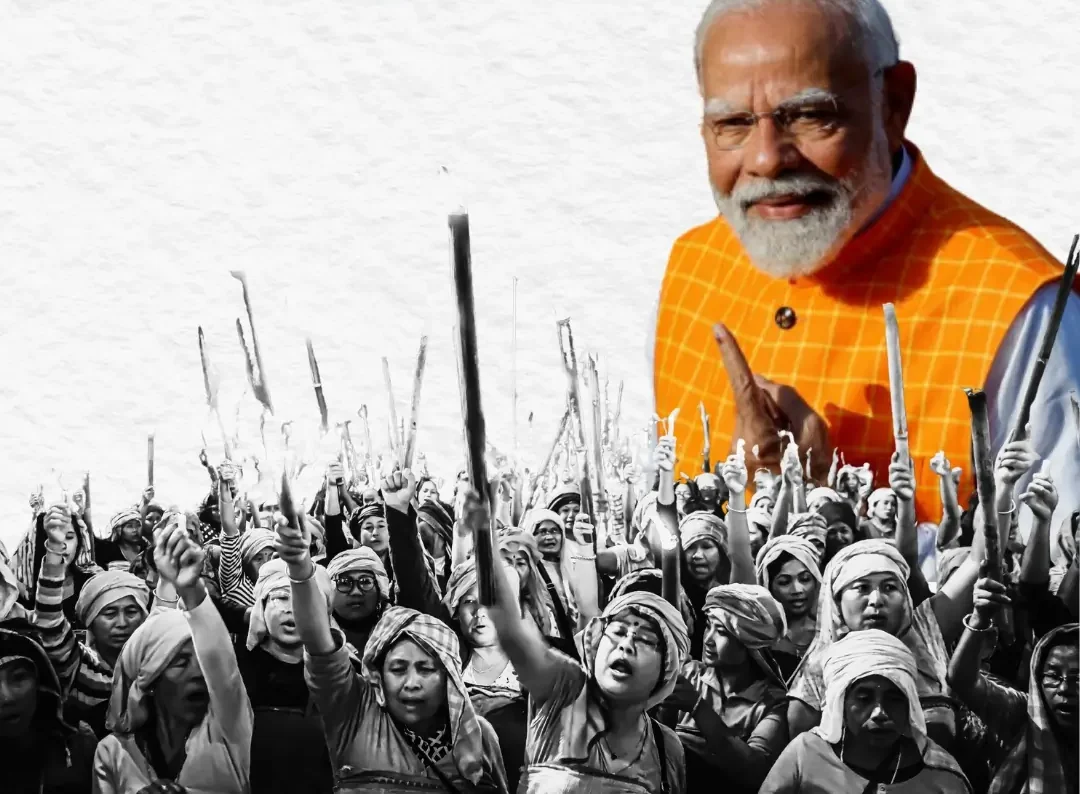
Tribal women lying on funeral pyres in Bundelkhand. Children were killed in Manipur. Forty thousand workers on the streets of Noida. And the Prime Minister is busy with optics.
This is the week India is having. Not the India that appears in government press releases or prime-time panel discussions, but the actual country, with its actual people, in actual crisis. In Bundelkhand, tribal women are lying on funeral pyres in the middle of a river, holding their infants, in scorching April heat, demanding justice or death. In Manipur, two children, a four-year-old boy and his six-month-old sister, were killed in their sleep by a rocket attack, and when protesters stormed a security camp in grief and rage, police opened fire and killed two more civilians. In Noida, forty to forty-five thousand factory workers across eighty locations took to the streets demanding wages that keep pace with the cost of living, and the protests turned violent enough that police vans were set on fire and tear gas was deployed on workers who earn less in a month than a Delhi bureaucrat spends on a dinner. And the Prime Minister of India spent the week at rallies and managing his public image ahead of the five state elections.
This is not a coincidence. This is a governance model.
The Chita Movement Nobody Is Talking About
The Ken-Betwa River Link Project in Panna and Chhatarpur districts of Madhya Pradesh is one of the country’s largest infrastructure undertakings, connecting the Ken River with the Betwa River to address Bundelkhand’s chronic drought. The project requires a dam inside Panna National Park. That dam requires land. That land belongs to tribal farmers who have lived on it for generations.
The government promised compensation. The compensation was not delivered. When the farmers protested, the administration’s response was not negotiation. It was a siege. Police imposed Section 163 around the protest site. Rations were stopped. The water supply was cut. The calculation was simple and brutal: starve them out, and they will leave.
The tribal women did not leave. They escalated. They lay down on funeral pyres, chitas, in the middle of the river, carrying their children, declaring they would accept death before they accepted dispossession without justice. Social activist Aamir Bhatnagar, leading the movement, told reporters that this fight has moved beyond compensation. It is now about survival itself, about water, forests, and land that belong to communities whose relationship with that geography predates the Indian state.
This protest is not receiving national television coverage. India’s prime-time is occupied with a song, Bengal political maneuvering, and election campaign coverage. The tribal women of Bundelkhand are lying on pyres, and the nation’s media apparatus has collectively decided that this is not the story worth telling.
Manipur: Two Years of Ethnic War, Four Dead in One Week
On April 7, 2026, a suspected rocket or projectile struck a house in Tronglaobi village in Bishnupur district. The victims were a four to five-year-old boy and his approximately six-month-old infant sister, killed while sleeping. Their mother was critically injured. The attack on sleeping children produced exactly the kind of outrage that no government statement or security force deployment can contain.
Protesters stormed a security forces camp. Police opened fire. Two more civilians died. Four people killed in a single day, two of them children, in a state that has been under ethnic conflict between Meitei and Kuki-Zo communities since 2023, a conflict that has claimed hundreds of lives, displaced tens of thousands, and received from the central government precisely the quality of sustained attention that its distance from Delhi’s political calculations suggests it deserves, which is very little.
This week, internet and mobile data remain suspended in five valley districts. Curfew violations have led to 166 detentions. Markets in Bishnupur remain shut a week after the attack. Schools in parts of the state have been told to stay closed. Meira Paibi women’s torch rallies are moving through the streets of Imphal Valley, demanding justice and accountability. The NIA is investigating.
What is not happening is any visible, urgent, personal engagement from the Prime Minister with a state that has been in active ethnic conflict for over two years. President’s Rule was lifted in February 2026. A new state government has been formed. The violence has continued.
Noida: When Workers Ask for Wages, They Get Tear Gas
Forty thousand to forty-five thousand factory workers, primarily from textile, hosiery, and electronics manufacturing units, walked off their jobs and onto the streets of Noida and Greater Noida this week. Their demands are not radical. They want wages that reflect the actual cost of living. They want weekly offs. They want overtime pay. They want labour laws that exist on paper to be implemented in practice. They looked at wage revisions in neighbouring Haryana and asked why workers in Uttar Pradesh should earn less for the same work.
On April 13, the protests turned violent in Phase 2, Sector 60, Sector 62, Sector 84, and other industrial corridors. Vehicles were set on fire. Police used tear gas. Traffic across major Delhi-Noida routes, the DND, NH-9, the Delhi-Meerut Expressway, was paralyzed for hours. On April 14, fresh violence broke out in Sector 121 and Sector 70. Stone-pelting injured police personnel including women officers.
The UP government’s response followed a predictable sequence. First, over 350 arrests. Then, an investigation into “outsiders” and “coordinated conspiracy.” Chief Minister Yogi Adityanath suggested the protests might be an attempt to revive Naxalism. Some officials raised the possibility of a “Pakistan angle.” Then, once the political cost of sustained violence became clear, the government announced a 21 percent interim minimum wage increase effective retrospectively from April 1 and formed a high-powered committee to address worker grievances.
The wage hike that forty thousand workers had to take to the streets to extract, which required burned vehicles, tear gas, and 350 arrests to produce, could have been implemented through a routine labour policy review. It was not. It required a crisis. That is not incidental to how this government manages working-class demands. It is the method.
Where Is the Prime Minister?
This is the week India has been having. Four crises, each serious, each involving real people in genuine distress, each demanding sustained executive attention.
The Prime Minister has been at election rallies, preparing for five state elections, managing the optics of Operation Sindoor’s diplomatic fallout with foreign visits, and continuing the relentless public relations exercise that has become the primary output of this administration’s energy.
There is a pattern here that goes beyond this week. When tribal farmers are put under siege in Bundelkhand, the story does not reach prime time. When children are killed in Manipur, the Prime Minister does not cancel a rally. When forty thousand workers demand living wages, the initial response is to investigate Pakistan’s involvement. And through all of it, the speech-making continues, the chest-thumping about Viksit Bharat continues, and the gap between the India being described from podiums and the India actually existing in Bundelkhand’s rivers and Manipur’s curfew zones and Noida’s burning streets continues to widen.
Governance is not the management of appearances. It is the management of reality. This week, India’s reality required urgent attention in at least four different places
simultaneously.
The Prime Minister was at a rally.







Leave a comment