









Despite repeated claims by the Rastriya Swayamsevak Sangh (RSS) that it functions solely within India, evidence shows that the organization maintains a significant global presence through its so-called Vishwa Vibhag, or “world department.” Investigations reveal that the RSS and its affiliated organizations operate in over 200 countries, quietly coordinating cultural, religious, and political activities among the global Indian diaspora.
Global Gatherings and the Vishwa Sangh Shibir
In December 2025, Hyderabad hosted the Vishwa Sangh Shibir (VSS) 2025, a five-day event attended by over 1,600 participants from 79 nations. Although the organizers characterised it as a cultural and spiritual event advocating Sanatan Dharma (Hinduism), the assembly convened representatives from multiple RSS-affiliated organizations, including the Hindu Swayamsevak Sangh (HSS), Sanatan Dharma Swayamsevak Sangh (SDSS), Sewa International, Samskrita Bharati, and the Vishwa Hindu Parishad (VHP).
The VSS events occur every five years and function as a platform to synchronize global initiatives of the Sangh Parivar, the collective assembly of RSS-affiliated organizations. Throughout the years, these events have encompassed training camps for international swayamsevaks, leadership workshops, and sessions on global coordination strategies.
Disputes Regarding US Lobbying
RSS leaders assert that the organization does not function internationally; however, documents indicate otherwise. In 2025, the US lobbying firm Squire Patton Boggs (SPB) revealed that it received payments from State Street Strategies to “introduce the RSS to US officials,” underscoring a direct effort to sway international policy. Despite RSS spokesman Sunil Ambekar’s denial of these operations, the filings and ensuing lobbying modifications suggest the network’s strategic endeavors to establish a global presence.
Comprehending the Vishwa Vibhag
The Vishwa Vibhag functions as the RSS’s international coordination arm. The structure comprises a samyojak (coordinator), sah-samyojaks (co-coordinators), and a cadre of pracharaks (full-time officers) who manage operations globally. Saumitra Gokhale functions as the samyojak for the United States, Ram Vaidya supervises Europe, and Anil Vartak manages Asia.
The Vishwa Vibhag partners with Indian organizations including Shri Vishwa Niketan (SVN), Vishwa Adhyayan Kendra (VAK), and Antar Rashtriya Sahayog Parishad (ARSP). These institutions orchestrate international programs, training camps, and publications, including the RSS-affiliated Samvad, which disseminates in more than 100 countries.
The Hindu Diaspora and Cultural Collaboration
The RSS network abroad seeks to connect with the Indian diaspora, advocate Hindu cultural principles, and enhance community solidarity. Historically, the RSS has augmented its influence among second-generation Indians who frequently lack institutional affiliations with Hindu religious organizations.
The RSS network consolidates various entities under umbrella organizations, including affiliate organizations like the Hindu American Foundation (HAF) and the Hindu Council of Australia. These entities frequently symbolize Hindus in local governance, education, and cultural affairs, while conveying an illusion of extensive community representation.
In 2016, the HAF advocated to educational policymakers in California concerning the representation of Hinduism in school textbooks, specifically regarding caste-related matters. These activities underscore the dual function of the RSS network: cultural preservation and political advocacy.
The Global Network Mapping
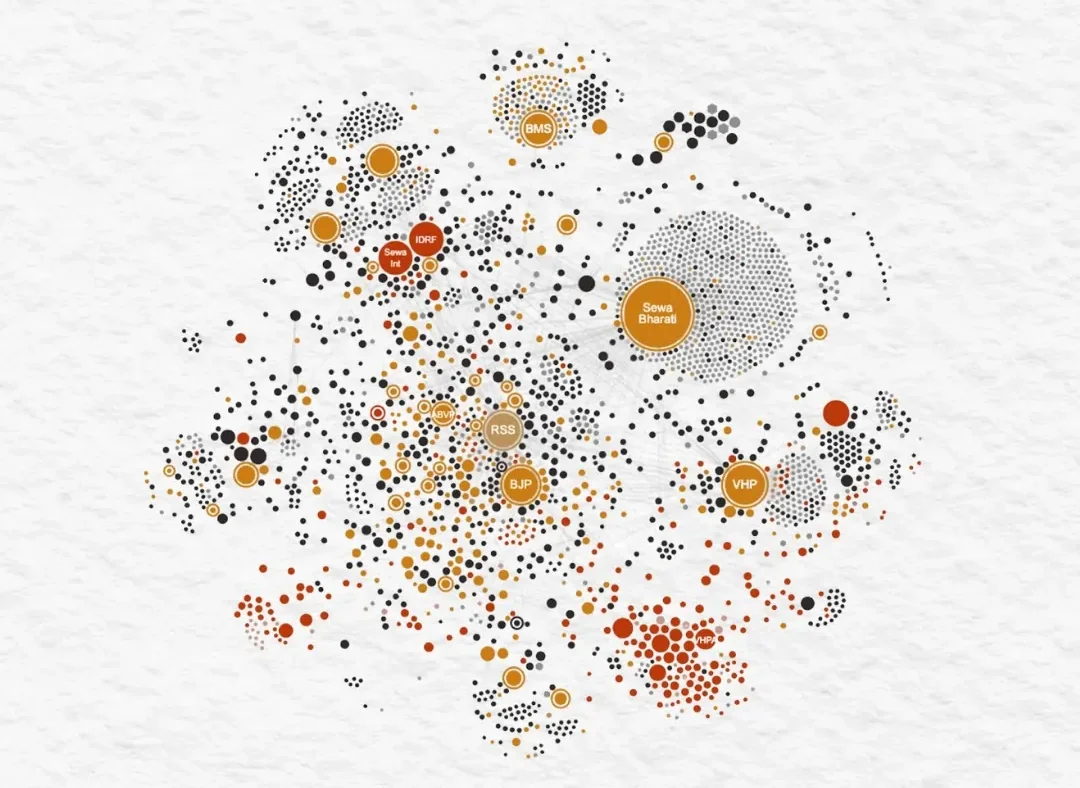
Scholarly investigations validate the magnitude and extent of the RSS network. The “Seeing the Sangh” initiative, directed by Christophe Jaffrelot from Sciences Po, Paris, and Felix Pal from the University of Western Australia, catalogued more than 2,500 entities associated with the RSS. Among these, 2,240 are located in India, 107 in the United States, 34 in Australia, and 26 in the United Kingdom.
The research indicates that these organizations collaboratively manage leadership, communications, finances, and event coordination. Pal characterizes the Sangh Parivar as “the largest far-right network in history,” emphasizing its operation as a cohesive entity rather than a loose coalition of groups. The dataset demonstrates the network’s adaptation to diaspora contexts, establishing local counterparts of the VHP or HSS to impact social and political environments.
Collaboration and Governance
Numerous RSS leaders occupy dual positions in international organizations. Saumitra Gokhale has been designated as both Vishwa Vibhag Samyojak and HSS Global Coordinator. Additional prominent individuals comprise Shankar Tatwavadi, who augmented HSS operations in the United States and Africa, and Ravi Kumar Iyer, who subsequently managed RSS communications and think-tank networks in India.
Vishwa Vibhag operations often require trips abroad to oversee programs, facilitate training sessions, and offer guidance. The RSS network abroad also forms informal networks that exchange best practices, resources, and volunteers without establishing formal legal or contractual relationships.
Worldwide Scrutiny
The global community has commenced examining these activities. In 2026, the United States Commission on International Religious Freedom (USCIRF) proposed sanctions against the RSS, citing infringements on religious liberty. Likewise, the UK, Mauritius, Australia, and various other nations have identified Hindutva organizations as potential risks to social cohesion and internal security.
Reports from Mauritius and Australia indicate that social media campaigns and lobbying initiatives by RSS-affiliated organizations have aimed to sway elections and mold public opinion in diaspora nations. This has initiated enquiries into the operations of organizations like the Hindu Council of Australia.








Leave a comment