


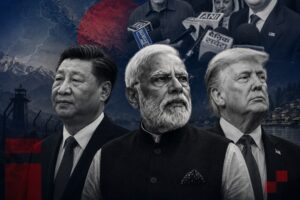
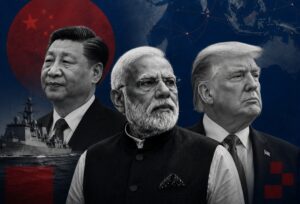
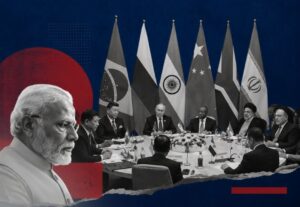

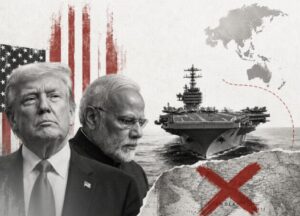

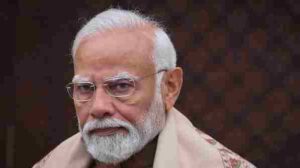
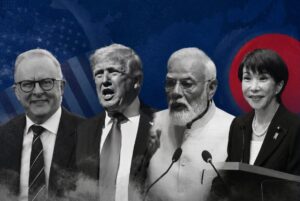
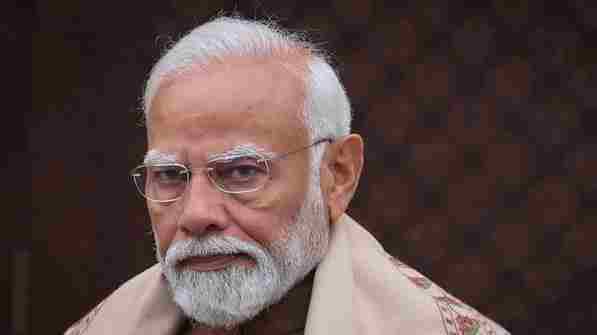
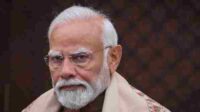
Norwegian journalist Helle Lyng simply asked a question of Narendra Modi in Oslo this past May – why not take questions from “the freest press in the world” – and was not looking for any headlines. She was at work. That the moment went viral, sparking a round of synchronized online abuse against her is more a testament to how much Modi has built over the last 12 years or so in his own backyard, than it is to Lyng. It’s not just that a prime minister hasn’t held a single unscripted, open press conference in 12 years, it’s that’s not normal. He’s the creator of a system, and that system should be examined, not only as a political narrative, but as a textbook on how power with regards to communication is concentrated, and how opposition is marginalized in the modern information age.
There are two theories and one strategy.
The influence of those in power upon the view, hearing and belief of the general public has been the subject of study in mass communication for many years. There are two frameworks that are particularly helpful to getting the Modi playbook. The first is gatekeeping theory, which is the idea that information is screened before it reaches the public, who, what and how. Modi’s strategy is the strictest form of gatekeeping: where to he goes, his presence is emphasized; what he says is what he is supposed to say; what he does is what he is supposed to do. Gatekeeping has been taken to the extreme in the report from the Indian government of its own demand to prevent journalists from asking questions during Modi’s G7 meeting with Donald Trump. It is not confrontation. It’s not persuasion. It’s architecture: it’s about constructing the room in a way that makes it impossible to ask certain questions in there.
The second, more disturbing, structure is Elisabeth Noelle-Neumann’s spiral of silence theory. Her basic understanding was that people are social beings who don’t like being alone and that gives them a voice that they will use and say publicly when they think their opinion is popular or a safe bet. People who think that they represent the minority voice self-censor and, when multiplied by everyone, the majority voice sounds even more ‘mainstream’ than it really is. A spiral has the ability to feed itself. This is the silence which Modi created in the secular India, where religious intolerance coupled with state authoritarianism has completed diminished the idea of a free press.
This is exactly what happened with journalists such as Lyng and Wall Street Journal’s Sabrina Siddiqui in 2023 when she posed a question on minority rights to Modi during his visit to the White House with Joe Biden. The message being conveyed by these pile-ons is not subtle: don’t ask an uncomfortable question or you’re the story – not because it was officially censored, but because it’s a mobbed version of “public criticism is too expensive. In the face of each journalist who waits to see Siddiqui or Lyng get bogged down in abuse, the question of whether a hard question is “worth it” gets even quieter.
Why Authoritarians don’t like to be on the microphone.
The reluctance of Modi to be questioned openly is no abnormality. A pattern that is common to leaders everywhere who rule without the normal democratic accountability. But unscripted press conferences are risky to this sort of leadership because they are unscripted: If a question is asked live and adversarial, it can’t be pre-approved, cut or reframed after the fact. It demands an instant reply, on the other person’s terms and if a leader stumbles or reacts in a different manner, that’s the moment that makes news.
The danger is too great for a leader who relies on strength, certainty and popular adoration. A press conference implies a form of accountability, that the leader is accountable to the public via an intermediary who is not under his control. The evasion of it leaves the fiction of a leader who needs no defense: never allowing challenge to reach him. At the same time it is depriving critics and opposition voices of one place where they can raise their concerns directly to power, face-to-face, without editing it.
That’s why it is always the same format: friendly interviews, monologue-style presentations and social media posts with a one-way flow of information. If you can’t control the medium, then you can’t control the story.
Why it works better at home than abroad
Explain the reason for this. Explain why this is better at home than abroad. Norway is revealing because it didn’t go as planned. The media strategy is designed for an India where over 10 years, the media has been remolded into a mirror of the government, and as reporting has revealed, the government has made it clear how to “control narrative,” and “track negative journalists.” This institutional gatekeeping, combined with the chill effect of the spiral of silence has been pretty effective within the Indian boundaries. But gatekeeping has an external dimension and a spiral of silence has an internal one: Where does the reputational risk actually hit? Neither travels well. The Norwegian reporter, who is working in India’s press culture where asking questions that help bring about a discussion is the norm, is not caught up in India’s spiral but is standing outside it, undeterred by the incentives that keep Indian journalists silent.
The real story isn’t Modi. It’s the normalization.
That is why the question was picked up as global news, it highlighted by contrast how bizarre the silence at home has become. It’s not Modi per se. It’s the normalization. The most telling line in this entire story is the one that Modi didn’t say: Nothing. It is the fact that in most democracies, asking a leader why he wouldn’t answer questions would “make little news. This question itself was the story in India. It’s not just Modi who doesn’t like difficult questions as most politicians do, but over the last decade, a whole stock of media has been indoctrinated with a decade of social risk engineering to believe that it shouldn’t ask them in the first place. Once the baseline moves far enough, it is defiant to return to normalcy, to simply report the facts. Theories on mass communication have been developed to account for the nature of public perception in the face of power without formal proclamation of decree. There was no ban on the media asking questions of Modi in India. They had to somehow make the asking price high, frequent enough, that fewer and fewer accepted to ask. It is not a lack of censorship. It’s the most lasting form of censorship.




Leave a comment