




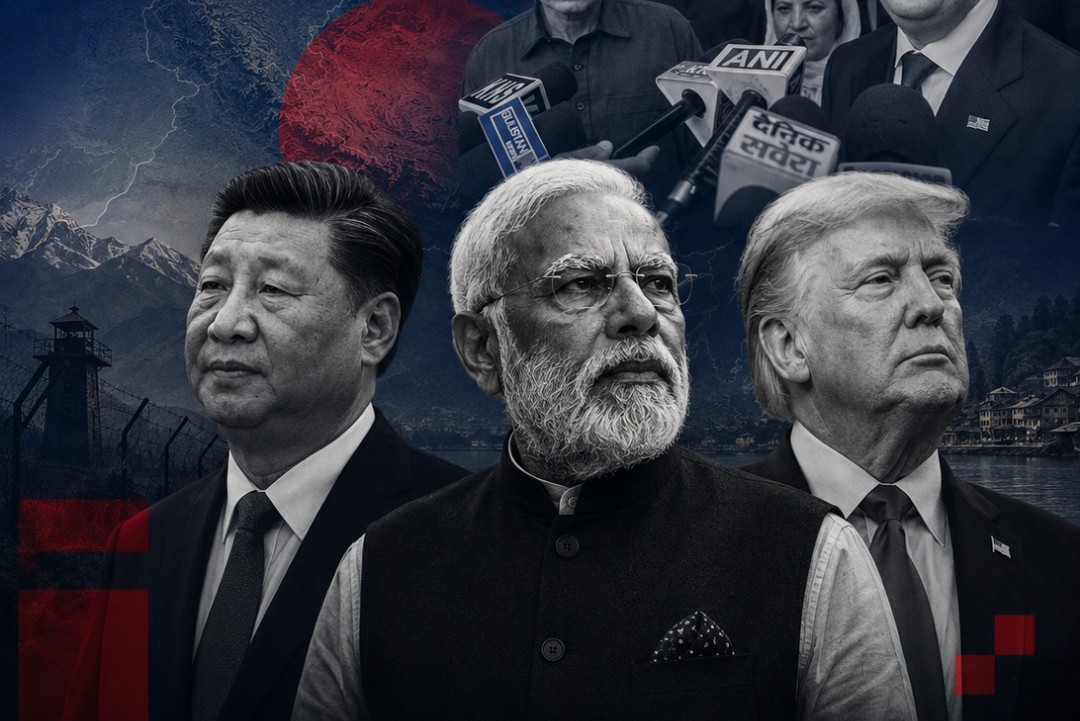
When The U.S. Ambassador to Kashmir, Sergio Gor, on August 19 declared Kashmir as safer place than before 2019 and this was welcomed with a smile in New Delhi. Now here was an American validation of what the government had long claimed – that the withdrawal of Article 370 had brought peace and normalcy to a region that had not seen any peace or normalcy for decades. Foreign envoys’ statements are not just statements. They are diplomatic tools, which are tuned to the interests that do not necessarily relate to the place to be described. These are the words of Gor, which should be taken that way, and, when read that way, the “normalcy” story he’s supporting seems far less credible.
One thing is clear and that is the assessment of the US Ambassador is neither an objective understanding of Kashmir and nor is that assessment is a picture of the actual US policy concerning India or the overall region.
A Convenient Endorsement
One might ask, why an American ambassador would bother to state anything so specific about the situation of Kashmir’s internal security? It is not about Kashmir, but about a change of calculating of Washington. The United States has a national debt just over $40 trillion; the half-century-old petrodollar system, which has underwritten America’s economic dominance, is new pressures from the prolonged instability in West Asia. In this context, India has become one of the growing markets for the American exports of goods, services and capital. At the heart of that is the bilateral target of $500 billion of trade by 2030 that was agreed upon by Prime Minister Modi and President Trump known as the Mission 500. A kind note to Kashmir is free of cost to Washington and is worth its while in a relationship that it desperately needs to strengthen.
This is what Pravin Sawhney, the former Indian Army officer and editor of FORCE magazine has said emphatically in his FORCE commentary on the visit. Sawhney sets his argument in the broader context of America’s decline and retreat, saying that a diplomat is motivated to flatter a partner whose access to market is more important to Washington than that of Srinagar’s ground realities. So, while one can draw whatever conclusions one wishes about his broader geopolitical context, it cannot be overlooked that an ambassador’s endorsement is not proof, but diplomacy.
The Normalcy
The Gor statement is deeper than that, in that it assumes that no visible large scale unrest is proof of ‘normalcy’ when ‘normalcy’ is a much more stringent criterion. Kashmir today is still a Union Territory, and not a state, although the constitutional amendments of 2019 were to have been a mere step towards the statehood the Valley had hoped for. Chief Minister Omar Abdullah’s government is constitutionally elected but according to him, the real power on security issues and appointments to government posts still lies with the office of the Lieutenant Governor. It’s not a footnote. It is a central reality in the governance of the Kashmir today and it does not fit with the restoration of the democratic norm.
True normalcy would be something different. It would mean that the troops that are still stationed around the Valley – in far larger numbers than a peaceful area would need – would be visibly withdrawn. It would entail removing the prohibition which continues to hamper independent media in J&K. It would mean the restoration of statehood, which New Delhi has repeatedly promised and yet not done. No one has achieved any of these marks. Instead, there is the “silence of the graveyard”—a surface calm that mimics not only the end of the dissent, but its suppression as well—what Sawhney calls a “silence of the graveyard”.
The Region Around Kashmir is also changing
Gor’s visit also should be viewed in a broader regional context, where the influence of the United States is diminishing in the region of South Asia and Central Asia. Earlier this year, it was reported that Gor had been met with a relatively “cool reception” at his visits to the Maldives and Nepal, which have traditionally been considered within the “comfortable range” of India and the West. Meanwhile, China’s Belt and Road initiative has attracted almost all the countries in the region, including almost all of India’s neighbors other than India and Bhutan, putting Beijing’s economic and infrastructural clout into most of the land once considered part of Washington’s sphere of influence – and New Delhi’s. Meanwhile, a tentative security arrangement between Pakistan, Turkey, Saudi Arabia, and possibly Bangladesh is starting to realign the region in Islam in ways that may further distance India.
In this context, Gor’s remarks in Srinagar seem to be not an independent evaluation of the security situation in Kashmir but a token gesture of gratitude to India’s trade openness, at a time when Washington is sorely in need of India’s economic cooperation and has comparatively little diplomatic leverage in the rest of the region.
The Missing Piece
But the situation is far from being peaceful, and an American diplomat’s poised endorsement doesn’t replace the more difficult and challenging political game that real peace demands. That involves direct contact with Pakistan, something that New Delhi has long resisted, but that remains a challenge if Kashmir’s underlying issue is to be taken from the realm of managed quiet to a real resolution.
As aforementioned, security challenge is a crucial aspect of international politics and it is applicable in the context of Kashmir as well. US is asking India to take a break from India relations, as the overall logic of FOIP (free and open indo pacific) policy.
Until that battle is fought and the markers of real normalcy established, statements like Gor’s will continue to be the diplomatic ploy and not an honest assessment. New Delhi might well be wise in recognizing the distinction, even if it is to their benefit for now.





Leave a comment