




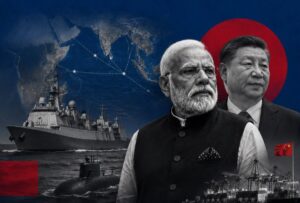





China has built villages on Indian-claimed territory, stationed J-20 stealth jets at high- altitude bases, and deepened its military alliance with Pakistan. India is racing to catch up. This is what that race looks like from the ground.
In June 2020, twenty Indian soldiers died in hand-to-hand combat in the Galwan Valley. No firearms were used. Iron rods, rocks, and sub-zero temperatures were the weapons. It was the bloodiest border clash between India and China in fifty-three years, and it happened because China had moved forward, built positions on territory India considered its own, and created facts on the ground before India’s military command fully registered what was happening.
Five years later, the ground has changed, but the fundamental problem has not. China is still where it was in 2020. The buffer zones negotiated at multiple friction points lie largely on territory where Indian patrols previously operated. The trust deficit between the two armies remains structural and deep. And India is now racing, with a speed and resource commitment it never demonstrated before 2020, to build the infrastructure, capability, and deterrence architecture that should have been built in the previous decade.
Ladakh is not a land dispute in any conventional sense. It is the most dangerous militarized frontier on Earth, where two nuclear-armed states with the world’s largest combined populations share a contested, undemarcated, high-altitude border whose management has collapsed twice in living memory. Understanding what India perceives as the threat there requires understanding not just China but the increasingly integrated China-Pakistan military axis that could transform a one-front problem into a two-front existential challenge.
The Chinese Threat: Salami-Slicing, Infrastructure, and Stealth Jets at 14,000 Feet
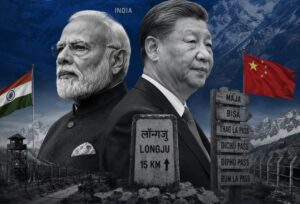
India’s core concern in Ladakh is Chinese military assertiveness expressed through what strategists call salami-slicing: the incremental, deniable forward movement of positions, infrastructure, and claims that individually appear manageable but cumulatively alter the strategic reality. The 2020 Galwan clash was the most violent expression of a pattern that had been building for years through the Depsang standoff of 2013, the Chumar standoff of 2014, and dozens of smaller friction events along the 832-kilometre LAC in Ladakh. Chinese airfields at Hotan, Kashgar, Gargunsa, Shigatse, Bangda, Nyingchi, and Hoping now host additional fighters, including J-20 stealth jets, alongside bombers, reconnaissance platforms, and drones. Multiple new heliports have been constructed by China across the LAC region. India’s air assets operating from Leh, the main operational base before Nyoma’s activation, faced the structural disadvantage of requiring fuel-intensive climbs to reach the operational altitude where Chinese aircraft were already operating. China had systematically upgraded its Himalayan airpower while India’s high-altitude air infrastructure lagged.
The Depsang Plains and Demchok area represent the most strategically sensitive unresolved points. In the Depsang, China has obstructed Indian patrols at points that India claims were accessible before 2013. These patrol points, known as PPs 10 through 13, sit in terrain that controls access to the strategically vital Daulat Beg Oldie sector, home to the world’s highest military airstrip and India’s northernmost forward position. Losing patrol access is not a bureaucratic grievance. It is a strategic compression that limits India’s ability to detect and respond to Chinese movement in the sector.
China has also built what analysts call “salami villages,” civilian settlements in disputed areas, including Pangda village in what India claims as its territory in Arunachal Pradesh and infrastructure projects in Aksai Chin that serve both civilian and military logistics. The PLA’s Western Theater Command, which covers the India-facing front, has received increased resource allocation and has been modernizing its combined arms capabilities specifically for high-altitude operations in the Himalayas.
The Two-Front Nightmare: When Pakistan and China Coordinate
India’s most dangerous strategic nightmare in Ladakh is not China alone. It is China and Pakistan simultaneously.
Pakistan shares a frontier with China’s Aksai Chin. The China-Pakistan Economic Corridor passes through Gilgit-Baltistan, giving China direct economic and military stakes in Pakistani territory adjacent to India’s most contested border. The two countries conduct joint military exercises, share intelligence, and have deepened their interoperability through what both call an “all-weather strategic partnership.” CPEC, with its $62 billion investment commitment, has given China a permanent infrastructure and logistics presence in Pakistan that it did not previously have.
In a two-front scenario, Pakistan would open its western front, stretching Indian Army divisions that are simultaneously engaged with Chinese forces in the north and east. India’s reserves, which represent its ability to sustain operations, reinforce threatened sectors, and escalate when operational advantage begins to assert itself, would face competing demands that neither strategic direction alone would impose. Nuclear weapons on both the Chinese side and the Pakistani side create escalation thresholds that constrain how aggressively India can pursue operational objectives on either front without risking a level of response it cannot absorb.
Former Army Chief General MM Naravane has publicly stated that the two-front threat is India’s most serious strategic challenge and that it shapes every major force structure decision the army makes. The raising of the 72 Infantry Division in eastern Ladakh under 14 Corps, permanently stationed rather than rotated, is a direct institutional response to the assessment that the China threat in Ladakh requires dedicated, specialized, high-altitude capable formations that cannot be diluted by competing demands elsewhere.
The Infrastructure Race: How India Is Closing a Dangerous Gap
For decades, China’s road network along the LAC was significantly more developed than India’s. China could reinforce its forward positions faster than India could reinforce its own. The 2020 Galwan standoff demonstrated that this asymmetry had operational consequences. India launched a crash programme to close the gap. The results, while still not fully eliminating the asymmetry, are visible.
On December 7, 2025, Defence Minister Rajnath Singh dedicated 125 strategically significant BRO infrastructure projects to the nation, the most ever inaugurated simultaneously, from Ladakh. Spread across Ladakh, Jammu and Kashmir, and seven border states, the projects, including 28 roads, 93 bridges, and four miscellaneous works, were completed at a cost of approximately Rs 5,000 crore, the highest-value inaugurations in BRO’s history.
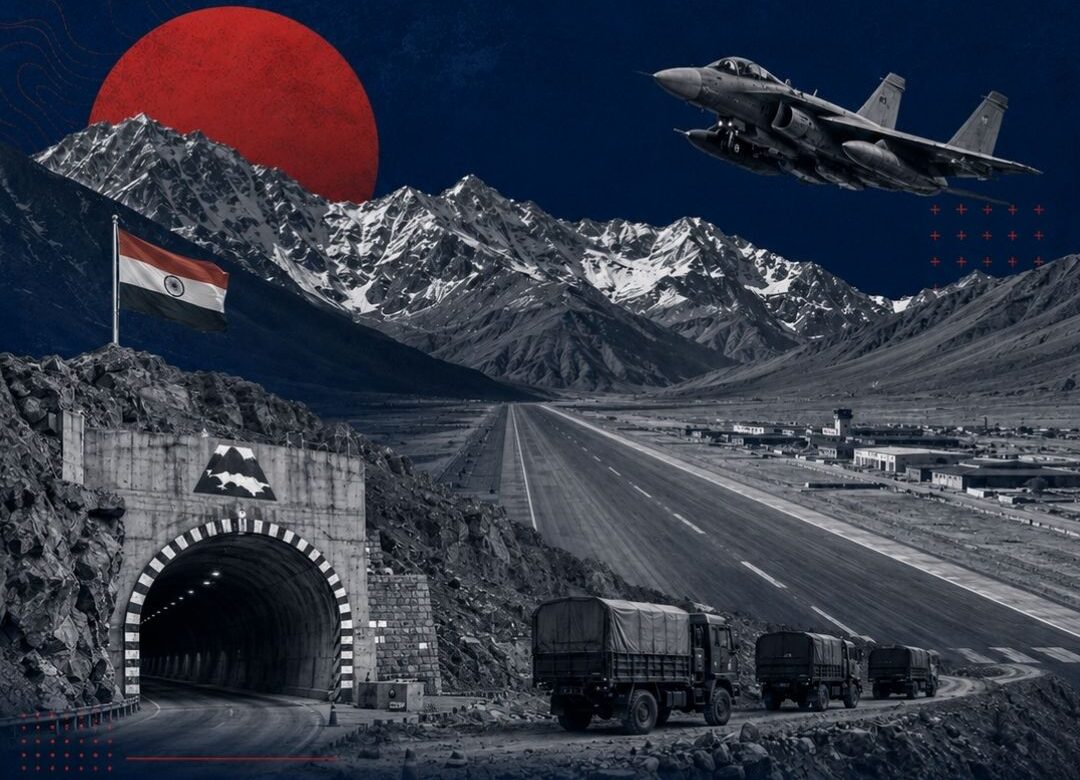
The Shyok Tunnel, a 920-metre cut-and-cover engineering achievement on the Darbuk- Shyok-Daulat Beg Oldie road, was among the key projects inaugurated. It ensures all- weather, reliable connectivity to one of India’s most critical forward areas, which faces heavy snowfall, avalanches, and extreme temperatures. The tunnel significantly enhances security, mobility, and rapid deployment capabilities on the DS-DBO road, India’s main arterial route to its northernmost positions.
Of the 125 projects, 41 were completed in Ladakh alone. The BRO also deployed indigenously developed Class-70 modular bridges at forward locations, designed to support rapid military movement of heavy loads. BRO’s budget allocation increased from Rs 6,500 crore to Rs 7,146 crore in the 2025-26 Union Budget, and the organisation recorded its highest ever expenditure of Rs 16,690 crore in FY25.
The alternate road on the Sasoma-Sasser La-Gapshan-DBO axis, currently under construction, will provide a second route to Daulat Beg Oldie that is less exposed to Chinese observation than the existing DS-DBO road. When complete, it will reduce transit time from nearly two days to a few hours and give India a redundant supply line to its most forward position.
Nyoma Airbase: India’s Answer to China’s Himalayan Air Superiority
In November 2025, India operationalised the Nyoma airbase, one of the world’s highest fighter-capable bases at approximately 13,700 feet above sea level, located approximately 35 kilometres from the LAC. The base features a 2.7-kilometre runway, air traffic control infrastructure, bombproof hangars, and accommodation, built for Rs 218 crore by the Border Roads Organisation.
The IAF Chief Air Chief Marshal AP Singh landed a C-130J at Nyoma on its operationalisation, demonstrating the base’s capability to handle large transport aircraft. The base is expected to support regular fighter detachments, including Rafale and Sukhoi- 30 MKI operations by early 2026, supported by attack helicopters and unmanned platforms. Outlook Business
The strategic value of Nyoma cannot be overstated. From Nyoma, fighters do not need the steep and fuel-intensive climbs required from Leh. Already at cruising altitude, they can establish air presence across the Kailash Range within minutes. The base also enables C-17 and IL-76 aircraft to land nearer to the LAC than ever before, substantially improving India’s ability to reinforce forward posts or reposition air defence equipment. Its primary role is rapid deployment of troops, weapons, and supplies to key areas like Pangong Tso, Demchok, and Depsang in eastern Ladakh. Nyoma is India’s fourth Air Force base in Ladakh alongside Leh, Kargil, and Thoise, and represents the most significant single addition to India’s Himalayan airpower since the 2020 standoff began.
India Is Managing a Crisis It Cannot Win on Current Trajectory
India’s Ladakh infrastructure push represents the most serious and sustained effort to address the border capability gap in the post-independence period. The pace, scale, and funding of BRO projects, the Nyoma activation, the permanent divisional deployment, and the force rebalancing toward the China threat are all genuine strategic improvements. They deserve acknowledgment without inflation.
But acknowledgment without honesty is not analysis. The plain reality is that China is winning this competition on every measurable dimension that matters.
China’s road network on its side of the LAC is more extensive, more resilient, and more deeply connected to its national logistics infrastructure. Its air assets at Tibetan Plateau bases retain numerical and capacity advantages that India’s Nyoma airbase, however significant, does not offset. China has raised villages and built permanent civilian-military infrastructure on territory India claims, and those facts cannot be erased by inaugurating bridges on India’s side. The Depsang patrol points that India lost access to in 2013 have not been restored. The buffer zones created after 2020 sit on land India previously patrolled. These are not negotiating positions. They are territorial realities that have been normalized through diplomatic engagement India agreed to without extracting the restoration it originally demanded.
The two-front scenario India fears most is already partially real. Pakistan and China are integrated militarily, economically, and diplomatically in ways that would have been unimaginable twenty years ago. India’s response, infrastructure sprints, and permanent deployments, address the symptom. The disease is a decade of strategic miscalculation that treated economic engagement with China as compatible with territorial firmness, that hollowed out human intelligence networks in Kashmir through political decisions, and that now asks the Border Roads Organisation to compensate for what diplomacy and foresight failed to prevent.











Leave a comment