




The Prime Minister has asked citizens to cancel foreign trips, cut gold purchases, and switch to railways. He is currently on a 5-country foreign tour where Sweden just gave him its highest civilian honour. This is not irony. This is governance in 2026.
On May 19, 2026, Prime Minister Narendra Modi is somewhere in Europe, completing what his office describes as a 5-country foreign tour. Sweden has just conferred on him the Royal Order of Polar Star Commander Grand Cross, its highest civilian honour. The Prime Minister accepted it, posed for photographs, and will add it to a collection that Shiv Sena UBT’s Sanjay Raut estimates is approaching a century of foreign awards.
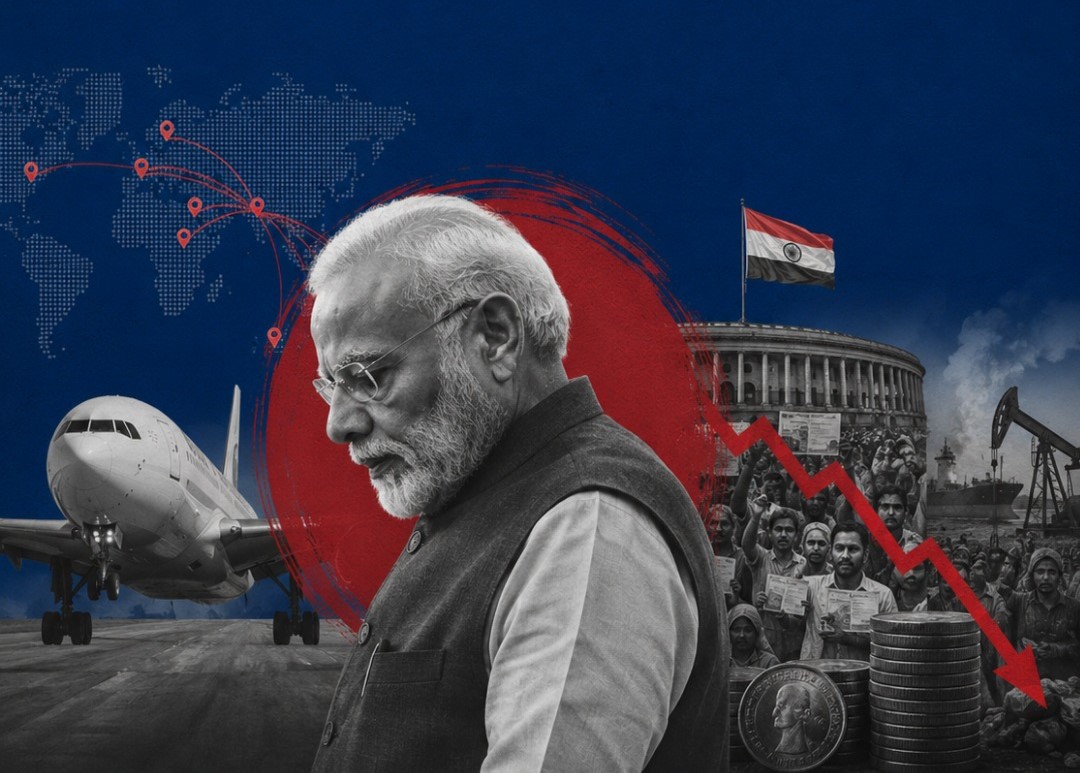
Back in India, the rupee is at a record low and is Asia’s worst performing major currency. Wholesale price inflation hit a three-year high of 3.88 percent in March driven by the West Asia war India refused to criticise. The IMF has downgraded India from fourth to sixth largest economy. Forty thousand factory workers in Noida needed a violent protest and 350 arrests before the government gave them a 21 percent wage hike. NEET protests are back. West Bengal is still burning from post-poll violence. Manipur has had two children killed in a rocket attack. Tribal women in Bundelkhand are lying on funeral pyres demanding justice for stolen land.
Sanjay Raut asked the question directly in Parliament this week: “Where is Modi?” The answer is: abroad, collecting an award, while asking Indians to stay home.
The Seven Appeals That Modi Does Not Apply to Himself
In the backdrop of the West Asia crisis that has disrupted the Strait of Hormuz and sent crude oil prices past $118 per barrel, Prime Minister Modi issued what his office called seven voluntary appeals to Indian citizens. The list deserves to be reproduced in full because its relationship to the Prime Minister’s own conduct is the most complete available description of how this government understands the word “sacrifice.”
Modi asked Indians to work from home. To postpone gold purchases. To curtail foreign travel and destination weddings. To reduce edible oil consumption. To lower chemical fertiliser use. To prioritise swadeshi products. To use railways for logistics.
He then departed on a 5-country foreign tour that includes bilateral meetings, multilateral summits, diaspora events, and the acceptance of Sweden’s highest civilian honour. The tour is not a security emergency requiring the Prime Minister’s physical presence in a foreign capital. It is a diplomatic itinerary of the kind that can be, and routinely is in genuine national crises, postponed or condensed.
Raut captured the contradiction with the precision of someone who has been watching this government long enough to stop being surprised by it: “He is telling us not to go on foreign trips, and he himself is visiting countries. He will complete the century in getting awards. He gets the highest award in whatever country he visits. What will he do with this award?” The question is not rhetorical. It is constitutional. When a Prime Minister asks citizens to bear sacrifice in a national emergency, the first condition of moral authority is that the sacrifice applies to the one asking. A government that imposes austerity on citizens while its head of government collects European honours on a 5-country tour has forfeited the moral standing to make those appeals credible.
India’s Actual Condition While the PM Tours
To understand the weight of Modi’s absence, you have to understand what India looks like right now from the ground up, not from a BJP rally podium or a prime-time news panel, but from the data and from the streets.
The IMF’s April 2026 World Economic Outlook placed India sixth globally, behind Japan and the UK, two countries India had previously celebrated overtaking. The rupee has fallen 9 percent against the dollar in a single year. India’s GDP base year has not been updated since 2011, meaning the growth figures being celebrated may be systematically overstated. Bangladesh has marginally overtaken India in per capita income. These are not opposition claims. They are IMF numbers.
The West Asia war that India declined to comment on because America and Israel are strategic partners has directly hit India’s economy. Crude petroleum wholesale prices rose 49 percent month-on-month in March, the highest single-month increase since 2011. India’s strategic crude reserves were only 64 percent full when the crisis struck. Fertilizer plants dropped to 70 percent capacity. The cooking gas that Modi’s own seven appeals acknowledge as a concern passes 90 percent through the Strait of Hormuz that the war has disrupted.
Raut named this dependency directly: “Why didn’t you talk about the Iran war? Did America not tell you or allow you to buy oil from Russia? We say this is a Trump-dependent India.” That characterisation is harsh. It is also not entirely inaccurate. India’s silence on the West Asia conflict, its inability to join the Islamabad peace process, and its subsequent begging for tanker access from Tehran, all reflect a foreign policy that has constrained India’s options by aligning too closely with one side to function as an independent actor.
NEET, West Bengal BRICS: The Domestic Emergency Nobody Named
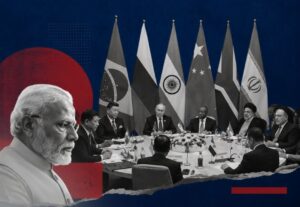
While the Prime Minister tours Europe, India this week is a country dealing with simultaneous fires. NEET 2026 has erupted in fresh paper leak allegations across multiple states, with students back on the streets in Delhi, Patna, and Kota demanding accountability from a testing body that promised reform after last year’s scandal and delivered none. Bengal is still processing post-poll violence that has killed at least four people, with TMC offices burned, Muslim homes attacked, and a bulldozer running through New Market in Kolkata on the night of BJP’s victory. The rupee hit a fresh record low this week, cementing its position as Asia’s worst performing major currency. India’s first official inflation data since the West Asia war began confirmed wholesale price inflation at a three-year high of 3.88 percent, with crude petroleum prices up 49 percent month-on-month. The BRICS foreign ministers’ meeting in Delhi on May 14 and 15 ended, by most diplomatic assessments, without the strong joint statement India needed to justify its chairmanship claims. And the families of the twenty-six people killed in Pahalgam one year ago are still waiting for the compensation and justice the government promised them on national television. This is the India the Prime Minister is touring away from.
The Convoy Problem: Austerity Is for Citizens, Not Ministers
Raut extended his criticism beyond the Prime Minister to Maharashtra Deputy Chief Minister Devendra Fadnavis, whose convoy recently caused massive traffic blockages in Pune. A social worker documented the convoy on video. The documentation became a small viral moment before being absorbed into the general background noise of Indian political life.
“Devendra should appeal to the public or reduce this behaviour,” Raut said. “How many tours do you have to do? Everyone has a strategy, but you are just sitting in the Prime Minister’s or Ministers’ chairs.”
He extended the same observation to Union Home Minister Amit Shah, noting that “three major roads of Delhi are closed just for their safety.” The security convoys of senior ministers, which require entire arterial roads to be shut for extended periods while millions of citizens wait, are the most visible daily manifestation of the gap between the austerity being preached and the privilege being practiced.
When the government asks citizens to use railways for logistics and curtail foreign travel, and when those same citizens are stuck in traffic for an hour because a minister’s convoy needs an unobstructed road, the seven appeals do not sound like shared national sacrifice. They sound like instructions from the people inside the convoy to the people stuck outside it.
What Leadership in a Crisis Actually Looks Like
India is not in a crisis so severe that it cannot survive a Prime Minister’s foreign tour. Countries function during their leaders’ absences. Institutional governance continues. The seven appeals, whatever their limitations, reflect a government aware that the West Asia crisis is causing genuine economic hardship.
The problem is not that Modi is travelling. It is that the gap between what is being asked of ordinary Indians and what is being practiced by the government asking it has grown visible enough that even loyalist media cannot entirely ignore it. A Prime Minister who asks citizens to sacrifice foreign travel while accepting European honours on a 5-country tour, who asks for swadeshi while India’s trade deficit with China exceeds its defence budget, who issues austerity appeals while his government’s infrastructure decisions dispossess tribal farmers and his economic policies produce 40 percent youth graduate unemployment, has a credibility problem that no award ceremony can resolve.
Raut’s “where is Modi” is not really a question about geography. It is a question about presence, the presence of a government in the lives of the people it governs when things are difficult rather than when cameras are present.
India knows where Modi is. He is in Europe. The question Raut is actually asking is whether the Prime Minister who returns from collecting his European award will be present to the India he comes home to.
That India has forty thousand workers who needed violence to get a wage increase. Two children killed in a rocket attack in a state the PM has not visited in two years. Tribal women on funeral pyres in Bundelkhand. A currency at a record low. An economy ranked sixth where the government said fourth. And students protesting NEET, again, because the system that determines their futures remains as broken as it was last year.
The PM’s award cabinet is getting full. The national inbox is overflowing.




Leave a comment