








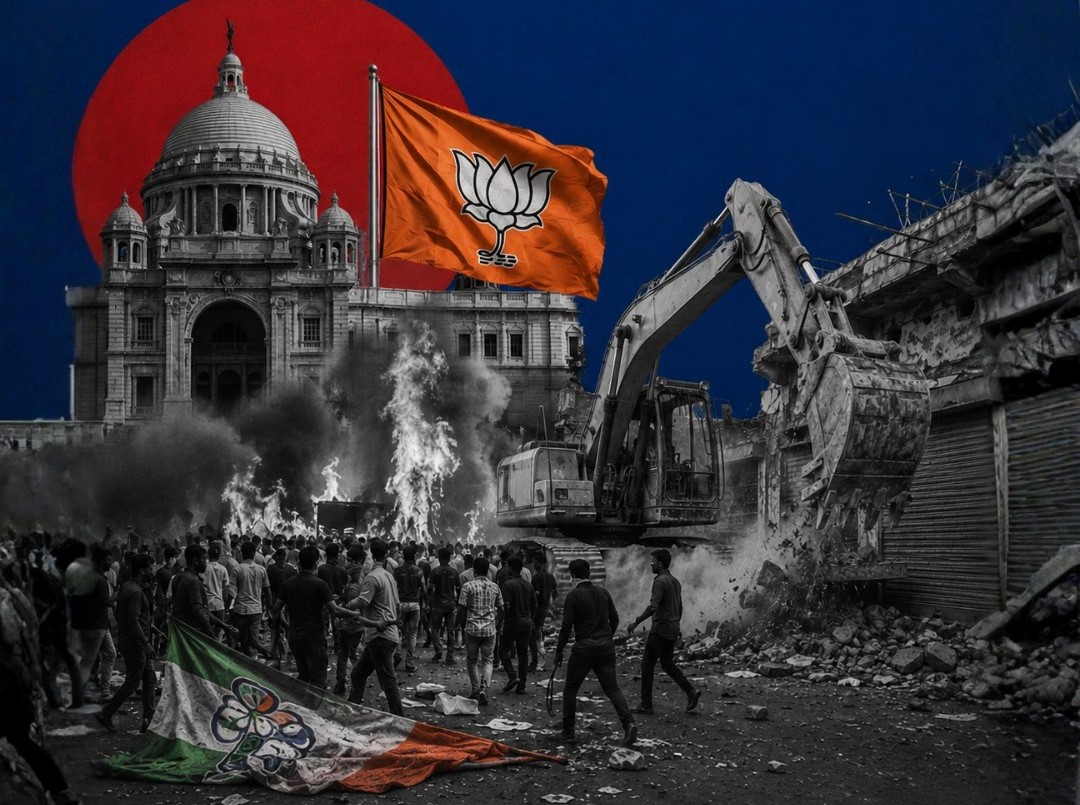
On May 4, 2026, West Bengal’s fifteen-year TMC government ended. BJP won approximately 206 seats out of 294. Mamata Banerjee lost her own Bhabanipur constituency. The state that had been held up for four years as proof that the BJP could be stopped had fallen. By the time the sun set on May 5, party offices were on fire, workers were dead in the streets, and a bulldozer was moving through New Market in Kolkata while crowds cheered.
To understand what happened in Bengal, you have to start not with election day but with the months that preceded it. Because the result on May 4 was shaped decisively by decisions made long before a single vote was cast.
The 90 Lakh Voters Who Never Got to Vote
West Bengal’s electoral rolls underwent a dramatic shake-up ahead of the 2026 Assembly elections, with nearly 90 lakh voters removed under the Special Intensive Revision. The state’s total electorate dropped from 7.6 crore in 2024 to 6.7 crore, a steep 12 percent decline. To put that in perspective, the entire population of Switzerland is approximately 87 lakh. India deleted Switzerland from Bengal’s voter list.
The revision process began in December 2025, initially leaving out 58 lakh names. Subsequent scrutiny led to further deletions, including 27 lakh names in early April, while 33 lakh voters remained in limbo following directions from the Supreme Court.
The Election Commission categorized the majority of deletions under a classification called “Logical Discrepancy,” created especially for West Bengal. Voters with mismatched name spellings, or a single individual linked as a parent to more than six voters, or where the age difference between voter and grandparent was less than 40 years, all these factors were flagged as logical discrepancies that could get a name deleted from rolls.
The communities most affected were not random. As opposition parties alleged and data analysts found, the most adversely impacted were Muslim minorities, women, and tribals. Bengali Muslims constitute 27 percent of the state’s population. Minority-dominated regions like Murshidabad, with a 66 percent Muslim population, and Malda, with 52 percent Muslim population, saw 4.5 lakh and 2.5 lakh voter deletions, respectively. In Mamata Banerjee’s own Bhabanipur constituency, there were 47,000 deletions, with around 40 percent reportedly Muslim voters.
In one house in densely populated Metiabruz, of the 80-odd adult voters, as many as 30 had been struck off the rolls. A 65-year-old woman named Masooda Bibi asked reporters: “Do you see any Bangladeshis here among us?” (Ideasforindia
Amit Shah backed the SIR publicly, arguing it removed illegal immigrants. The BJP saw political gain. TMC saw electoral damage. Both assessments were correct.
2.4 Lakh Security Forces, TMC Agents Blocked, and a Compliant Election Commission
More than 2.4 lakh Central Armed Police Forces were deployed across West Bengal for the 2026 elections. The Election Commission restructured the state police command structure extensively, transferring officers with knowledge of local networks. As one analyst noted, “Lines of command have been completely blurred with individuals aware of disruptive elements and networks now transferred. Once the central forces are withdrawn, there will be an absolute vacuum.”
On election day, TMC’s complaints were specific and documented. Chief Minister Banerjee said after Phase Two: “The atrocities by the central forces are unprecedented. What is happening is not at all free and fair polls. Central forces are supposed to guard the country’s borders, but instead, they are working for a particular party. They have assaulted so many of our cadres and have forced our polling agents to leave the booths.”
TMC alleged systematically that its polling agents were prevented from sitting inside booths across constituencies, leaving the counting of votes inside those booths to proceed without opposition witnesses. The Election Commission, which had issued what it called “straight talk” warnings to TMC before the election, specifically about booth management, received and processed these complaints with the institutional energy it had displayed throughout the election cycle, which is to say, selectively.
Re-polling was ordered across all 285 booths of the TMC stronghold constituency of Falta in South 24 Parganas following what the ECI described as “severe electoral offences and subversion of the democratic process.” The irony of the commission ordering re-polling in a TMC stronghold while processing TMC complaints about booth access across the state with considerably less urgency was not lost on observers.
The Guardian had already set the tone for international coverage before polling began, running the headline: “Millions in India stripped of vote before critical state election, as government seeks to ‘purify’ electoral roll.” That framing, contested by BJP and the Election Commission, captured what the 90 lakh deletions looked like from outside the institutional apparatus that authorized them.
The Result: 206 Seats and a Historic Collapse
When results came on May 4, the scale was beyond even BJP’s internal projections. 206 seats. TMC down to approximately 80 from 215 in 2021. Mamata Banerjee personally defeated in Bhabanipur by Suvendu Adhikari, the man whose defection she never forgave and whose revenge she could not prevent. The RG Kar Hospital rape-murder victim’s mother, Ratna Debnath, won from Panihati by a margin of 28,836 votes against a TMC candidate, carrying the weight of one of 2025’s most galvanizing anti-TMC moments. Five years of accumulated anti-incumbency, genuine anger over crimes against women, panchayat-level corruption, and the structural advantages produced by 90 lakh deleted voters and 2.4 lakh central forces created a result that was simultaneously a democratic verdict on TMC’s governance failures and a product of an electoral process that the opposition described as systematically tilted.
Both things can be true. They are.
The Bulldozer Arrives in Kolkata
Before the counting tables were cleared, the violence had begun.
TMC offices in Kolkata’s Tollygunge and Kasba, in Baruipur, Kamarhati, Baranagar in the suburbs, and in Howrah and Baharampur in the districts were vandalised by mobs since Monday afternoon. At Ruby Crossing, the office of TMC councillor Sushanta Ghosh was rampaged by a crowd holding BJP flags.
The most symbolically charged incident of the post-poll period occurred at New Market and Hogg Market in central Kolkata, where videos circulated on social media showing a crowd accompanying an excavator that demolished a structure identified by TMC as its union office. TMC’s Mahua Moitra shared the footage on X and labelled it directly: “Yogi- style bulldozer politics has arrived in Bengal.”
The bulldozer has become, in contemporary Indian political symbolism, inseparable from BJP’s governance approach in UP under Yogi Adityanath, where it has been deployed against Muslim homes, businesses, and properties with a consistency that the Supreme Court has since been required to address. Its appearance on the streets of Kolkata on the night of BJP’s Bengal victory was not experienced as neutral by anyone watching.
Four Dead, Offices Burned, Muslim Homes Attacked
In Howrah’s Udaynarayanpur, BJP supporter Yadav Bar, 48, died after being allegedly assaulted while returning home from victory celebrations. In Birbhum’s Nanur, TMC worker Abir Sheikh was killed with a sharp weapon during a dispute in Santoshpur village. BJP worker Madhu Mondal died after being beaten up allegedly by TMC workers during a victory procession in New Town. In Kolkata’s Beliaghata, TMC worker Bishwajit Pattnaik was found with serious injuries outside his home and died, with his family alleging murder by BJP supporters.
Four people were killed in two days. All ordinary party workers. None of them are the leaders who will give television interviews about the tragedy of Bengal’s political violence culture. Reports from Muslim-majority areas in North 24 Parganas, Murshidabad, and parts of Howrah documented attacks on Muslim homes and properties by mobs celebrating the BJP’s victory. These reports, coming from communities that were already among the most heavily impacted by the SIR voter deletions, reflected a fear that had been building through the campaign: that the BJP’s Bengal victory would be followed by the kind of targeted communal violence that has accompanied the BJP’s rise to power in other states.
TMC posted on social media a video purportedly showing its party office in Siliguri being set ablaze. TMC candidate in Maniktala, Shreya Pande, shared a clip of a middle-aged party leader with his shirt soaked in blood, alleging he was her election agent beaten by BJP workers after counting.
BJP’s state president Samik Bhattacharya warned that post-poll violence would “not be tolerated” and that those involved could face expulsion, urging the administration to act “irrespective of political affiliation.” The warning came after the violence was already underway. Its enforcement remains to be seen.
What Bengal’s New Government Inherits
BJP is set to form Bengal’s government for the first time in its history. Suvendu Adhikari and Sukanta Majumdar are the names circulating for Chief Minister. The incoming government inherits a state with genuine governance needs, a demoralized but still organizationally significant TMC opposition, a Muslim population that constitutes 27 percent of the electorate and which has experienced the SIR deletions and election day disruptions as a direct assault on its political participation, and a post-poll violence situation that the central forces deployed for the election cannot remain to manage indefinitely.
As one analyst noted before the results: “Once the central forces are withdrawn, there will be an absolute vacuum.” That vacuum is already being filled.
Bengal’s poriborton arrived with fire, a bulldozer, four bodies, and offices burning across a dozen districts. Whether the change Bengalis voted for, accountability, development, safety, governance that reaches beyond Kolkata, is what they will actually receive is the question May 4 opened, but cannot answer.
The votes have been counted. The reckoning is just beginning.







Leave a comment