












The War India Didn’t Fight Is Now Costing Every Indian Household
Government data released this week confirms what millions already feel in their pockets: the US-Iran war has delivered India’s worst wholesale inflation in over three years, and the worst is still ahead.
On April 15, 2026, India’s Ministry of Commerce and Industry released the country’s first official inflation data since the US-Israel strikes on Iran began on February 28. The government did not hold a press conference. No minister went on television to explain what the numbers mean for ordinary Indians. The data was quietly uploaded to a government portal and left there.
The numbers deserve considerably more attention than they received.
The Headline Figure and What It Hides
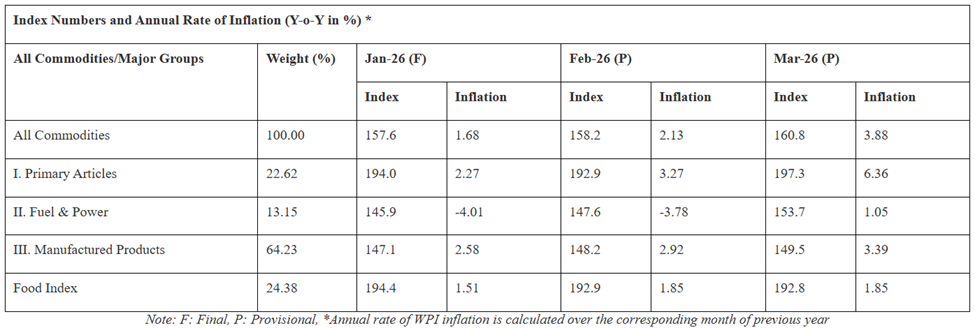
India’s wholesale inflation, measured by the Wholesale Price Index, rose to a 41-month high of 3.88 percent in March 2026, the fastest pace of growth since January 2023. To understand why that matters, consider the trajectory. WPI inflation was 2.13 percent in February 2026 and just 1.68 percent in January 2026. In six weeks, as the West Asia conflict escalated and the Strait of Hormuz came under disruption, wholesale inflation nearly doubled.
The upward movement was broad-based, affecting several core sectors simultaneously. Manufacturing, which accounts for 64.23 percent of the WPI weight, trended upward, with 16 out of 22 industrial groups recording price increases. Key sectors contributing included food products, chemicals, basic metals, and textiles.
This is not a single-sector spike that can be managed through targeted intervention. It is a system-wide price pressure event, and its cause is unambiguous.
Crude Petroleum: The Number That Should Alarm Everyone
Within the primary articles group, the cost of crude petroleum and natural gas surged by 36.16 percent year on year. Open Magazine On a month-on-month basis, the jump was even more dramatic, with crude petroleum prices rising approximately 49 percent compared to February, the highest single-month increase since 2011.
India imports approximately 87 percent of its crude oil requirements. Primary articles recorded an overall inflation of 6.36 percent, led by the surge in crude oil and natural gas prices. The fuel and power category turned positive at 1.05 percent, reflecting higher energy costs amid global uncertainties.
The mechanism is direct and unavoidable. Global crude oil prices have risen approximately 31 percent since the conflict began. India’s strategic crude reserves, as reported earlier in March 2026, were only 64 percent full at the time the crisis struck, representing roughly four to five days of national consumption. A country that imports nearly nine-tenths of its crude, with inadequate strategic buffers, facing a war that disrupted the waterway through which much of that crude travels, was always going to absorb this price shock. The March WPI data is the first official confirmation of that absorption.
Oilseeds, Plastics, and the Supply Chain Cascade
The crude petroleum figure captures attention, but the spread of price increases across the WPI basket tells the fuller story of what a Gulf war does to an import-dependent economy. Wholesale oilseed prices rose approximately 23 percent compared to the same period last year. India imports a large share of its edible oil requirements, primarily through sea routes that pass near or through the affected region. When shipping insurance premiums surge, as they did from approximately 0.25 percent to as high as 3 percent of vessel value per voyage during the crisis, the cost increase reaches every commodity that moves by sea.
Even manufactured products such as plastic goods rose 3 to 4 percent in their highest monthly increase in over four years. This matters because plastics are input costs for hundreds of downstream industries, from packaging to agriculture to consumer goods. The index for manufactured products rose by 0.88 percent, with chemicals, basic metals, and textiles all recording increases.
The index for the fuel and power group increased by 4.13 percent from 147.6 in February to 153.7 in March, driven largely by mineral oils, which saw prices rise by 8.77 percent. The Retail
Inflation Gap: The Calm Before the Storm
Here is the element of this data that should concern every Indian household. Retail inflation, measured by the Consumer Price Index, has not yet risen sharply. WPI at 3.88 percent has now surpassed CPI at approximately 3.40 percenthttps://voice.lapaas.com/march-wholesale-inflation-rise-to-41-months-of-3-88/. Historically, when wholesale inflation leads retail, it acts as a lead indicator, suggesting that consumer prices may rise in the coming two to three months as manufacturers eventually pass on costs. The WPI food index, mercifully, remained constant at 1.85 percent year on year in March 2026, with the food index marginally decreasing from 192.9 in February to 192.8 in March, Press Information Bureau, partly cushioned by a strong rabi harvest currently reaching mandis. But food price stability that rests on a single good harvest is fragile. Fertilizer plants, which were operating at 70 percent capacity in March due to natural gas allocation cuts, will produce less in the coming months. Less fertilizer means reduced crop yields in the kharif season. That consequence will arrive in the October-December CPI data.
As Radhika Rao, Senior Economist at DBS Bank, noted in her assessment of the March figures: “The impact of higher energy prices is likely to be more material in the WPI index. We expect the impact of higher energy prices to gradually percolate over the coming months.”
Gradually percolate. That is the economist’s way of saying: what you are paying today is not the final bill.
What the Government Is Not Saying
The Ministry of Commerce released this data without commentary on the West Asia conflict’s role in driving it. The government press release attributed the WPI rise to “increase in prices of crude petroleum and natural gas, other manufacturing, non-food articles, manufacture of basic metals and food articles,” without once mentioning that these increases are the direct transmission of a foreign military conflict into Indian household budgets.
That omission is itself a statement. Acknowledging the causal chain, from the decision to align closely with Israel, to the resulting loss of diplomatic credibility with Iran, to the Strait of Hormuz disruption, to the wholesale price surge now visible in government data, would require the government to connect dots it has a strong political interest in keeping separate. Manufactured products saw inflation at 3.39 percent, with price increases observed across a majority of industrial categories. Every one of those percentage points represents a cost that will move, in time, from the wholesale level to the retail shelf, from the factory gate to the household budget.
India did not start this war. It did not fight this war. But through the combination of strategic misalignment, inadequate energy preparedness, and a decade of diplomatic choices that left it with no leverage in the region where its energy lifeline runs, it is paying for this war. And the March 2026 WPI data, the first official government confirmation of that payment, shows clearly that the invoice has only just begun to arrive.
The worst, as every economist assessing these numbers agrees, is still ahead.









Leave a comment