








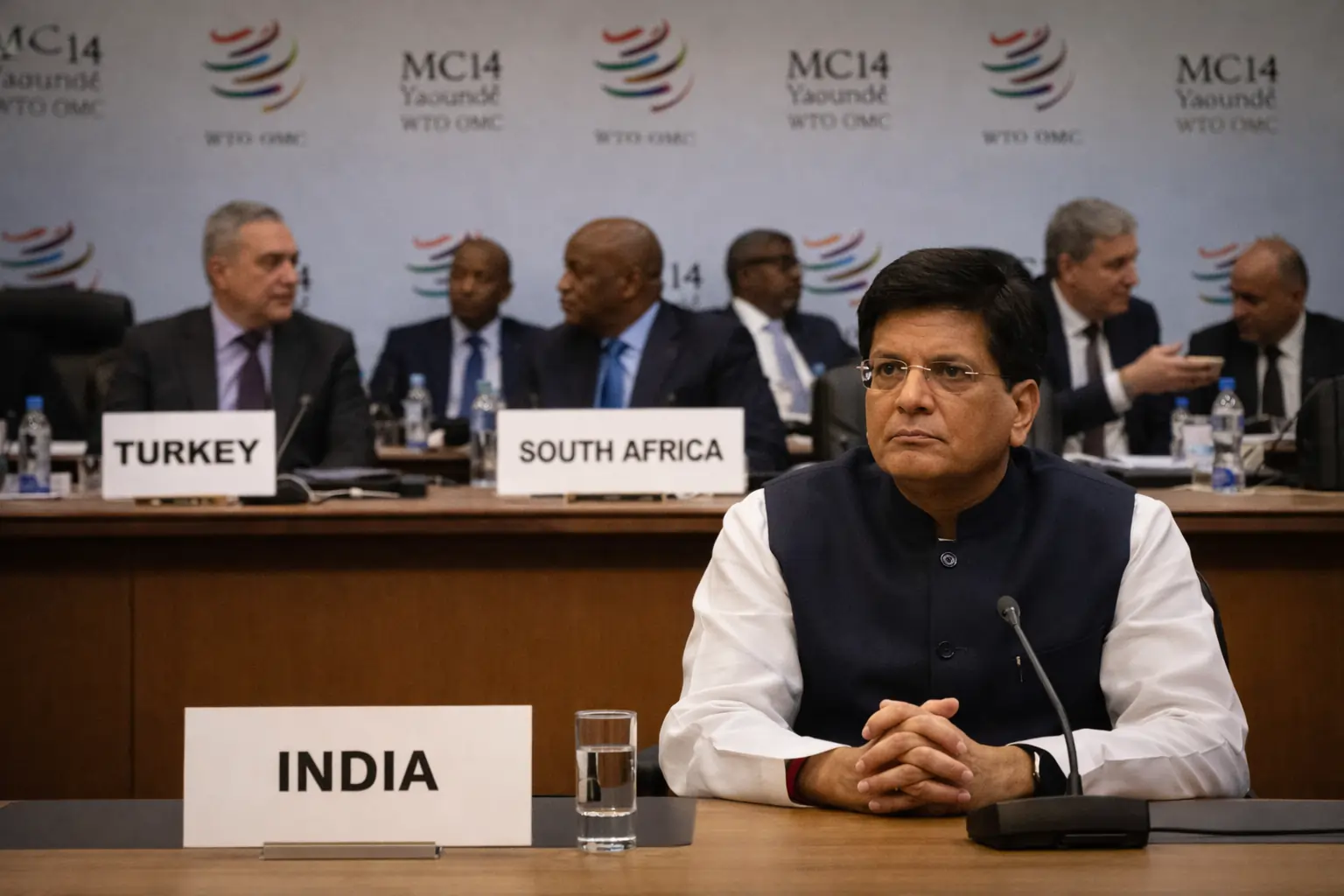
India’s fight to keep the China-backed Investment Facilitation for Development (IFD) pact out of the WTO legal framework has grown stiffer, with Turkey, one of the three major countries initially objecting to it, formally withdrawing its opposition at the ongoing WTO MC14 in Yaounde, Cameroon.
Now, the responsibility to safeguard the WTO’s “consensus-based architecture” falls mostly on India, as South Africa had already signaled its intent to step aside during General Council sessions before the meeting, say experts. India is under pressure on the WTO investment pact after Türkiye steps aside.
Standalone issue
India’s opposition to investment facilitation (IFD) was on its own and not dependent on Turkey’s support. While India is the only influential country continuing to oppose investment facilitation, many countries share similar concerns on the larger systemic implications of allowing plurilateral to become the norm at the WTO. So, the picture on investment facilitation is getting complicated, as countries may no longer see it as a standalone issue,” said interna-
The IFD, supported by 128 WTO members, aims to facilitate FDI flows by enhancing the transparency of investment frameworks, as well as the predictability and efficiency of investment procedures.
Earlier this week, India said that it supported the facilitation of FDI flows to developing countries and least developed countries (LDCs), but a government spokesperson added that the country did not believe that the WTO was the right forum to do so.
India has been opposing the integration of the IFD in the WTO framework as it is a “non-mandated” initiative pushed as a plurilateral agreement (not involving all members) without full consensus. It would set a precedent for other non-mandated issues gaining legitimacy at the cost of long-pending mandated ones, such as food security, it believes.
Some WTO members, mostly led by developed countries, are trying to push for rules on new issues like e- commerce, investment facilitation, services domestic regulation, and micro, small, and medium enterprises, by- passing the traditional consensus rule through a plurilateral initiative termed the Joint Statement Initiatives (JSIS).
India, together with South Africa and Turkey, had been arguing that JSIs have no legal basis under the Marrakesh Agreement (the WTO’s founding charter).
Specifically, regarding investment, the countries referred to the 2004 General Council decision that explicitly dropped “investment” from the WTO agenda. At the WTO, a subset of members cannot unilaterally revive an issue that was removed by consensus, India had said.
Moreover, cluttering the negotiating table with new issues without the mandate of the entire membership diverted attention from the long-pending issues of interest to developing countries and LDCs already on the table, such as food security and public stockholding programmes and special safeguard measures to protect agriculture against a spike in imports and other problems.
However, with South. Africa declared in December 2025 that it would not resist the incorporation of the IFD pact into the WTO legal framework (Annex 4 of the Marrakesh Agreement), and now, with Turkey following suit, the going will not be easy for India at a decisive meeting on the issue in Yaounde on March 28.





Leave a comment