




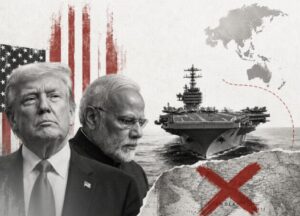

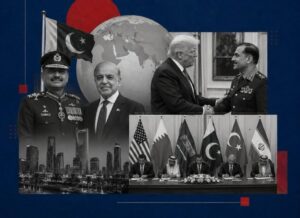


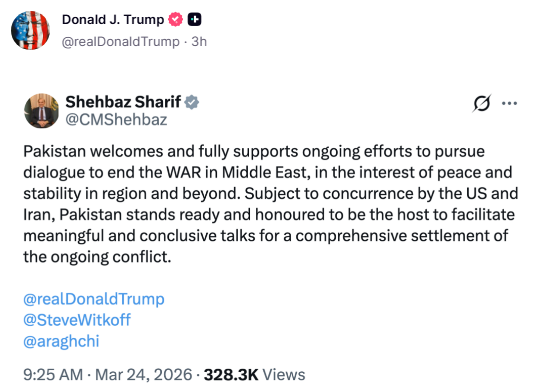
In a notable turn of events in the ongoing Middle East crisis, Pakistan has openly offered to host talks between the United States and Iran to end the escalating conflict, a development that underscores a important strategic setback for India. On 24 March 26, Pakistan’s Prime Minister Shahbaz Sharif announced on social media that his country stands ready to help facilitate talks to ease tensions in the region. This announcement was made in the midst of a continuing unclear situation about whether negotiations between the U.S. and Iran had already begun, with Iran dismissing comments by former President Donald Trump about talks between the U.S. and Iran.
Shahbaz Sharif tweeted, “Pakistan welcomes and fully supports ongoing efforts to pursue dialogue to end the war in the Middle East.” He offered his nation as a meeting ground for talks between the U.S. and Iran, “subject to approval from both sides.” This offer by Sharif was not immediately answered by either the U.S. or Iranian government, but there are reports from Pakistan that there are continuing backchannel talks with intermediaries such as Egypt and Türkiye, and Pakistan, to ease tensions in the region.
The emergence of Pakistan as a primary intermediary between the U.S. and Iran is a significant event in regional geopolitics. It is noted by analysts that the military and civilian leadership of Pakistan have been able to increase their credibility by improving relations with both the U.S. and Iran. As noted by Qamar Cheema, an executive director of the Islamabad-based think tank Sanober Institute, “Pakistan’s Army Chief Asim Munir maintains a direct line of communication with U.S. Envoy Steve Witkoff, which speaks to Pakistan’s position in facilitating dialogue between the US and Iran.
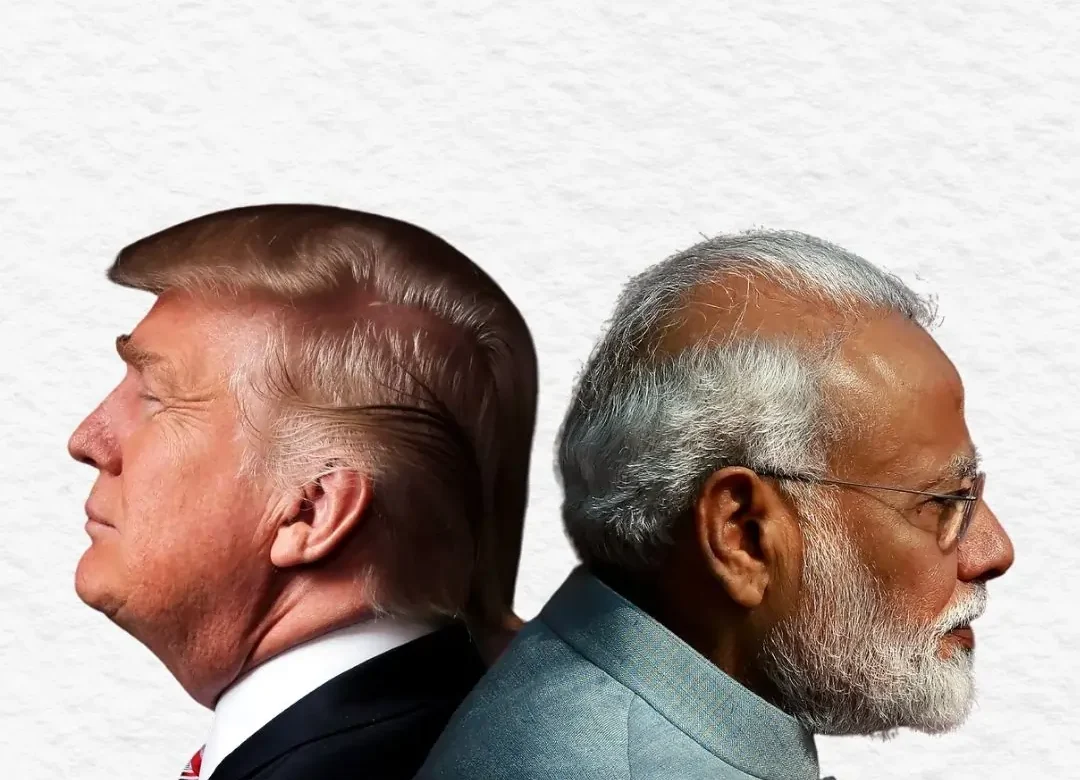
Meanwhile, Pakistan is acting as a force for stability, Israel and Iran continued their confrontation, and the Iranian strikes involving missiles landed in Tel Aviv, resulting in civilian casualties and damage to property. At least six people have been injured, and strikes have been reported at several locations in Israel. The need for urgent intervention and the stakes involved in back-channel diplomacy are once again underscored. The implications from the point of view of India are rather embarrassing, as Prime Minister Narendra Modi has spent several years trying to isolate Pakistan diplomatically, portraying his neighbor as irresponsible and incapable of providing leadership in the region. But when urgent diplomacy was needed to prevent conflict between a world power and a regional power, the United States chose to work with Pakistan rather than India. The marginalization of India is a measure of the failure of Modi’s foreign policy, which has focused more on style and personality rather than substance.
Secondly, Modi is humiliated on an international level. The fact that India does not feature in the major backchannel communications that influence the resolution of the conflict is a serious blow to his image as a world peacemaker and a Vishwa guru. Islamabad, Ankara, Cairo, the architecture of diplomacy is operating in the first significant engagement between the second Trump term and Iran, and New Delhi is left out. Observers believe that its perceived association with Israel and the US makes India less credible as an impartial mediator able to handle complex conflicts on its own.
Thirdly, the Indo regional influence and credibility have suffered a physical blow. Pakistan is not deemed to be trusted with important communications between Washington and Iran whereas India has had to be under the pressure of U.S sanctions and to have to operate her energy relationship with Iran carefully. So far, the efforts of New Delhi to exert power in the form of infrastructure development like the Chabahar Port corridor have produced very minimal geopolitical capital especially with the rise of Pakistan as a focal point in regional politics. The fragility of the US-India strategic partnership is also evident in the crisis. With high profile state visits, crusades, and personal relationship between Modi and the U.S. leaders, it is surprising to find that Washington avoided India and instead chose Pakistan. This is a big message that India is not considered a priority interlocutor when it comes to the issue of West Asian stability, but a side player whose role is to serve U.S. and Israeli interests. The fact that Modi caved in to pressure over sanctions and energy agreements only serves to strengthen the impression that India is a reactive state as opposed to a strategically proactive one. The success of Pakistan is in stark opposition to the failures of India. Islamabad has been able to use its connections with Washington and Tehran to become a convincing mediator. The fact that Pakistan continues to have security and diplomatic relations with Saudi Arabia and other power brokers in the region supports this credibility.
Comparatively, India has not succeeded in its attempts to avoid Pakistan and establish influence in Tehran especially as Iran strengthens its relationships with China and Pakistan. The affiliation of Modi with Israel and the U.S has cost India flexibility and goodwill in diplomacy and has kept it locked out of a crucial regional decision-making process. A new three-way diplomatic triangle is taking shape, including Pakistan, Turkiye and Egypt that are collectively running the three lines of communication to ensure that neither Iran nor the U.S. goes over the edge. With this alliance operating in Gaza, the Red Sea and the Organization of Islamic Cooperation (OIC), India remains even more marginalized. The belligerent posture that Modi took to defend Israel and the hostility towards Pakistan have not paid off as far as influence is concerned but have instead left India with no opportunity to play a significant role in this regional crisis.
The rise of Pakistan as a significant diplomatic mediator is a big shock to the Indian ambitions in the region. The marginalization of New Delhi to favor Islamabad reveals the constraints of the foreign policy of Modi who has focused more on optics, personal branding and high-profile diplomacy at the expense of engaging seriously on issues that bear strategic significance. The US- Iran war has brought out the long-term applicability of Pakistan as a regional pivot and the declined strength of India at the time when it is needed most. In the case of India, the out tactic by a crisis-stricken Pakistan is both a strategic snub and a wake-up call as to the redesigning of its view of the West Asian diplomacy. The personal and political brand of global statesman has been hit hard in the case of Modi and this clearly shows how India is in dire need of regaining credibility and leverage in the ever-changing geopolitical environment.





Leave a comment