








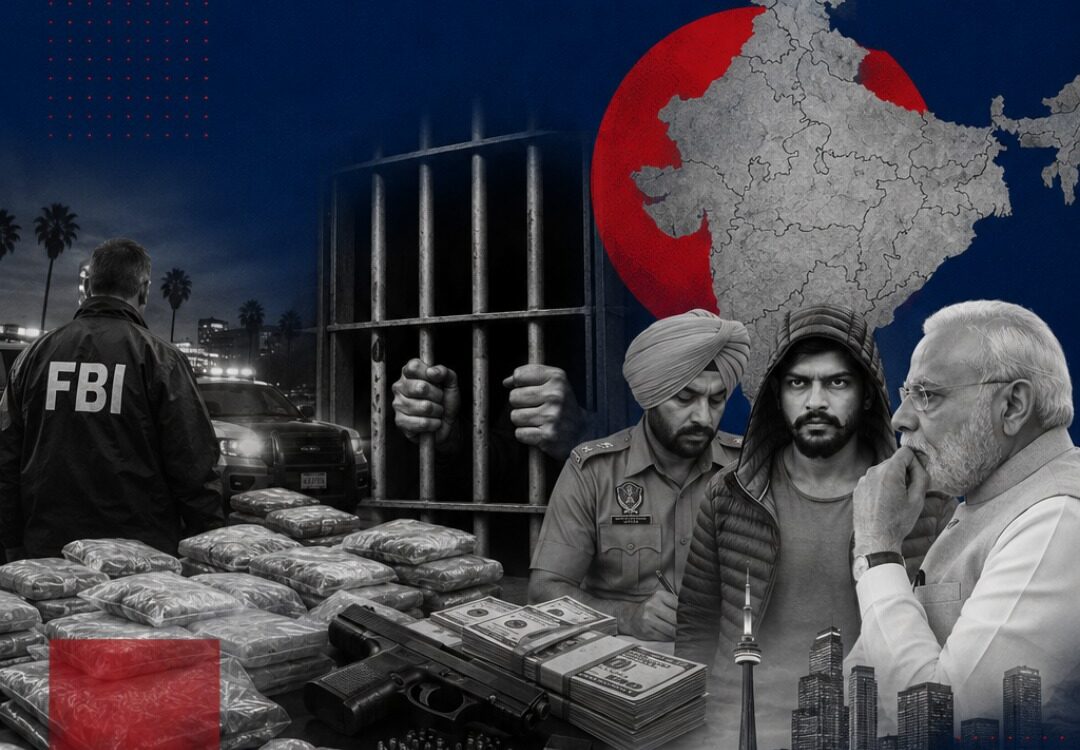
On July 7, 2026, the US Department of Justice unsealed indictments against 37 defendants linked to India-based criminal syndicates. The most damaging detail is not the murders or the cocaine. It is that the man who allegedly ordered them has been in Indian custody since 2014.
There is a specific kind of institutional embarrassment that arrives not through failure to act but through documented evidence that action was taken and made no difference. On July 7, 2026, the United States Department of Justice delivered exactly that to India when it unsealed the indictments of Operation Hard Ball, a multi-year investigation involving the FBI, the Royal Canadian Mounted Police, and European law enforcement partners that resulted in charges against 37 defendants linked to three India-based criminal syndicates. The charges include racketeering under RICO statutes, international drug trafficking, extortion, contract killings, firearms offences, money laundering, and organized violence targeting Indian diaspora communities across North America and Europe. Twenty-four arrests have been made across the United States, Canada, and Spain. More than ten suspects remain fugitives. Approximately 1,000 kilograms of cocaine were seized. Multiple transnational trafficking routes were dismantled.
These are serious criminal charges against a serious criminal network. They would be concerning under any circumstances. What elevates them from a law enforcement story to a national governance scandal is one specific detail: the man US prosecutors identify as directing the network’s most violent operations has been sitting in an Indian prison since approximately 2014.
The Prison That Wasn’t a Prison
Lawrence Bishnoi is 33 years old. He has been incarcerated in India for over a decade. According to the US Department of Justice indictments, none of that incarceration meaningfully disrupted his criminal operations. US prosecutors allege that Bishnoi, coordinating with Canada-based associate Goldy Brar, ordered the June 2023 assassination of Hardeep Singh Nijjar in Surrey, British Columbia, directed extortion campaigns across North America, coordinated international narcotics trafficking worth hundreds of millions of dollars, and managed targeted killings and violent intimidation against Indian diaspora members, all from inside Indian custody.
The operational mechanism was not sophisticated in any way that prison administration cannot address: smuggled mobile phones, encrypted communications applications, and VoIP services. These are not exotic tools that require special intelligence capabilities to interdict. They require mobile phone detection equipment, consistent cell searches, and prison governance that treats communication restriction as an operational priority rather than an administrative aspiration.
The fact that a man incarcerated for over ten years in India’s prison system could maintain command and control of a global criminal enterprise with alleged involvement in a Canadian assassination, narcotics trafficking across multiple continents, and extortion networks targeting diaspora communities, tells you something specific about those prisons that no government statement can adequately address.
US officials have stated explicitly that incarceration failed to disrupt the syndicate’s command structure. That is a foreign government’s law enforcement apparatus telling India, in a formal legal document, that India’s prisons do not function as prisons for people with sufficient money and organizational capacity to keep them operational from the inside. This is not an allegation from a hostile government. It is a finding embedded in a federal prosecution that 24 successful arrests across three countries validates.
The Three Syndicates and Their Global Reach
Operation Hard Ball targeted not one but three India-based criminal networks operating simultaneously across North America and Europe. Bishnoi’s network is the most extensively documented given his connection to the Nijjar assassination, which has already been a central point of tension in India-Canada relations. Ravinder Dhanda and Jaggu Bhagwanpuria lead the other two syndicates named in the indictments.
The geographic breadth of the operation, involving the United States, Canada, Spain, and other European jurisdictions simultaneously, demonstrates that these are not local or regional criminal enterprises that happened to develop international connections. They are structured transnational criminal organizations with established supply chains, money laundering networks, enforcement arms capable of conducting contract killings in Western countries, and the organizational resilience to survive multi-year law enforcement investigation while continuing operations.
The 1,000 kilograms of cocaine seized in the operation represents a fraction of what these networks were likely moving, given that successful trafficking operations maintain functional supply chains even after interdiction losses. The RICO charges, which US prosecutors use for criminal organizations with structured hierarchies and patterns of criminal activity, indicate that American law enforcement views these networks as operating with the sophistication and organizational coherence that statute requires for racketeering prosecution.
The Nijjar Connection and Its Diplomatic Geometry
The Nijjar assassination creates a specific diplomatic complexity that India has not yet fully processed. Hardeep Singh Nijjar, a Canadian Sikh activist and alleged Khalistan separatist, was killed in Surrey, British Columbia, in June 2023. Canada’s Prime Minister Justin Trudeau subsequently alleged Indian government involvement in the assassination, a claim India denied forcefully and which became the central rupture in India-Canada relations, resulting in the expulsion of diplomatic personnel from both sides.
The Operation Hard Ball indictments allege that Bishnoi and Brar ordered the Nijjar assassination. If the US prosecution establishes this to the standard required for federal conviction, it produces a specific evidentiary outcome: the killing of a Canadian citizen on Canadian soil was ordered by a man in Indian government custody, using communication infrastructure that Indian prison authorities were either unable or unwilling to interdict. This does not automatically resolve the question of Indian government involvement that Canada raised. Criminal networks and government intelligence agencies are distinct actors and their operations do not necessarily overlap. But it does establish, if proven, that Indian prison infrastructure housed the command center for what the US federal government is now prosecuting as the murder of a foreign national on allied territory. That is a governance failure with diplomatic consequences that extend beyond the criminal prosecution itself.
The extradition dimension compounds this. The United States is now seeking the extradition of Bishnoi and other defendants currently in Indian custody to face federal racketeering and murder charges in American courts. India does not have an extradition treaty with the United States for Indian nationals. Extradition requests can be honored through bilateral cooperation outside formal treaty frameworks, but they require political decisions at the highest level. India must now decide whether to cooperate with American extradition requests for individuals it has been imprisoning for a decade while they allegedly ran a global criminal empire from their cells.
Refusing extradition while acknowledging the prison communication failures that made the criminal enterprise possible is a position of considerable institutional awkwardness. Cooperating with extradition concedes that Indian courts and Indian prisons are inadequate to deliver the accountability that American prosecutors believe the crimes require. Neither option is comfortable. Both are the direct consequence of a decade of inadequate prison governance.
What India’s Prison System Needs to Answer
India’s prison system is chronically overcrowded, understaffed, and under-resourced. The National Crime Records Bureau’s Prison Statistics India reports consistently document occupancy rates above 115 percent nationally, with some states running significantly higher. Staff-to-prisoner ratios are inadequate for the supervision that preventing mobile phone smuggling requires. Infrastructure for communication interdiction, including signal jamming technology, is inconsistently deployed and maintained.
These are systemic problems that predate Operation Hard Ball and extend far beyond Lawrence Bishnoi. Prisons that cannot prevent mobile communication for high-profile, high- risk remand prisoners are prisons that cannot perform their primary security function. The failure is not unique to Bishnoi’s case. It is the condition in which India’s prison system operates, and Operation Hard Ball has simply made that condition visible to a global law enforcement audience that now has formal documentation of its consequences.
Former Director General of Police and prison reform advocate Rishi Kant Singh has noted in various forums that India’s prison reforms have consistently been deferred in favor of more politically visible law enforcement investments. Building new prisons, hiring additional staff, installing communication interdiction technology, and implementing the record- keeping and audit systems that prevent contraband entry require sustained budget allocation that prison administration has not historically received. The consequence of that chronic under-investment is documented in a US federal court filing.
The Diaspora Dimension
One element of the Operation Hard Ball indictments that has received insufficient attention in Indian coverage is the targeting of the Indian diaspora itself. The charges include organized violence and extortion directed specifically at Indian diaspora communities across North America and Europe. These are Indian-origin citizens and residents of foreign countries being victimized by criminal networks that originate in India and whose leadership reportedly sits in Indian prisons.
The Indian diaspora in North America numbers over four million people. They are taxpayers, voters, professionals, and community members in the countries where they live. Criminal networks based in India are reportedly extracting extortion payments from diaspora businesses, conducting targeted violence against diaspora individuals, and using diaspora communities as revenue streams for networks whose leadership the Indian state is housing in its prisons.
India’s government has invested considerable effort in cultivating diaspora goodwill and presenting overseas Indians as ambassadors of Indian success and soft power. The
Operation Hard Ball indictments describe a parallel reality in which some of those same diaspora communities are being victimized by criminal enterprises operating with apparent impunity from Indian territory and Indian custody.
The International Pressure India Cannot Ignore
Operation Hard Ball is not the first time India’s transnational criminal networks have attracted international law enforcement attention. The Bishnoi network’s alleged connection to the Nijjar assassination had already made it a subject of Canadian parliamentary inquiry and diplomatic confrontation. The US indictments elevate the issue to a different institutional level: federal RICO prosecution in the world’s most powerful legal jurisdiction, backed by a multi-year investigation involving multiple allied law enforcement agencies.
India cannot treat this as a bilateral irritant to be managed through diplomatic channels. RICO prosecutions are not diplomatic communications. They are legal proceedings with evidentiary standards, discovery processes, and public records that will document India’s prison governance failures in detail that no government press release can contain or counter. The question India must answer is not how to respond to the Operation Hard Ball indictments diplomatically. The question is whether it will treat them as the governance alarm they represent. Twelve years of incarceration that functioned as a corporate headquarters for international crime is not a law enforcement failure in any conventional sense. It is the outcome of a prison system that was never adequately funded, staffed, or equipped to prevent it.
Fixing that requires budget allocation, infrastructure investment, staffing reform, and oversight mechanisms that are less politically visible than a surgical strike announcement or a flagship scheme inauguration. It requires sustained institutional attention to a problem that becomes visible only when a foreign government’s prosecutors make it visible. Operation Hard Ball has made it visible. What India does with that visibility is the test of whether its institutional response matches the scale of the problem documented.








Leave a comment