





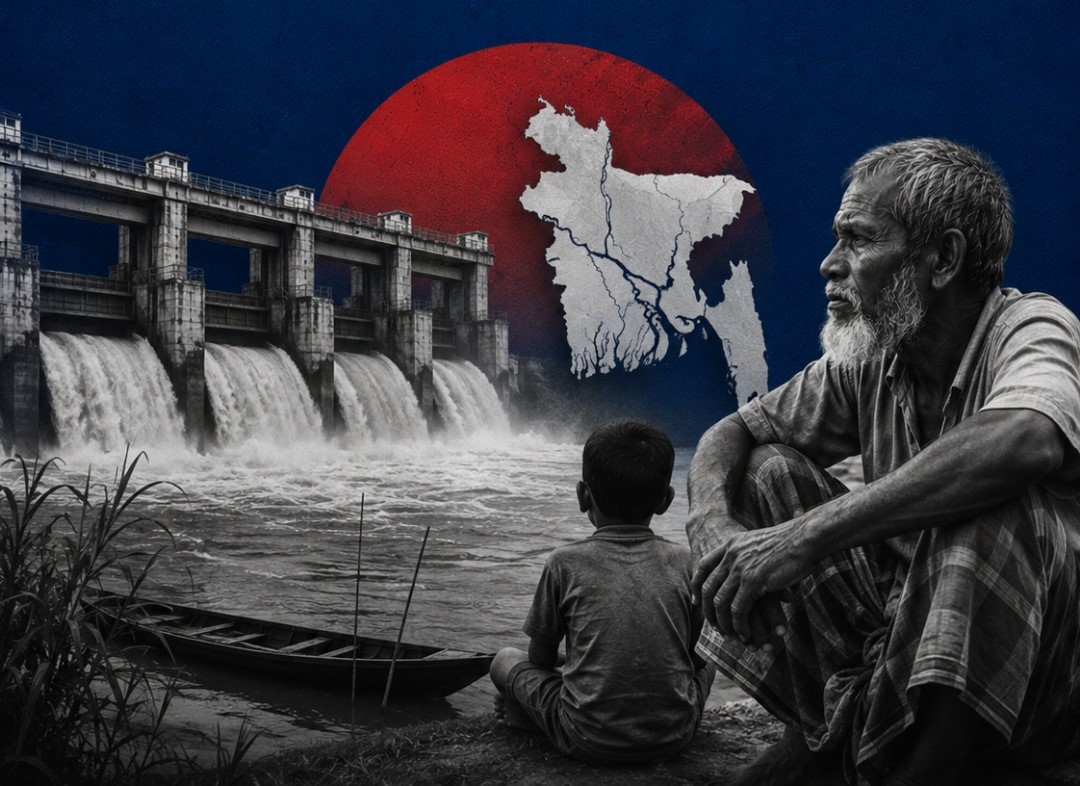
The Ganges treaty expires in 2026. Teesta remains unresolved after fifteen years. BJP now governs every state on Bangladesh’s border. And India’s water diplomacy has no answer for what happens when river sharing becomes electoral politics.
Water is where geography becomes fate. Bangladesh receives 54 major rivers that originate or pass through India before reaching its territory. It controls the flow of none of them. Every agricultural season, every fishing cycle, every household in Bangladesh’s southern districts that depends on river water for drinking and irrigation is, at some structural level, dependent on decisions made upstream, in Indian states, by Indian governments, shaped by Indian political calculations that have nothing to do with Bangladeshi livelihoods and everything to do with Indian electoral arithmetic.
This is not a conspiracy. It is hydrology. But hydrology becomes hydropolitics when the upstream country has a government that has demonstrated, repeatedly and without apology, its willingness to use every available instrument of regional leverage for domestic political purposes. And in 2026, with the Ganges Water Treaty due for renewal, the Teesta agreement still unresolved after fifteen years, and the BJP now controlling every Indian state on Bangladesh’s border, the distinction between hydrology and hydropolitics has effectively collapsed.
The Ganges Treaty Renewal: India’s Most Important Water Deadline
The Ganges Water Sharing Treaty, signed in December 1996 between Prime Minister HD Deve Gowda and Prime Minister Sheikh Hasina, established a framework for sharing the Ganges flows at Farakka during the lean season between January and May. The treaty was a landmark achievement, replacing decades of unilateral Indian control over Farakka Barrage flows with a negotiated allocation formula. It was signed for thirty years.
It expires in 2026.
The timing could not be more geopolitically complicated. The treaty renewal arrives in the same year that BJP has completed its electoral sweep of India’s Bangladesh-facing frontier, that the post-Hasina political transition in Bangladesh has produced a government still finding its India posture, that bilateral relations are already strained by border shootings, trade disruptions, and the “Bangladeshi infiltrator” rhetoric that defined BJP’s Bengal election campaign.
Water treaty negotiations require trust, institutional continuity, and a shared framework of mutual interest. Bangladesh and India are entering the Ganges renewal without adequate reserves of any of these three elements. India has not publicly indicated urgency about renewal timelines. Bangladesh’s diplomatic bandwidth is stretched across multiple simultaneous challenges. The treaty that has governed the most important shared river between the two countries for thirty years may lapse or be extended on inadequate terms simply because neither government has created the political conditions for a serious renegotiation.
If the Ganges treaty is not renewed on terms that protect Bangladesh’s dry-season allocations, the consequences are not abstract. According to World Bank assessments, reduced dry-season flow in the Ganges affects agriculture, fisheries, and groundwater recharge across Bangladesh’s western districts. Salinity intrusion, already worsening in southern coastal areas due to climate change, accelerates when freshwater flows decline. For a country of 165 million people with one of the world’s highest population densities and extreme climate vulnerability, water flow is not a diplomatic issue. It is a survival issue.
The Teesta Deadlock: Fifteen Years of Deliberate Inaction
The Teesta River originates in Sikkim, flows through West Bengal, and enters Bangladesh before joining the Brahmaputra. Bangladesh depends on Teesta flows for irrigation in its northwestern districts, particularly during the dry season from October to April. An agreement was reached at the level of both central governments in 2011 under the Manmohan Singh government and the Hasina government. The framework was essentially finalized. A framework for sharing Teesta flows was agreed upon during Singh’s scheduled visit to Dhaka in September 2011.
Mamata Banerjee refused to board the plane. She withdrew her consent to the agreement at the last moment, citing Bengal’s own water security concerns and arguing that sharing Teesta water with Bangladesh would harm Bengal’s farmers. The treaty died in the departure lounge. It has remained dead for fifteen years.
For fifteen years, India’s central government has cited West Bengal state politics as the reason it cannot conclude the Teesta agreement. For fifteen years, every Indian Prime Minister who has visited Dhaka has expressed sympathy for Bangladesh’s Teesta needs and cited state-level complications as the reason nothing has been done. For fifteen years, Bangladesh has been told that its water rights are hostage to the political calculations of a state government that it has no institutional mechanism to influence.
Now that state government has changed. BJP controls West Bengal. BJP controls the central government. The political excuse that Mamata’s obstruction made the Teesta agreement impossible has been removed. There is no longer a state government blocking the central government’s stated intention to resolve Teesta. Both are now the same party. Which means 2026 is the year India discovers whether its fifteen-year Teesta explanation was a genuine account of institutional constraints or a diplomatic convenience that served the purpose of deferring a difficult negotiation indefinitely. If BJP’s Bengal government and BJP’s central government cannot produce a Teesta agreement in 2026, the explanation that the treaty was blocked by state politics will have been revealed as precisely what Bangladesh always suspected it was.
India’s Upstream Control Architecture: Farakka to Feni
India’s control over shared river flows with Bangladesh is not limited to Farakka and Teesta. India manages upstream flows across the Feni River, the Dharla, the Monu, the Muhuri, and dozens of smaller tributaries that collectively shape Bangladesh’s agricultural and ecological landscape. The Tipaimukh Dam project in Manipur, proposed on the Barak River whose tributaries include the Surma and Kushiyara that enter Bangladesh, has generated concern in Dhaka for two decades about potential impacts on downstream flow and sediment patterns.
India’s infrastructure decisions on rivers are made unilaterally, as the sovereign right of an upstream riparian state. Bangladesh is consulted selectively and informed after decisions are made. The Joint Rivers Commission, the bilateral body established in 1972 to manage shared water resources, has produced one treaty in fifty-four years of existence. It has produced the 1996 Ganges treaty and nothing else. The Teesta agreement, technically within the JRC’s mandate, has not been concluded. The JRC meets periodically, issues communiqués, and defers the substantive disagreements to the next ministerial meeting.
For Bangladesh, the asymmetry is structural. India controls the flow. Bangladesh experiences the consequences. The institutional architecture available to Bangladesh to influence Indian upstream decisions is the JRC, the bilateral diplomatic relationship, and whatever leverage it can generate through multilateral forums and international pressure. None of these have proven sufficient to resolve the Teesta question in fifteen years. None of them will become suddenly more powerful because the BJP has won Bengal.
The Nationalism Problem: When Rivers Become Rhetoric
India’s water relationships with its neighbors have undergone a visible rhetorical shift in the past decade. The suspension of the Indus Waters Treaty with Pakistan following the Pahalgam attack, however temporary and legally contested that suspension may be, established a precedent: India is willing to deploy river treaties as instruments of political pressure rather than treating them as sacrosanct bilateral commitments insulated from political disputes.
That precedent matters for Bangladesh in ways that direct policy statements cannot fully capture. The Indus Waters Treaty was suspended not because India had a legal basis for suspension but because suspension served a domestic political narrative about resolve and strength. If that calculus can apply to Pakistan, it can theoretically apply to any bilateral water relationship where domestic political benefit exceeds the cost of treaty violation. BJP leaders campaigning in Bengal used language about Bangladesh, about “infiltrators,” about demographic threats, and about teaching Bangladesh “lessons,” that suggests the bilateral relationship is being processed primarily through a nationalist lens rather than a strategic one. A government that frames Bangladesh as a source of demographic threat for electoral purposes is not best positioned to approach Teesta or Ganges renewal as a straightforward technical water-sharing exercise.
Water nationalism, where river control is presented domestically as an expression of sovereign strength rather than a shared resource management challenge, is a tendency visible in Indian political discourse well beyond its relationship with Bangladesh. The Indus suspension, the aggressive rhetoric around Teesta, the border securitization, and the BSF communiqué about deploying crocodiles in riverine border gaps all reflect a political culture that is increasingly comfortable treating rivers as instruments of coercive statecraft.
India’s Legitimate Interests Cannot Be Ignored
India’s water allocation decisions for rivers like the Teesta are not made in a vacuum. Bengal’s farmers in districts like Jalpaiguri and Cooch Behar depend on the Teesta flows for their own irrigation. The argument that sharing water with Bangladesh reduces availability for Indian farmers in Bengal is not manufactured. It is a real distributional conflict between two sets of agricultural communities that both need water from the same river during the same dry season.
India’s broader water security concerns, shaped by Himalayan glacier retreat, irregular monsoon patterns, and increasing domestic agricultural demand, make the government cautious about committing to fixed allocations in treaties that must be honored during low- flow years. These are genuine policy constraints, not pretexts.
The problem is not that India has water interests. The problem is that India’s water interests are managed through a political process that routinely subordinates bilateral treaty obligations to domestic electoral calculations, which has allowed the Teesta question to remain unresolved for fifteen years rather than making the difficult domestic political investments needed to reach agreement, and that has demonstrated through the Indus suspension that it is willing to weaponize water relationships when political opportunity arises.
Legitimate interests, managed through illegitimate processes, produce the same outcomes as bad faith. Bangladesh experiences the downstream consequences either way.
What the 2026 Moment Requires
The Ganges treaty renewal, the Teesta resolution, and the broader framework of India- Bangladesh water diplomacy are reaching a critical inflection point simultaneously. The political conditions that made these issues tractable, a West Bengal government with some institutional empathy for Bangladesh’s concerns, a bilateral relationship built on the Hasina-Modi personal framework, a BRICS and multilateral context where both countries shared some common interests, have all changed in 2026.
India’s government, if it is serious about the “neighborhood first” doctrine it espouses in foreign policy speeches, must treat the Ganges renewal and Teesta resolution as urgent national priorities, not as problems to be managed diplomatically while being deferred substantively. The central government now controls both South Block and Nabanna. The institutional excuse for Teesta’s fifteen-year delay is gone. What remains is the political will to make it happen.
Bangladesh’s government must simultaneously build the domestic consensus and the diplomatic strategy to engage India’s new political reality without either capitulating to coercive framing or retreating into rhetorical nationalism that forecloses negotiation. Water is too important to Bangladesh’s 165 million people to be managed through the politics of pride.
Conclusion
Rivers do not respect borders. They do not recognize electoral maps or ideological realignments. The Ganges flows through Farakka whether India renews the treaty or not. The Teesta enters Bangladesh, whether or not a government in Kolkata finds it politically convenient to share it. What changes with politics is not the river. It is the terms on which human communities on both sides of the border access what the river carries.
India controls the tap. Bangladesh drinks from it. That structural fact will outlast every government in both countries. The question 2026 poses is whether the two countries will negotiate terms for sharing that water as neighbors with mutual interests or whether water will join the list of instruments through which India’s current political culture expresses its regional dominance.
The rivers have no opinion on the matter. The 165 million Bangladeshis who depend on them do.








Leave a comment