







West Bengal just concluded its most contested election in a decade. Here is everything that happened, everything that was ignored, and the one question that results on May 4 cannot
answer.
West Bengal voted on April 29, completing the second and final phase of its 2026 Assembly elections. All 294 seats have now been polled. Counting is scheduled for May 4. The results will tell you who won. They will not tell you what this election cost the people who participated in it.
Because before a single vote is counted, this election has already produced a deleted voter roll of staggering proportions, documented violence against civilians and women at polling booths, a media apparatus that covered one party’s rallies and largely ignored everyone else’s, and a Chief Minister who used the word “terrorism” to describe the conduct of election observers in her own state. That is the election Bengal just had. The results on May 4 will be a number. This is the context around it.
90 Lakh Voters. Gone.
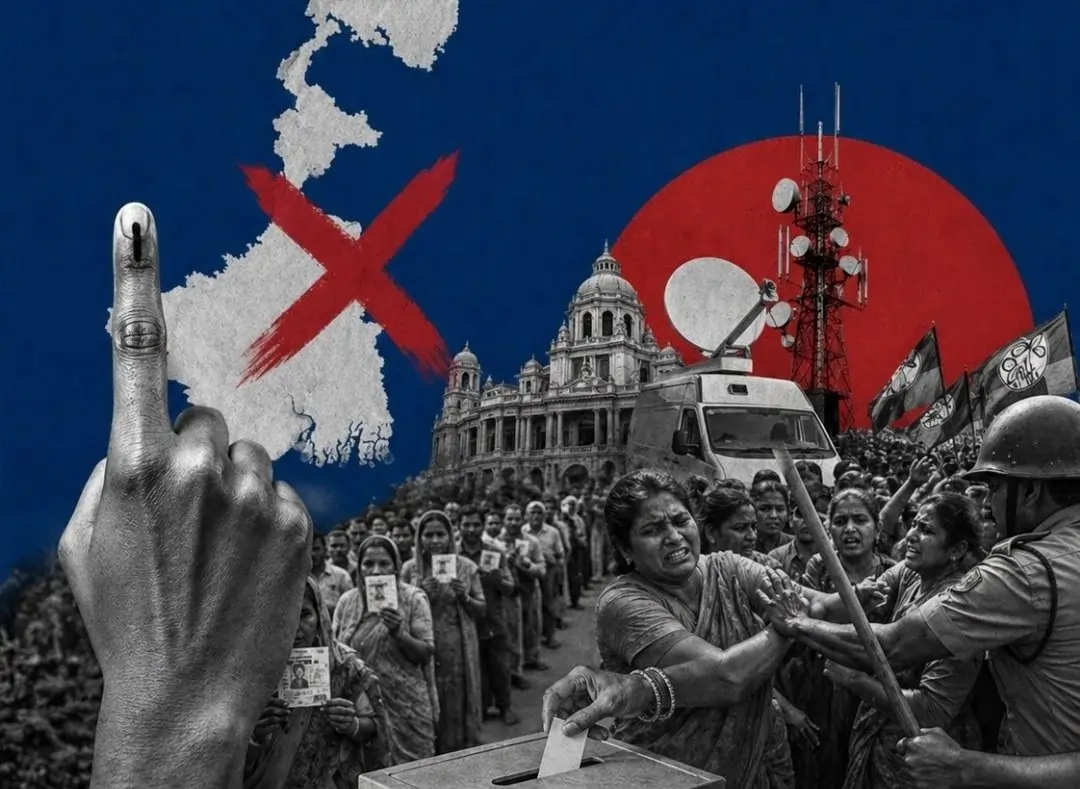
The single most consequential fact about the 2026 Bengal election is one that received far less prime-time attention than Modi’s rally speeches or Mamata’s padyatra. The Special Intensive Revision exercise, conducted by the Election Commission in the months preceding the election, deleted over 90 lakh names from the electoral rolls in West Bengal. Ninety lakh. That is nine million people who were registered voters in a previous election and were not registered voters in this one.
The Indian Express reported that of the 89 lakh names deleted, 34 lakh had approached Tribunals to contest their removal. The Hindu noted that when this deletion is factored into turnout calculations, the reported 92 percent voter turnout in Phase One begins to look statistically inflated, not because more people voted, but because the denominator, the total registered electorate, had been dramatically reduced. As The Hindu put it, the high turnout reflects “a reduced denominator rather than genuinely expanded participation.”
The Guardian covered this as its primary Bengal election story under the headline: “Millions in India stripped of vote before critical state election, as government seeks to “purify’ electoral roll.”
The communities disproportionately affected by the deletions were Muslim voters, whose concentration in certain constituencies and whose voting patterns make their electoral participation a matter of direct political consequence. Whether the SIR was a legitimate exercise in voter list accuracy or a targeted suppression of specific communities is a question the Election Commission has not answered with any specificity, and Indian television news largely declined to ask.
Violence at the Booths
Elections in Bengal have a long history of booth-level intimidation and political violence. The 2026 election continued that tradition, with documented incidents across both phases that drew sharp responses from both parties, each accusing the other.
What distinguishes this election is the scale and nature of reported violence against women. Multiple reports documented women being beaten, pushed, and physically prevented from accessing polling booths in various constituencies. Women voters who attempted to cast ballots independently, without the guidance or accompaniment of party workers, reported intimidation. The Meira Paibi-style resistance, women forming human chains to protect the electoral process, which has historical precedent in Northeast Indian elections, had echoes in how some Bengal communities attempted to self-organize for protection at booths.
Chief Minister Mamata Banerjee, campaigning in her Bhabanipur constituency on April 29, made accusations that went beyond standard electoral complaints. She described the conduct of certain election observers as “hooliganism” and, in some reports, used the word “terrorism” to characterize their actions. “Votes will be cast by voters, not by the police or security forces,” she said. “The BJP wants to forcefully rig the election.”
The BJP dismissed these allegations as pre-result narrative management, with Suvendu Adhikari and other party leaders calling them baseless. They argued that central forces were deployed precisely because Bengal’s election history under TMC involved documented booth capture and intimidation of opposition voters. Both parties have documented histories of electoral violence in Bengal. That documented history does not make any specific 2026 allegation automatically true or automatically false. It makes independent investigation essential and its absence conspicuous.
The Media Asymmetry Nobody Wants to Name
The Press Institute of India’s media monitoring, documented by journalist Shailaja Bajpai, found a clear and consistent pattern in television news coverage of the Bengal election. Live coverage of speeches, roadshows, and rallies was overwhelmingly allocated to BJP leaders: Prime Minister Modi, Home Minister Amit Shah, Uttar Pradesh Chief Minister Yogi Adityanath. TMC rallies received occasional brief coverage. CPI(M) and Congress, parties with deep Bengal roots, were virtually absent from television news entirely.
On the final day of campaigning on April 27, television coverage was dominated by Modi’s speech, his cavalcade, Yogi’s rally, and Shah’s roadshow. Glimpses of Mamata Banerjee’s padyatra appeared occasionally. The Left and Congress were functionally invisible on national television despite contesting seats in a state where CPI(M) governed for 34 consecutive years.
This asymmetry in coverage is not neutral. In a state where many voters form their electoral impressions partly through media, the allocation of airtime functions as an invisible thumb on the scale. When national television covers one party’s final campaign day in full and another’s in glimpses, it is making an editorial choice with political consequences, whether or not any specific instruction was given.
The more absurd dimension of the coverage involved television reporters on polling day pressing Muslim women voters to say something on camera about their choice. When the women declined or gave noncommittal answers, reporters on at least one channel responded with visible frustration. The voters’ right to privacy was apparently less important than filling broadcast time with community-specific vox pops.
What This Election Is Actually About
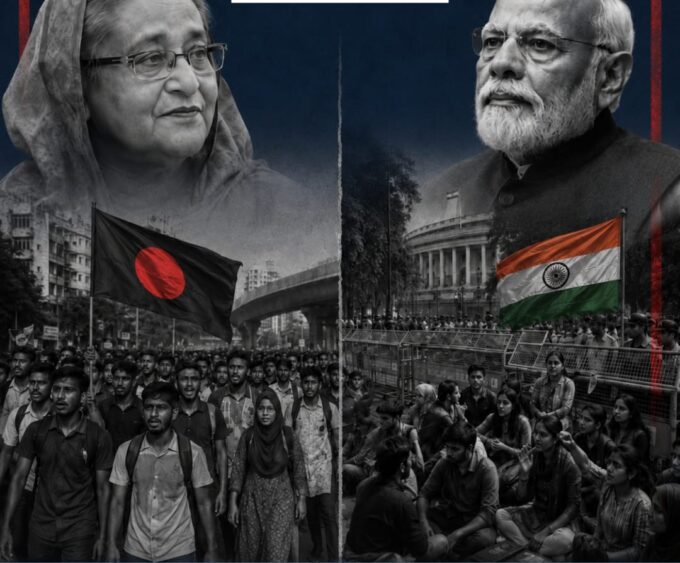
The framing of Bengal 2026 as “Didi vs. Modi” captures the electoral theater but misses the substantive stakes. Mamata Banerjee seeks a fourth consecutive term for TMC, governing a state that has real governance failures: documented crimes against women, corruption allegations, development gaps in districts outside Kolkata, and a party organizational culture that tolerates booth-level intimidation when it serves TMC’s interests.
The BJP seeks to break a state where it has never governed, using a combination of Hindu nationalist mobilization, infiltration rhetoric targeted at Muslim communities, and genuine anti-incumbency sentiment against fifteen years of TMC rule. Its campaign featured the full deployment of central government resources: the Prime Minister’s personal presence, the Home Minister’s rallies, the UP Chief Minister’s appearances, and the central security force deployment that Mamata characterizes as partisan interference.
Both parties have credible accusations to make about each other. Neither has a clean record in Bengal. The 90 lakh deleted voters, the booth violence, the media coverage asymmetry, and the allegations of observer interference sit above the partisan divide. They are questions about the integrity of the electoral process itself, not about which party wins.
The Question May 4 Cannot Answer
Results on May 4 will determine whether TMC wins a fourth term or whether BJP achieves its most significant state-level breakthrough. Political analysts have described the contest as genuinely close, a “kaante ki takkar,” though most in-depth newspaper analysis suggests this election remains Mamata’s to lose, given her incumbency advantages, the TMC’s organizational strength at the booth level, and the BJP’s persistent failure to identify a credible Bengali Chief Ministerial face.
What the result cannot answer is whether the 34 lakh people who approached Tribunals to contest their voter list deletion were legitimate voters who were wrongfully removed. It cannot tell us whether the women beaten at booths received any accountability. It cannot explain the media’s decision to cover one party’s campaign as the default and another’s as an occasional digression.
Those questions do not resolve on May 4. They accumulate. Election by election, deletion by deletion, booth by booth, they accumulate into a picture of what Indian democracy is actually becoming, not in the speeches about the world’s largest democracy but in the experience of the voter who shows up at a booth and is told their name is not on the list, or the woman who is pushed away before she can cast her ballot, or the nine million people whose participation in this election was decided not by their own choice but by an administrative exercise that nobody in power wants to examine too closely.
Bengal voted. India should be paying attention to more than the result.






Leave a comment