









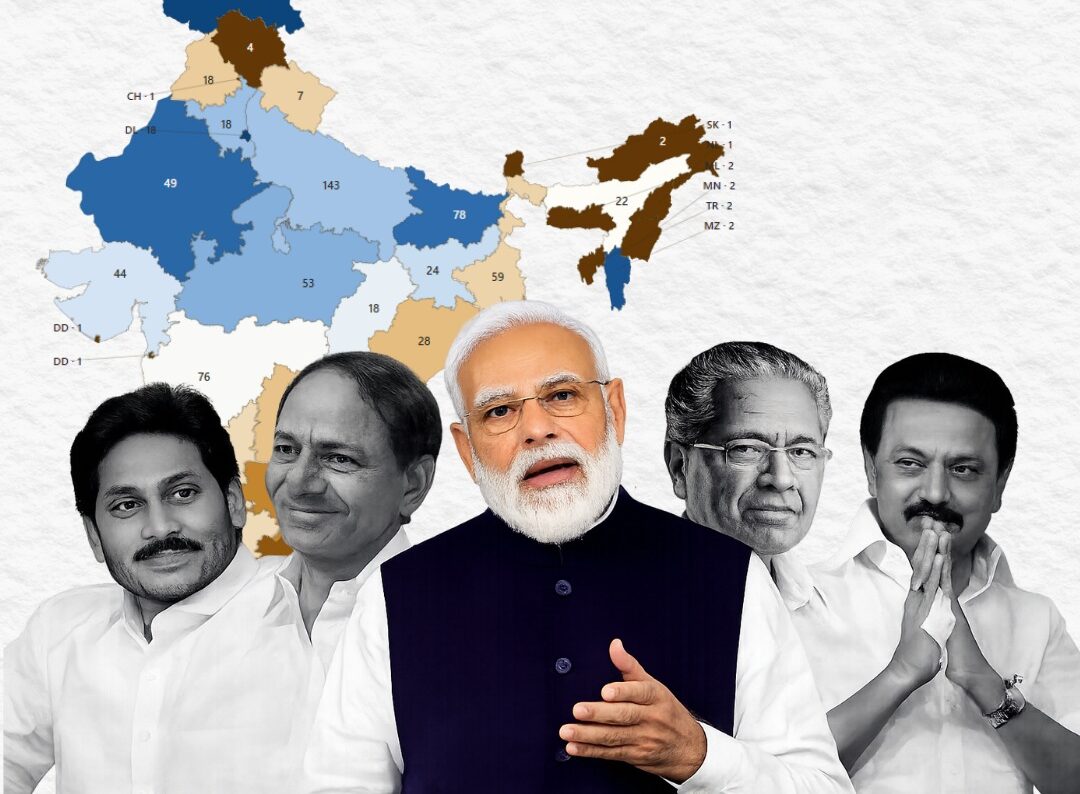
India’s Delimitation Bill 2026 is the most consequential redrawing of political power since independence. An interactive data explorer built on public census figures shows exactly who wins, who loses, and why the South is right to be afraid.
The Modi government introduced three bills in Parliament on 16 April that together constitute the most significant restructuring of Indian democracy since the 1971 census froze representation for the next half century. The Constitution (131st Amendment) Bill, 2026, increases the maximum number of seats in Lok Sabha from 550 to 850, with 815 from states and 35 from Union Territories. A Delimitation Bill and a Union Territories Laws Amendment Bill accompanied it.
The government calls it fairer representation. Southern India calls it demographic punishment. The data, drawn from public census and economic figures and modeled across five allocation formulas in an interactive tool built by researcher Chirag Patnaik, shows that both descriptions are simultaneously true, depending entirely on which state you live in.
The Freeze That Created This Crisis
To understand what is happening now, understand what happened in 1976. Prime Minister Indira Gandhi’s government passed the 42nd Constitutional Amendment, freezing parliamentary seat allocations at 1971 census levels. The stated purpose was to prevent states from being penalized for successfully controlling their populations. If seats tracked population, states that reduced fertility rates would lose representation. The freeze was meant to incentivize family planning nationwide.
Representation Imbalance Today
| State | Population (Approx) | Lok Sabha Seats | People per MP |
| Uttar Pradesh | ~240 million | 80 | ~3 million |
| Bihar | ~130 million | 40 | ~3.2 million |
| Tamil Nadu | ~80 million | 39 | ~2 million |
| Kerala | ~35 million | 20 | ~1.7 million |
The freeze was extended by the 84th Amendment in 2001 until after the 2026 census. A limited delimitation in 2008 redrawn constituency boundaries within states without altering total seat counts.
Fifty years later, the demographic consequences are stark. Tamil Nadu, Kerala, Karnataka, Andhra Pradesh, and Telangana implemented family planning effectively. Their populations grew slowly. Uttar Pradesh, Bihar, Madhya Pradesh, and Rajasthan did not. Their populations grew rapidly. Under the frozen allocation, a voter in UP is represented by far fewer MPs per capita than a voter in Tamil Nadu. The argument for delimitation, on pure democratic grounds, is not entirely wrong.
The argument against it is that the states being rewarded with more seats are precisely the states that ignored the policy the freeze was designed to incentivize. And the states being effectively punished are the ones that followed it.
What the Data Actually Shows
The Lok Sabha delimitation explorer built by Chirag Patnaik models five different formulas for allocating 850 seats using 2026 projected population data from the Ministry of Health and Family Welfare and 2023-24 GSDP figures from MOSPI.
Under pure population allocation, the results are the most dramatic. Uttar Pradesh gains 63 seats and Bihar gains 39 under an 848-seat expansion based on projected 2026 population. Meanwhile, Tamil Nadu and Kerala see their share of the house shrink significantly, even if their absolute seat numbers increase marginally, because everyone else gains proportionally more.
Regional Power Shift After Delimitation
| Region | Current Share | Post-Delimitation Trend |
| North India | Dominant | Strong Increase |
| South India | Moderate | Declining Share |
| West India | Stable | Slight Change |
| East India | Moderate | Increase |
The key distinction the explorer makes visible is between gaining seats and gaining share of the house. A state can receive more seats in absolute terms while simultaneously losing voting weight in Parliament, because its share of the total floor has declined. This is the arithmetic the southern Chief Ministers are fighting about. It is also the arithmetic that most national media coverage of delimitation consistently fails to explain.Seat Gain Vs. Power Loss
| State Type | Seats Gained | Share of Lok Sabha | Net Political Power |
| High-growth states (UP, Bihar) | High | Increase | Gain |
| Low-growth states (TN, Kerala) | Moderate | Decrease | Loss |
Southern states are not losing seats; they are losing relative influence.
Population Vs Governance Divide
| Factor | North India | South India |
| Population Growth | High | Low |
| Fertility Rate | Higher | Below replacement |
| GDP Contribution | Moderate | High |
| Human Development | Lower | Higher |
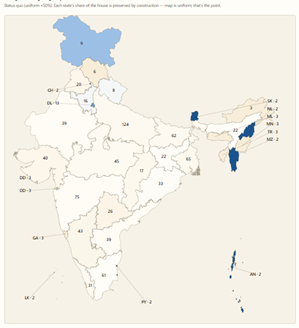
Under the Status Quo model, where each state’s seat count grows proportionally by 50 percent preserving current share, no state loses relative weight. But the explorer’s methodology notes that Article 81’s equal-ratio mandate arguably points to pure population as the constitutionally required method, and the bill is explicitly silent on which inter-unit allocation rule the Delimitation Commission must follow. That silence is not accidental. It is where the political contest will be decided.
The Five Models and What They Mean
The explorer presents five formulas, each producing different winners and losers:
- Pure Population gives each state seats in direct proportion to the projected 2026 population. UP and Bihar gain enormously. Southern states gain seats but lose House share.
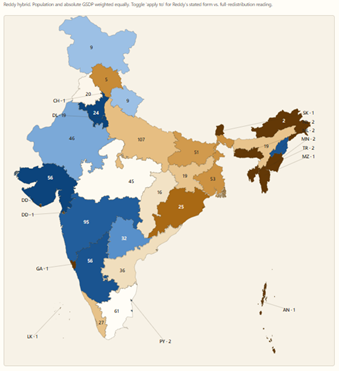
- Reddy Hybrid splits seat allocation 50-50 between population and absolute state GDP, as proposed by Telangana Chief Minister Revanth Reddy. This rewards economically productive states and reduces the pure population penalty on the south. Under this model, applied only to the 285 new seats, southern states gain meaningfully more than under pure population.
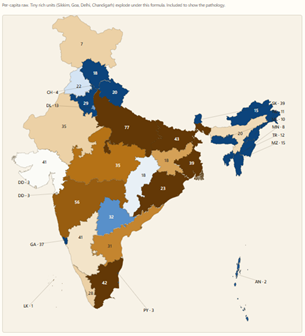
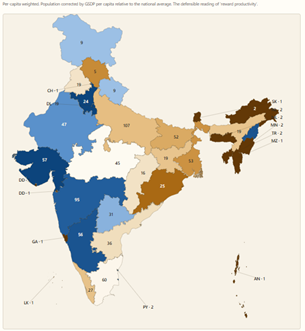
- Per-Capita Raw substitutes per-capita GDP for absolute GDP in the hybrid formula. This gives outsized weight to small wealthy units and is included primarily to demonstrate what “rewarding productivity” means, taken to its logical extreme.
- Per-Capita Weighted multiplies each state’s population by its per-capita GDP relative to the national average, then applies the hybrid split. This is described in the explorer’s methodology as “the more defensible reading” of the productivity-rewarding intuition.
The political fight is between the first two models. The government’s bill is constitutionally oriented toward the pure population. Southern states are pushing for some version of the hybrid formulas.
The Reserved Seats Dimension
A hidden consequence of reapportionment that receives almost no coverage is the effect on constitutionally reserved seats for the Scheduled Castes and the Scheduled Tribes. Slower- growing southern states stand to lose reserved seats, while faster-growing northern states stand to gain them.
This is not a minor procedural detail. Reserved constituencies shape which communities have direct parliamentary representation, which local issues reach the floor of the house, and which political careers are possible. A delimitation that redistributes reserved constituencies from south to north restructures representation for Dalit and tribal communities across the country simultaneously.
The BJP Simulation That Explains Everything
Researchers Vaishnav and Hintson simulated the 2014 Lok Sabha election results using a reapportioned map based on the 2011 census. Assuming the proportion of seats won by each party remained unchanged, their simulation indicated the BJP’s majority would have increased from 282 to 299 seats, largely at the expense of southern regional parties.
That single finding explains the political urgency behind the 131st Amendment Bill. Delimitation based on population, applied to an 850-seat house, produces a structural advantage for the BJP in any election where its vote share in northern states remains what it was in 2014. Southern regional parties, which currently hold significant blocking power in Parliament through their seat counts, would see that power reduced. The Congress, whose southern presence is proportionally stronger than its northern presence, loses leverage. The national opposition’s ability to constrain a BJP majority weakens.
The Constitutional Tension
The Constitution Amendment Bill changes Article 81 to allow Parliament to decide by law when to carry out delimitation and which census to use, with a simple majority. Given that the government has a simple majority in the Lok Sabha and the bill weakens the Rajya Sabha’s relative control over legislation READ MORE, the government could effectively control the timing and census basis of delimitation through ordinary parliamentary procedure.
This is a significant constitutional shift. The decision about which census to use, when to delimit, and therefore how to allocate political power across states, moves from a constitutionally mandated process into a parliamentary-controlled one. In a Westminster system where the ruling party controls Parliament, that is, functionally, the executive controls its own electoral geography.
The Delhi Anomaly
One counterintuitive finding from the explorer’s methodology deserves attention. Because states and Union Territories draw from separate seat pools, a Delhi resident ends up with approximately 50 percent more parliamentary representation per head than a resident of neighboring Haryana. Delhi, with 2.2 crore people, gets around 18 seats from the UT pool. Haryana, with 3.1 crore people, also gets around 18 seats from the state pool. This is not a modeling quirk. It is a feature of the constitutional architecture that the 131st Amendment does not address.
Conclusion
The delimitation debate is being presented in national media as a technical exercise in democratic fairness. The data says something more precise. It is a transfer of political weight from states that controlled their populations to states that did not, structured in a way that systematically benefits the ruling party’s existing strongholds, decided by a constitutional amendment that gives the executive significant control over the timing and methodology of the exercise itself.
The south is not being paranoid. The numbers in Chirag Patnaik’s explorer, built entirely from public government data, show exactly what the arithmetic produces under each formula. The question India must answer before the Delimitation Commission is
The question is a simple one: should a democracy reward states that followed national policy, or should it reward states that produced more people?
That question does not have a clean answer. But it does have political consequences. And they are written clearly in every model that the data supports





Leave a comment