













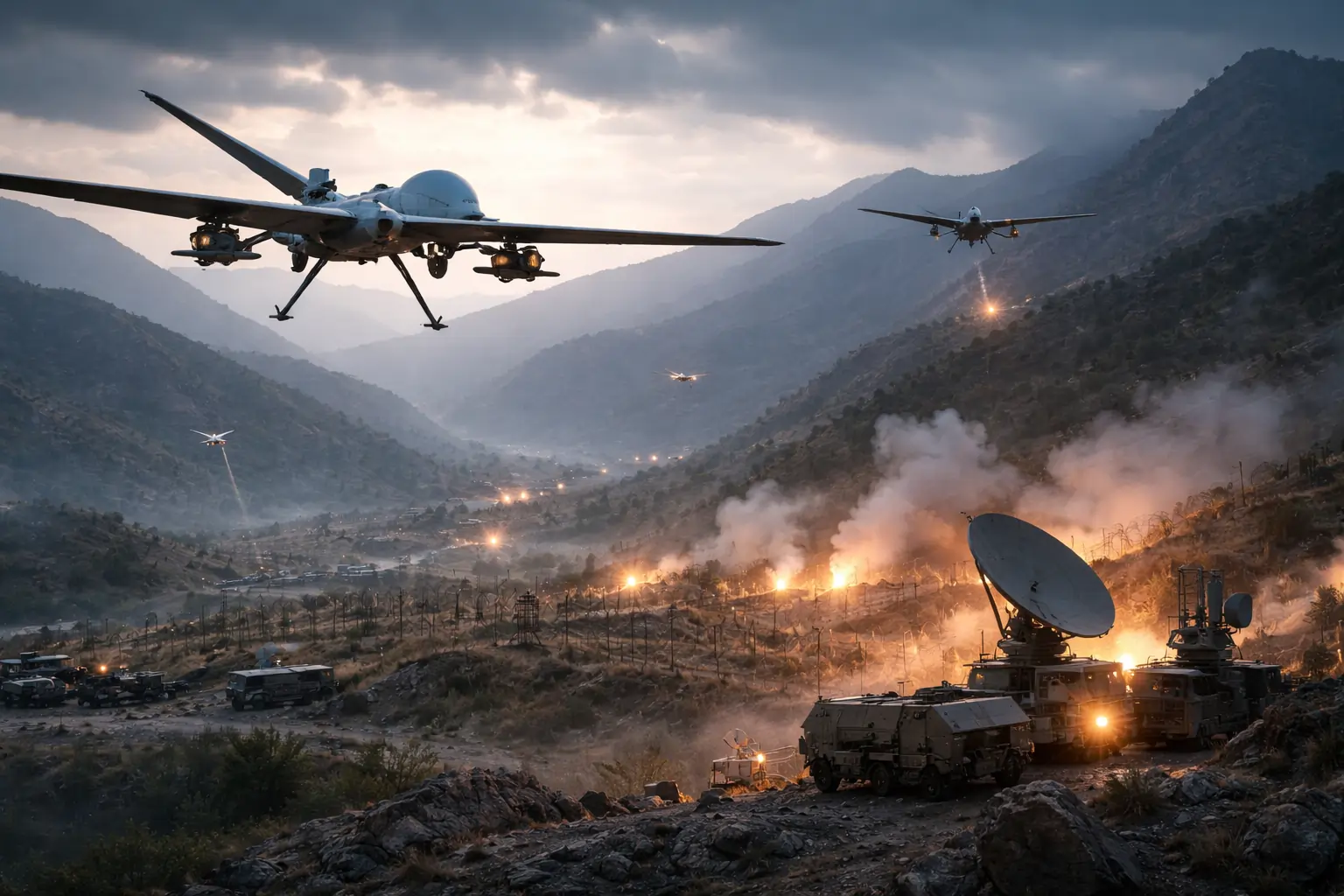
The rapid proliferation of unmanned aerial systems (UAS) has fundamentally transformed the India-Pakistan military rivalry. Traditional dependence on manned aircraft and large-scale ground operations is giving way to low-cost precision, persistent surveillance, deniable strikes, and ambiguous escalation. Along the militarized Line of Control (LOC), drones of all types ranging from commercial quadcopters for reconnaissance to advanced medium-altitude long-endurance (MALE) and high-altitude long-endurance (HALE) strike platforms have become integral tools of warfare. May 2025 became a pivotal moment with the first large-scale deployment of drones by both countries for surveillance and to test and strike the locations of command-and-control systems and operational preparedness of the air defense systems of the oppositions. This also signaled a change in the way wars could be planned and fought.
The use of drones in South Asia has lowered the threshold for the use of military force, made the assignment of responsibility for military actions unclear, and accelerated the military decision-making process. The growing autonomy and the increasing capability of these systems amplify the risks of miscalculation and explains the rising dangers associated with these systems in a nuclear setting. The India-Pakistan drone race needs to be understood in the context of the global revolution in unmanned warfare systems and not just in relation to the subcontinent.
Global Drone Revolution: Lessons for South Asia
Drones have revolutionized global conflict in ways unmatched by conventional technologies in the last decade. Israel’s engagements with Iran and its proxy networks demonstrate how loitering munitions and precision UAVs can enhance or replace manned operations in contested airspace. Azerbaijan’s victories against Armenia in 2020 and 2023 highlighted the effectiveness of platforms like the Turkish Bayraktar TB2 in neutralizing armored vehicles, artillery, logistics centers, and radar systems.
The conflict in Ukraine illustrates a novel paradigm: economical FPV drones, makeshift quadcopters, and long-range UAVs have eroded Russia’s numerical and technological dominance. These examples demonstrate how mass innovation, rapid adaptation, and cost-effective precision can erode traditional military power and aerial defense mechanisms. Indian and Pakistani strategists carefully monitor these developments, recognizing drones as tools that enable accurate strikes without the political risks linked to manned missions, weaken traditional defenses at a low cost, and offer plausible deniability for coercive actions.
Pakistan’s Drone Strategy: Versatility and Adjustment
Pakistan has employed adaptability, innovative procurement strategies, and modularity to augment its drone capabilities. The domestically developed Burraq UCAV program, supported by China, laid the groundwork for more advanced systems. Moreover, Turkish Bayraktar TB2s and Chinese CH-4 and Wing Loong UAVs have enhanced Pakistan’s operational capabilities. Pakistan’s proficiency is founded on improvisation: commercially available drones are often converted into loitering munitions for anti-armor, anti-radar, and deep-strike missions. Swarming tactics, coupled with brigade-level intelligence, surveillance, and reconnaissance (ISR) systems, enable real-time reconnaissance, artillery targeting, and rapid engagement, producing asymmetric advantages despite limited industrial capacity.
India’s Drone Development: Sophisticated ISR and Technological Integration
India’s drone strategy emphasizes sophisticated ISR platforms, foreign technologies, and domestic innovation. The Israeli Heron MALE drones and the MQ-9B Sky/Sea Guardian augment continuous surveillance, maritime oversight, and inter-service collaboration. Indigenous projects like the Ghatak UCAV and Loyal Wingman aim to develop stealthy, autonomous strike UAVs integrated into India’s command and sensor networks. India’s investments in electro-optical/infrared (EO/IR) systems improve comprehensive surveillance, precise targeting, and maritime situational awareness. Pakistan underscores economic adaptability, while India focuses on advanced ISR, multi-layered air defense, and technological integration; however, both countries are increasingly aligning operationally in domains such as continuous reconnaissance, rapid targeting, and joint-force coordination.
The India-Pakistan Crisis of May 2025: An Escalation Driven by Drones
The May 2025 crisis highlighted the strategic and operational significance of drones. Both nations utilized UAVs to assess defenses, observe troop movements, and execute targeted strikes on critical installations. Unlike prior instances, drones were utilized as instruments of coercive signaling: sufficiently visible to demonstrate resolve, yet plausible to disavow to avert significant retaliation.
Drones evaluated radar coverage, detected low-altitude defense weaknesses, and performed stand-off targeting of logistical hubs. Regular incursions compromised interception capabilities and provided real-time intelligence regarding enemy deployments. These operations revealed vulnerabilities in air and missile defense systems, which struggled to counter small, low-observable UAVs, especially in swarm formations. In the nuclear zone, misinterpretation of UAV operations could easily escalate tensions.
Emerging Technologies and Potential Risks
Emerging UAV technologies are likely to heighten escalation risks. Augmented autonomy, terrain-adaptive navigation, and anti-radiation capabilities empower drones to evade jamming and neutralize enemy air defenses. Miniaturized loitering munitions present a danger to fortified installations, including airbases and missile sites. Drones are unlikely to transport nuclear payloads; nonetheless, their proximity to vital civilian and military facilities increases the risk of misinterpretation and inadvertent escalation.
India and Pakistan are executing divergent counter-UAS strategies. India emphasizes multilayered defense systems, High Altitude Long Endurance (HALE) surveillance, and advanced optical and radio frequency tracking, whereas Pakistan concentrates on redundancy, mobility, and economic electronic countermeasures. Both exhibit structural asymmetries: low-cost offensive UAVs require disproportionately expensive defensive measures, intensifying the competitive and escalatory dynamics of the region.
Drones and Escalatory Instability
Researchers associate unmanned systems with deterrence instability and crisis escalation. Autonomous UAVs and swarming tactics increase operational velocity and reduce decision-making intervals, consequently heightening the risk of miscalculation in nuclear scenarios. Continuous ISR and rapid strike capabilities facilitate pre-emption, while deniability, speed, and precision complicate conventional deterrence evaluations and impede attribution during crises.
Navigating the Era of Unmanned Systems in South Asia
The India-Pakistan rivalry has evolved into the age of unmanned systems. Drones presently impact military operations, crisis dynamics, and strategic signaling. Observations from Ukraine, the Middle East, and the Caucasus indicate that developments in drone technology consistently outpace existing doctrine and countermeasures. Future battlefields will be saturated with autonomous systems adept at surveillance, deception, jamming, and precision strikes.
The principal challenge for India and Pakistan is alleviating the escalation risks associated with drones. This necessitates mountable counter-UAS capabilities, resilient communication networks for UAV incidents, confidence-building initiatives, and continuous investment in domestic secure technologies. In the absence of these measures, crises driven by drones may intensify, constricting decision-making parameters and heightening the risk of unintended escalation in one of the globe’s most unstable regions.










Leave a comment