





New Delhi’s foreign policy failures have quietly handed South Asia to Beijing, one neighbor at a time
India shares borders with seven nations. Seven opportunities to build trust, trade corridors, and a sphere of natural influence in its own backyard. Yet in 2026, as Balen Shah, a politician who publicly displayed maps claiming Indian territories, prepares to lead Nepal, the question is no longer strategic; it is embarrassing. How did the world’s most populous democracy become the most distrusted country in its own neighborhood?
The answer is not complicated. It is just uncomfortable.
The Pattern Nobody in South Block Will Admit
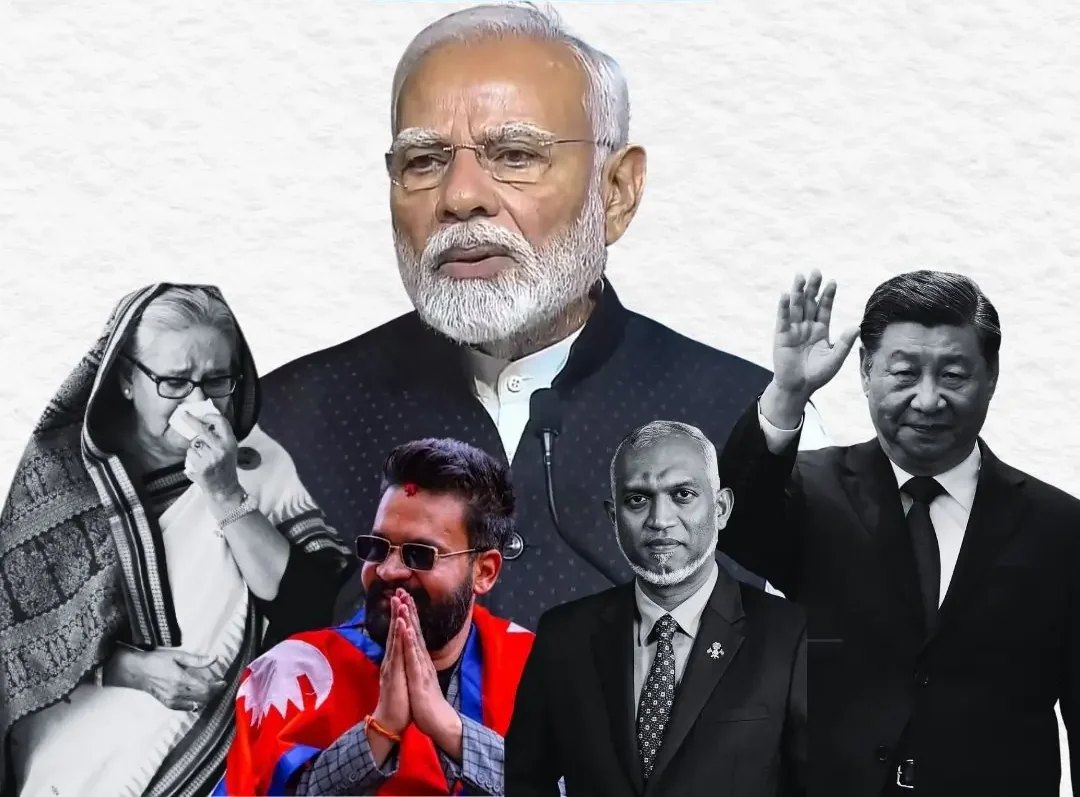
Walk through each neighbor and the same story repeats itself, wearing different costumes. Maldives: India assumed decades of goodwill were permanent, did nothing while China quietly funded infrastructure, and woke up to “India Out” protests and President Muizzu’s election campaign built entirely on removing Indian military presence. According to Maldivian election data from 2023, Muizzu won decisively. China became their largest bilateral partner almost overnight.
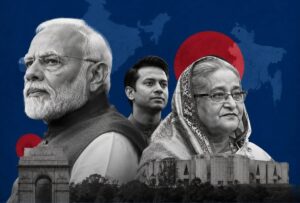
Bangladesh: India backed Sheikh Hasina so completely that when she fell in 2024, New Delhi had no channel left to the opposition, no bridge to the incoming government, and no credibility on the street. The Teesta water dispute, unresolved for over two decades despite dozens of bilateral meetings, remains a raw wound. You cannot claim to be a development partner while holding back a river.
Sri Lanka: China now holds Hambantota Port on a 99-year lease signed in 2017. India offered emergency credit lines during the 2022 collapse. China already owned the port. Too little, structurally too late.
Nepal: The Most Dangerous Miscalculation
Of all India’s neighborhood failures, Nepal is the one that should keep South Block awake at night. Balen Shah’s Rastriya Swatantra Party’s landslide win in March 2026 is not a routine political transition. As Kathmandu’s mayor, Shah displayed “Greater Nepal” maps in the capital, publicly asserting claims over Indian territories including Kalapani and Lipulekh. He banned Indian films. His party now wants to revisit the foundational 1950 India-Nepal Treaty.
How did India manufacture this outcome? The 2015 blockade. When Nepal adopted a constitution India disapproved of, New Delhi allowed an economic blockade that cut off fuel and medical supplies to a landlocked nation still reeling from a devastating earthquake. It was not firm diplomacy. It was punishment. And it created an entire generation of Nepali voters for whom anti-India sentiment is not ideology but lived experience.
Former Indian Foreign Secretary Shyam Saran, writing in The Hindu, observed bluntly:
“India’s Nepal policy has oscillated between indifference and heavy-handedness, neither of which serves our interests.”
He was being generous.
China’s Playbook Is Not Secret
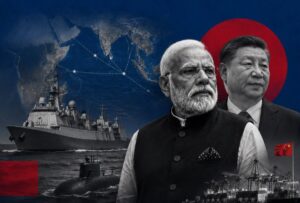
China does not lecture. It builds. Roads in Nepal, ports in Sri Lanka, airports in Maldives, CPEC’s $62 billion investment corridor through Pakistan. Beijing does not ask neighbors to choose values. It writes checks and shows up with engineers. India arrives with conditions, political preferences, and a deeply patronizing assumption that geography equals loyalty. As former National Security Advisor Shivshankar Menon noted in his book Choices, “India’s neighborhood policy has repeatedly confused proximity with influence.”
That distinction has cost India enormously.
Myanmar and China: A Study in Contrast
After Myanmar’s 2021 military coup, India went quiet. No position, no pressure, no clarity. China backed the junta decisively and maintained its infrastructure projects without hesitation. India’s silence was not neutrality. It was irrelevance dressed up as strategic patience.
Bhutan Is Not a Victory, It Is a Warning
India points to Bhutan as proof its neighborhood policy works. But Bhutan’s loyalty rests on specific treaty arrangements and security guarantees, not on genuine goodwill built over decades. It is a single data point, and a fragile one.
India’s foreign policy establishment is sophisticated, well-educated, and deeply
experienced. That makes this failure more troubling, not less. These were not accidents of geography or history. They were choices made in South Block, meeting rooms where arrogance substituted for strategy and domestic political calculations overrode long-term national interest.
Seven neighbors. One friend. And even Bhutan is watching.
The question is not whether India can recover its neighborhood standing. It is whether anyone in power is honest enough to admit it was lost.






Leave a comment