




February 25, 2009. While the world watched what appeared to be an internal military mutiny at Bangladesh’s Pilkhana BDR headquarters, 74 people-including 57 of the nation’s top army officers-were being systematically slaughtered in what a 2025 investigation now calls a “deliberate move to weaken the military” orchestrated with foreign intelligence support. The National Independent Investigation Commission, led by retired Major General ALM Fazlur Rahman, submitted its explosive 360-page report in November 2025 after 11 months of investigation. The findings name former Prime Minister Sheikh Hasina, her nephew Barrister Sheikh Fazle Noor Taposh, and multiple Awami League leaders as conspirators.
A Foreign Hand in the Killings: The Black Cats
Multiple testimonies paint a chilling picture of foreign involvement. Captain Tanvir Haider Noor, moments before he disappeared forever, called his wife in a frantic state to report the presence of Indian National Security Guard commandos inside Pilkhana. His wife, Tasnuva Maha, told investigators she heard three men talking with each other in Hindi.
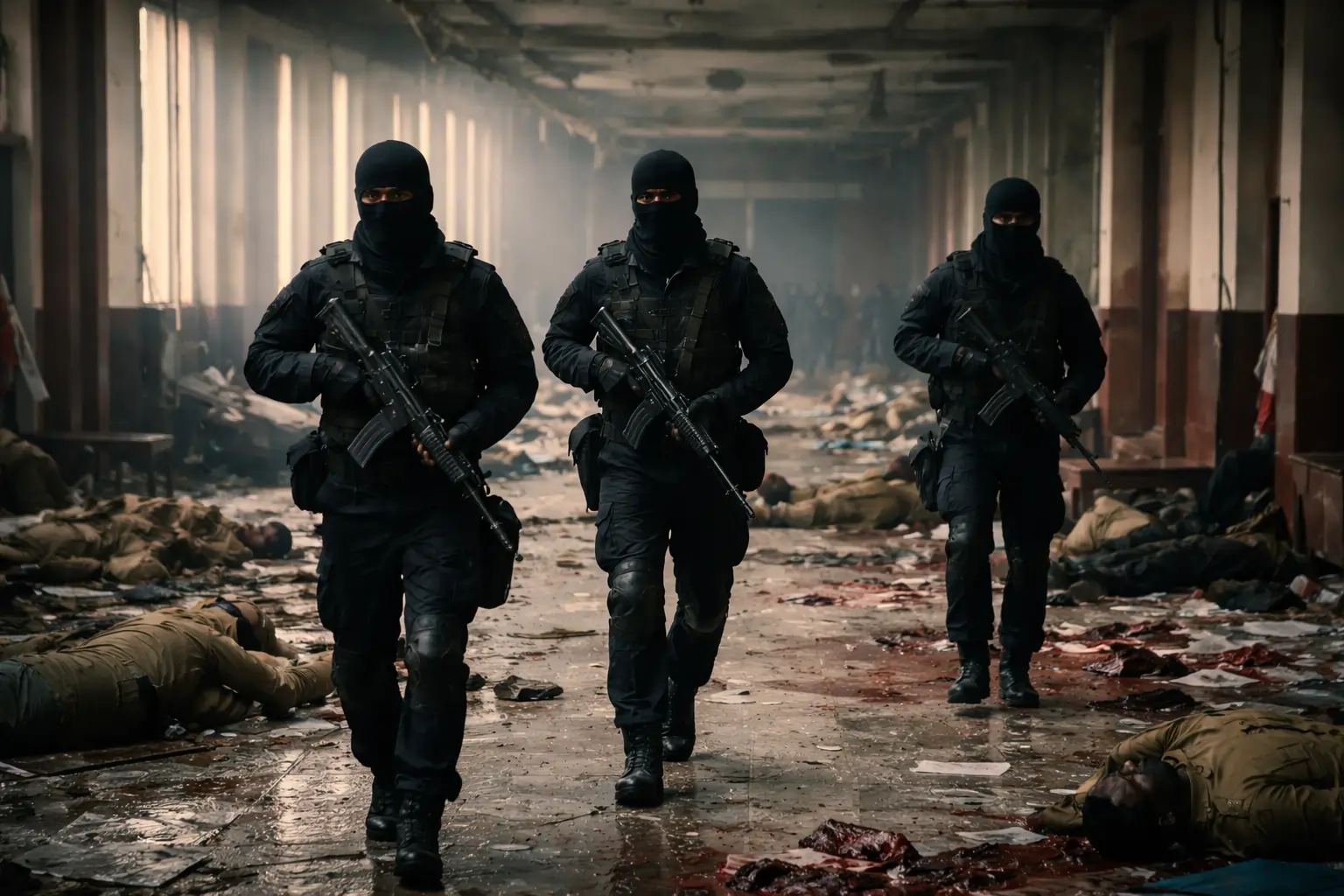
According to surviving BDR soldiers’ testimonies compiled in the commission report, the actual massacre was not led by regular troops but orchestrated by “a specific team of 12 to 14 men” whom soldiers “had never seen before.” Their appearance violated every military code: brand new BDR uniforms that looked untouched, faces hidden behind black cloth masks, and most shockingly, some killers had long hair-strictly prohibited in the army. Brigadier General Hassan Nasir, who led an initial investigation team, confirmed the existence of this 14-member squad. Leaked documents from WikiLeaks suggested the number was slightly higher-a 15-member elite team sent “for a specific purpose: to decapitate the leadership of the Bangladesh army.”
The commission’s findings on Indian passport holders are particularly damning. Between February 24-27, 2009, 827 Indian passport holders entered Bangladesh, with 65 having no exit records. Meanwhile, 1,221 Indian passport holders exited during the same period, with 57 having no record of entry. According to the investigation, four Indian RAW agents met at Taposh’s office and residence to plan the attack. Twenty Indian commandos were directly implicated in planning and executing the operation. The timing, the numbers, the missing records, all point to a covert military operation disguised as internal rebellion.
The Execution: A Timetable of Massacre
The precision of the attack reveals meticulous planning. On the night of February 24, the alleged commando team crossed into Bangladesh through Benipole landport and traveled straight to Dhaka’s Farmgate area. They checked into the Imperial Guest House owned by Awami League leader and then-Home Minister Sahara Khatun, staying overnight to prepare for the assault. On the morning of February 25, they remained there until 9:00a.m. At exactly 9:20 a.m., a gray microbus carried the killer team into Pilkhana, already dressed in BDR uniforms supplied the previous night, according to intelligence sources. Six minutes later, at 9:26 a.m., soldiers of the 44th and 36th battalions started the rebellion- but crucially, they only had blank ammunition used for training. Real lethal firepower arrived at 10:20 a.m. when a pickup van sent by Awami League leader Salem entered the compound carrying special gear and assault rifles.
The killing began shortly before 11:00 a.m. There were 132 officers present that day, but the killer team had a hit list, they hunted down specific brilliant officers. In the Darbar Hall, officers were massacred by brush fire. Those who tried to hide were hunted down one by one. Major General (retd) Abdul Matin told a press conference in September 2024: “The Pilkhana killings did not take place only for Operation Dal-Bhat or to increase the ration. This murder has been carried out as a long-term plan. This murder is intended to make Bangladesh a part of India.”
By 9:00 p.m. on February 25, the mission was complete. The cleanup operation began. Home Minister Sahara Khatun entered Pilkhana with a convoy of four vehicles, including Red Crescent vans and the Prime Minister’s special ambulance. During this time, electricity to Pilkhana was deliberately cut off. Under total darkness, the killers exited the compound inside those very ambulances. One team allegedly fled via Shahjalal International Airport to the Middle East that night. The second team escaped via Osmani Airport on February 28.
The Cover-Up: Silenced Witnesses and Forced Disappearances
Those who knew about the foreign commandos’ presence or dared to speak faced grim consequences. Major Suman, then-commander of the 46th Brigade, opened his mouth about the presence of the “Black Cats” the nickname for India’s National Security Guard Commandos. He was forcibly disappeared. Captain Shaaz, a member of the investigation committee who stumbled upon the truth, was abruptly dismissed from service. Major Tanvir, who called his wife about the NSG commandos, remains missing to this day-his body never recovered.
The commission’s report documented even more systematic suppression. Five military officers who had been on duty during the mutiny, took action against rebels, or were involved in post-event investigations were forcibly disappeared, tortured in a joint interrogation cell, and imprisoned for five years through court-martial. They were accused of attempting to assassinate Taposh with a remotely controlled bomb on October 21, 2009. The officers-Major Helal, Captain Rezaul Karim, Captain Khondokar Rajib Hossain, Captain Md Fuad Khan, and Captain Subayel Ibne Rafique-all testified to the commission that they were at their respective stations on the day of the attack and could not have been involved.
Captain Rezaul had fired at rebels during the mutiny. Fuad and Rajib had defied orders to keep the army out, seized weapons from the armory, and launched a rescue operation into Pilkhana on February 26 to save surviving officers. They told the commission they were forcibly disappeared and framed “to remove them from the investigation and destroy the evidence they had gathered.” All five said they were tortured in the infamous “Aynaghar” Joint Interrogation Cell. Brigadier General Imamul Huda, who headed the court-martial, admitted the officers appeared physically abused during hearings.
The Political Machinery: Taposh, Hasina, and Awami League Complicity The commission called Barrister Sheikh Fazle Noor Taposh-Sheikh Hasina’s nephew and current Dhaka South mayor-the “key coordinator” of the massacre. Sepoy Selim Reza, currently incarcerated, told the commission that ahead of the 2008 general election, Taposh met several BDR personnel to discuss their grievances. Another incarcerated BDR member, Nayek Sheikh Shahidur Rahman, claimed Torab Ali described a secret planning meeting at Taposh’s residence with former lawmakers Sheikh Selim, Jahangir Kabir Nanak, Mirza Azam, and mutiny leaders.
According to the report, a high-level meeting at Taposh’s office, with the presence of Sheikh Selim, Sohel Taj, and “a group of 24 foreign agents,” finalized the plan for the massacre. Major Sumon Ahmed of the 4th East Bengal Regiment told the commission that during the mutiny, he saw Taposh, former police inspector general Nur Mohammed, Nanak, and Mirza Azam enter and exit BDR HQ multiple times without hindrance, while others-including the army-were barred. Around 11:30 a.m., he saw Taposh distributing leaflets to the jawaans.
The commission found that Sheikh Hasina knew in advance about the mutiny. Commission chief Fazlur Rahman stated:
“Former prime minister Sheikh Hasina, barrister Fazle Noor Taposh, Sheikh Selim, Jahangir Kabir Nanak, Mirza Azam, Sahara Khatun, General Tarique Siddique, ex-Army chief General Moeen, these are the main plotters.”
The Military Stand-Down: When Generals Betrayed Their Own
Perhaps the most damning evidence involves senior military leadership’s inexplicable inaction. According to the commission, Army Chief General Waker-Uz-Zaman (then a major and second-in-command of the 17th East Bengal Regiment) arrived at the scene around 10:30a.m. and positioned troops from the 46th Independent Infantry Brigade near Gate 4, prepared to intervene. Lt Gen (retd) Abdul Mubeen, then principal staff officer of the Armed Forces Division, instructed Waker to fire rocket shells at the gate.
But then-Major General Tarique Siddique, bypassing the chain of command, explicitly instructed Waker not to launch an attack, citing “the government’s decision to pursue a political resolution.” Tarique was alerted to the massacre as early as 9:37 a.m. when Major Md Zaedi Ahsan Habib, trapped in the Darbar Hall as killings unfolded, called seeking help. Tarique had previously been Zaedi’s commanding officer. Despite knowing officers were being slaughtered, Tarique ordered military stand-down.
Army Chief General Moeen U Ahmed attended an emergency cabinet meeting at Jamuna and was tasked with overseeing military response. The commission found he “failed in his duty to protect his officers by not issuing specific operational orders” and instead spent critical hours at Jamuna. Despite reports of officer fatalities by noon, he supported political negotiations and ordered troops to withdraw two miles away-allegedly allowing attackers to continue killings and later escape. Fazlur noted that in Moeen’s absence, Tarique “set up a parallel chain of command,” and the army was instructed to fall back toward Abahani ground, creating a command vacuum that enabled the massacre to continue unimpeded.
The Massacre India Doesn’t Want Discussed
Seventeen years after 74 people were slaughtered at Pilkhana, the truth has finally emerged from sealed investigation files: this was not a spontaneous mutiny driven by grievances over rations or pay. This was a calculated military operation executed with foreign intelligence support to decapitate Bangladesh’s military leadership and ensure Sheikh Hasina’s political consolidation with Indian backing. The 921 Indian passport holders who entered Bangladesh during those days, the 67 whose whereabouts remain unknown, the Hindi conversations witnesses heard, the brand-new uniforms and black masks, the systematic hunting of specific officers, the political leadership’s deliberate military stand-down-all point to what Major General Abdul Matin called “a long-term plan to make Bangladesh a part of India.”
As Commission Chief Fazlur Rahman concluded: “This information is no longer a secret. It is an open document known to the military, administration, and political circles.” If this Indian involvement were officially declared today, all treaties with India would be suspended and diplomatic relations would freeze. Sheikh Hasina-who now lives in exile in India after being ousted in August 2024-remains protected by the very government the commission accuses of orchestrating the massacre that killed Bangladesh’s brightest military officers.
The Pilkhana massacre wasn’t just about weakening Bangladesh’s military. It was about demonstrating that India could reach into the heart of Dhaka, execute a covert operation inside a military headquarters, kill dozens of officers, and escape without consequence- all while a compliant government in Dhaka provided cover, transportation, and protection. Seventy-four bodies later, the message was clear: Bangladesh’s sovereignty exists only as long as New Delhi permits it. And that’s a reality no amount of diplomatic denial can erase.





Leave a comment