




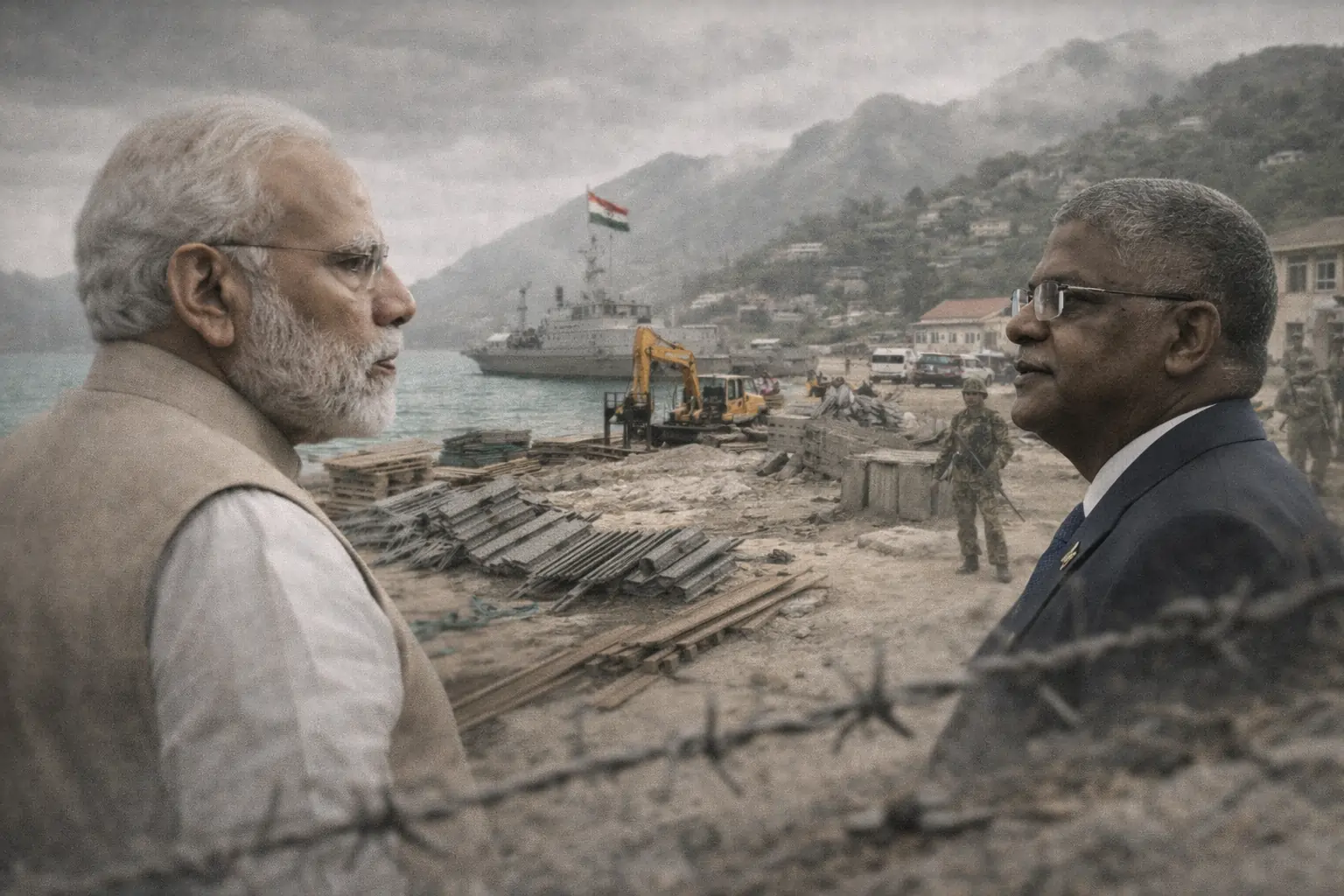
While farmers in Punjab protest unpaid dues and unemployment crosses 8% in urban India, Narendra Modi just announced a $175 million (1,457 crore) economic package for Seychelles-a country with a population smaller than a single Mumbai ward. On February 9, 2026, as President Patrick Herminie concluded his six-day state visit, Modi unveiled what he called a “Special Economic Package” covering social housing, e-mobility, vocational training, healthcare, defense, and maritime security. The Prime Minister framed it as part of India’s “MAHASAGAR Vision” for the Indian Ocean Region. The opposition has a simpler name for it: wasteful spending dressed up as strategic necessity. The timing itself exposes the hypocrisy. Just weeks ago, India cut its $120 million Chabahar port commitment under US pressure, abandoning two decades of strategic investment in Iran. Days later, India capitulated on Russian oil imports, surrendering cheap energy to appease Donald Trump’s tariff threats. And now, Modi government is handing ₹1,457 crore to a country that barely trades 100 crore annually with India. The question isn’t whether Seychelles needs help-it’s whether Indian taxpayers can afford Modi’s geopolitical vanity projects when the government pleads poverty for domestic welfare schemes.
The Numbers That Don’t Add Up
Let us take a look at what India is getting for the price of ₹1,457 crore. According to the official figures from the High Commission of India in Seychelles, the bilateral trade in 2024 was only $91.73 million of Indian exports and $2.46 million of imports from Seychelles. This makes a total of $94.19 million (approximately ₹785 crore). The trade surplus that India enjoys over Seychelles is large, but the total trade is insignificant. To put things into perspective, the total bilateral trade between India and the United States is $86 billion, with China over $100 billion, and even with Bangladesh, it is $15 billion.
The $175 million package that Modi has announced includes $125 million in rupee-denominated Line of Credit and $50 million in grant assistance. This will go towards funding public housing schemes, electric vehicle charging infrastructure, vocational training facilities, a new hospital, defense equipment for the Seychelles Coast Guard, and maritime security initiatives. India has also promised to provide 1,000 metric tonnes of grains and lentils for food security, 10 ambulances, training for civil servants, and setting up a hydrographic unit in Seychelles.
Now let us turn to the home budgetary allocation. As per The Diplomat’s analysis of India’s 2026-27 foreign aid budget, Seychelles gets an allocation of ₹190 million ($2 million) per year, which is small compared to Bhutan’s ₹20,970 million ($249.7 million), Nepal’s ₹7,340 million ($87.3 million), or even Mauritius’s ₹5,040 million ($60 million). However, this one $175 million deal is 87 times Seychelles’ annual budgeted foreign aid allocation. This translates to $1,458 per capita in Indian aid for a country of 120,000 people, which is roughly the population of Dwarka sub-city in Delhi.
Meanwhile, as per the 2025-26 budget estimates, India has allocated ₹2.66 lakh crore to the Ministry of Rural Development, ₹1.48 lakh crore to education, and ₹86,175 crore to health and family welfare. The entire Pradhan Mantri Awas Yojana (rural housing scheme) got ₹54,000 crore for the fiscal year 2025-26. Modi has just committed ₹1,457 crore—2.7% of India’s entire rural housing budget—to construct homes in a country where the entire population wouldn’t fill Delhi’s Jawaharlal Nehru Stadium.
The Strategic Justification: MAHASAGAR or Mirage?
The Modi government is using the location of Seychelles to justify the defense spending in the western Indian Ocean. During the joint press conference, the Modi government presented Seychelles as “a maritime neighbor and trusted partner in our region, central to our vision for the Indian Ocean under our program called ‘MAHASAGAR’.” MAHASAGAR refers to “Mutual and Holistic Advancement for Security and Growth Across Regions,” an Indian strategy for the Indian Ocean region.
Officially, the reasons provided are the geographical location of the Seychelles, which is near the major shipping routes to connect the Asian, African, and European continents. Additionally, the 1.4 million square kilometers of their Exclusive Economic Zone facilitate maritime security. India has helped Seychelles with two Dornier aircraft in 2013 and 2018. India also provided a few vessels to Seychelles: PS Topaz (2005), PS Constant (2014), PB Hermes (2016), PB Boudeuse (2025), and six coastal radars in 2015. The Indian Navy also conducts joint exercises dubbed “LAMITYE” twice a year with the Seychelles. Ten joint exercises have taken place so far, by March 2024.
However, the disparity can be highlighted if we look at the actual figures. According to AidData, which is affiliated with the College of William and Mary, China donated $144 million to the Seychelles between the years 2000 and 2023, which, on an average, equates to an annual donation of $6.26 million over 23 years. India, on the other hand, donated $175 million in a single package. If we add the $18 million China donated in 2011 to build houses in Les Mamelles, it is still less than the total donation received from India.
But here’s what the government won’t tell you: China’s influence in Seychelles remains limited compared to India’s. Seychelles joined the Colombo Security Conclave in November 2025 as the sixth member, alongside India, Sri Lanka, Mauritius, Bangladesh, and the Maldives a clear signal of strategic alignment with New Delhi over Beijing. India already operates surveillance infrastructure, conducts joint military exercises, and maintains defense cooperation agreements. President Herminie described India as a “trusted and reliable partner” during his visit. If India already has Seychelles’ strategic cooperation, why does it need to pay ₹1,457 crore more?
What India Gets vs. What India Gives
Examine the asymmetry. India provides $175 million, two Dornier aircraft, multiple patrol vessels, radar systems, 1,000 tonnes of food grains, 10 ambulances, hospital construction assistance, civil servant training programs, and defense equipment. What does India receive? According to the Ministry of External Affairs, bilateral cooperation includes Seychelles’ “support for India’s permanent membership in the UN Security Council” and “joining the Coalition for Disaster Resilient Infrastructure.”
Let’s be blunt: UN Security Council support is worth nothing. India has been seeking permanent UNSC membership for decades with support from dozens of countries. Seychelles’ vote changes nothing. The Coalition for Disaster Resilient Infrastructure, launched by India in 2019, already has 39 member countries. Seychelles joining doesn’t enhance India’s climate resilience or disaster preparedness, it’s symbolic at best.
The economic returns are even more dismal. Modi announced that India and Seychelles agreed to “explore new opportunities to strengthen economic cooperation” and “move forward in fintech and digital solutions.” These are aspirations, not deliverables. As Business Standard reported, bilateral trade is “rather modest, mostly due to the absence of a direct shipping line between India and Seychelles.” Even with IndiGo launching direct flights, Indian tourist arrivals remain modest-1,122 medical visas were issued in 2024-25 out of 1,775 total visas.
The people-to-people ties Modi emphasized? The Indian-origin population in Seychelles numbers approximately 5,000 citizens plus 7,000 non-resident Indians, according to official data. That’s 12,000 people total with Indian connections in a country of 120,000. India has larger diaspora communities in individual neighborhoods of New Jersey. Yet Modi committed ₹1,457 crore for a strategic partnership that delivers marginal commercial returns, symbolic diplomatic support, and maritime cooperation India already enjoys.
The Domestic Opportunity Cost
Here’s what ₹1,457 crore could fund domestically. According to the Pradhan Mantri Awas Yojana guidelines, rural housing assistance averages ₹1.2 lakh per unit in plains and ₹1.3 lakh in hilly areas. The Seychelles package could build approximately 1.2 million rural houses for Indian families. The Mahatma Gandhi National Rural Employment Guarantee Act provides 100 days of wage employment; ₹1,457 crore could fund 48 million additional workdays at the statutory minimum wage of ₹300 per day (varies by state).
In healthcare, this amount equals approximately 145 new 100-bed Community Health Centers at ₹10 crore each, covering construction, equipment, and initial staffing. For education, it could establish 291 new Kendriya Vidyalayas at ₹5 crore per school. In infrastructure, ₹1,457 crore could construct approximately 486 kilometers of rural roads under the Pradhan Mantri Gram Sadak Yojana at ₹3 crore per kilometer.
But instead of addressing India’s 216 million people living below the poverty line, or the 7.45% unemployment rate as of January 2026, or the crumbling rural healthcare infrastructure exposed during COVID-19, Modi chose to fund social housing in Seychelles. The optics are devastating: a government that delayed MGNREGA payments to its own citizens claiming budget constraints has ₹1,457 crore to spare for a tiny island nation 3,000 kilometers away.
The broader pattern is even more troubling. According to The Diplomat’s budget analysis, India’s total foreign aid allocation for 2026-27 stands at approximately $637 million (₹53,500 crore). Bhutan receives $249.7 million, Nepal $87.3 million, Sri Lanka $43.6 million, and Mauritius $60 million. The Chabahar allocation dropped from $43.6 million in 2025-26 to zero in 2026-27 after India surrendered to US pressure. Afghanistan receives $18 million, Mongolia $2.8 million, Bangladesh’s grant was halved to $7.2 million.
This allocation reveals the truth about India’s aid strategy: it prioritizes geopolitical posturing over development impact or national interest. Bhutan receives massive aid because it’s a client state that defers foreign policy to New Delhi. Nepal and Sri Lanka get substantial funding to compete with Chinese influence. Seychelles gets disproportionate assistance for symbolic maritime cooperation India already enjoys. Meanwhile, domestically critical programs face budget crunches year after year.
This allocation reveals the truth about India’s aid strategy: it prioritizes geopolitical posturing over development impact or national interest. Bhutan receives massive aid because it’s a client state that defers foreign policy to New Delhi. Nepal and Sri Lanka get substantial funding to compete with Chinese influence. Seychelles gets disproportionate assistance for symbolic maritime cooperation India already enjoys. Meanwhile, domestically critical programs face budget crunches year after year.
The China Competition Trap
The government’s defenders will argue that India must match or exceed Chinese assistance to maintain influence in the Indian Ocean Region. This argument falls apart under scrutiny. First, as noted earlier, India’s single $175 million package exceeds China’s entire 23-year, $144 million commitment to Seychelles. If the goal was to outspend China, mission accomplished-but at what cost?
Second, India cannot and should not compete with China on infrastructure financing. China’s Belt and Road Initiative commands $1 trillion in commitments globally. Chinese lending to developing countries totaled $1.34 trillion between 2000 and 2021, according to AidData. India’s entire foreign aid budget is $637 million annually-less than 0.05% of China’s lending capacity. Attempting to match Chinese outlays dollar-for-dollar is financial suicide.
Third, strategic influence doesn’t correlate with aid volumes. Despite receiving $144 million from China, Seychelles joined India’s Colombo Security Conclave, not China’s. Despite massive Chinese investments in Sri Lanka ($8 billion for Hambantota Port alone), Colombo maintains defense cooperation with India. Despite Chinese infrastructure projects worth $62 billion in Pakistan, Islamabad failed to prevent India from conducting cross-border operations.
The uncomfortable truth is that India’s strategic influence in its neighborhood stems from geographic proximity, cultural ties, defense cooperation, and democratic governance-not from checkbook diplomacy. Seychelles values India as a partner because India provides maritime security capabilities China cannot match in the western Indian Ocean, because of historical people-to-people connections dating to 1770, and because India doesn’t impose authoritarian governance models.
Throwing *1,457 crore at Seychelles doesn’t enhance these structural advantages. It simply drains India’s treasury for marginal diplomatic returns while Chinese competitors laugh at India’s fiscal recklessness.
Strategic Vision or Taxpayer Plunder?
On paper, the India-Seychelles partnership embodies the MAHASAGAR vision: sustainable development, maritime security, climate resilience, and people-to-people ties. The $175 million package funds hospitals, housing, defense equipment, food security, and capacity building. President Herminie praised India’s “consistent support” and Modi invited him as chief guest for Seychelles’ 50th Independence Day celebrations in June 2026.
But strip away the diplomatic language and examine the fundamentals. India committed ₹1,457 crore to a country of 120,000 people with whom bilateral trade totals barely ₹785 crore annually. This package is 87 times Seychelles’ annual budgeted aid allocation and exceeds China’s entire two-decade commitment. It could fund 1.2 million rural Indian houses, 48 million MGNREGA workdays, 145 Community Health Centers, or 291 Kendriya Vidyalayas.
Meanwhile, India cut $120 million from the Chabahar port under US pressure, capitulated on Russian oil imports costing billions in lost margins, and reduced aid to Bangladesh by 50% citing “project implementation” concerns. The government that pleads poverty when funding domestic welfare schemes suddenly discovers ₹1,457 crore for Seychellois social housing.
As The Diplomat noted in its budget analysis, “India’s historical challenge is not the size of its outlays. It is the speed and reliability of delivery.” But before worrying about delivery speed, India should question whether these outlays serve national interests or ministerial egos. MAHASAGAR might stand for “Mutual and Holistic Advancement for Security and Growth Across Regions,” but to Indian taxpayers watching their hard-earned money finance housing in Victoria while farmers die by suicide in Vidarbha, it looks more like “Money Advantaging Herminie And Seychellois At Gullible Accountholders’ Expense.”
Modi’s Seychelles package isn’t strategic vision. It’s fiscal irresponsibility dressed in diplomatic rhetoric, and Indian taxpayers are footing the bill.








Leave a comment