





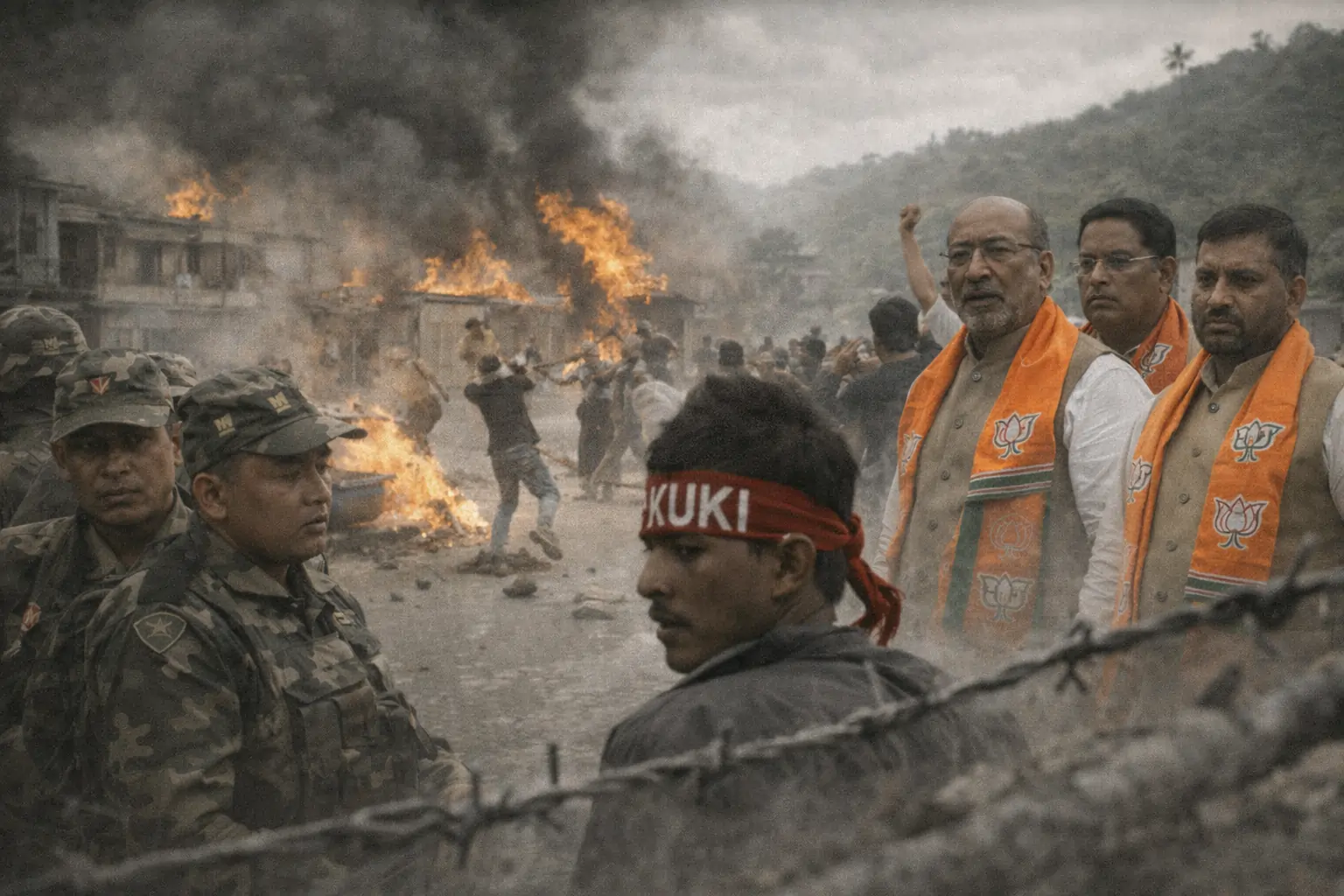
In the Indian state of Manipur, a growing wave of unrest and violence has erupted as Kuki groups have turned their ire against local Members of Legislative Assembly (MLAs) who have pledged their allegiance to the Meitei-led Bharatiya Janata Party (BJP) government. What started as a political dispute has rapidly evolved into widespread protests, including stone pelting, arson, and shutdowns across various regions of the state. This contentious issue is further exacerbated by the announcement of a “cash reward” by an armed Kuki volunteer group for the deaths of two particular MLAs, further intensifying the tensions. To understand the unfolding situation, it’s essential to examine the roots of the conflict, the political dynamics at play, and the complex ethnic divisions within the state of Manipur, which is home to multiple indigenous communities, including the Meitei’s and Kuki’s.
The Political Landscape in Manipur: An Overview
Manipur is a multi-ethnic and multi-religious state, with significant communities including the Meiteis, Kukis, and Nagas. The Meiteis, who predominantly follow Hinduism, inhabit the Imphal Valley, while the Kukis, who practice Christianity, mainly reside in the hill districts surrounding the valley. For decades, there have been undercurrents of friction between these two communities, exacerbated by political, economic, and cultural differences. In recent years, the state has witnessed volatile political dynamics, with the BJP-led government at the helm. The BJP, a right-wing political party known for its Hindutva agenda, has garnered significant support from the Meitei community, especially with the state’s Chief Minister, N. Biren Singh, at the forefront. However, this political dominance has not been without contention, as the Kuki community has been increasingly critical of the party’s stance on certain issues.
Kuki Groups’ Opposition to the Meitei-Led BJP Government
The primary source of Kuki groups’ growing discontent lies in their perception of the Meitei-led BJP government’s policies. For one, the Kukis feel marginalized by the political decisions made by the state government, which they believe largely benefits the Meitei community at their expense. The Kukis have long demanded greater autonomy and the recognition of their rights, which they feel have been consistently overlooked by the state administration.
The formation of the Meitei-led government, which includes a significant number of MLAs from the Meitei community, further deepened the divide. Many Kuki leaders perceive the political developments as a consolidation of Meitei dominance and view the government’s policies as biased against the hill people. For the Kuki community, this shift in political power represents a threat to their culture, identity, and regional interests.
The Role of MLAs: Allegiances and Betrayals
The catalyst for the recent wave of violence and protests has been the decision by certain Kuki MLAs to join the Meitei-led BJP government. These MLAs, who were originally aligned with the Kuki groups or had advocated for the community’s rights, are now seen as having betrayed their people. By aligning themselves with the BJP and the Meitei-led government, these MLAs are accused of abandoning the interests of the Kuki community in favor of political gain and power. This perceived betrayal has not gone unnoticed. In response to these actions, armed Kuki groups, including the so-called “village volunteers,” have taken to violent means to express their anger. These groups have declared a “cash reward” for the killings of two specific MLAs, Kigen and two Hmar-Zomi MLAs, who attended the swearing-in ceremony of the Meitei-led BJP government. The reward announcement is a stark indication of the high stakes involved and the dangerous levels of resentment simmering within the Kuki community.
The Escalation of Protests: Stones, Arson, and Shutdowns
The atmosphere in Manipur has become increasingly tense, as protests have spilled into the streets, with Kuki groups organizing shutdowns and staging demonstrations. The protests have been marked by acts of violence, including stone pelting and arson. These protests have severely disrupted normal life, with businesses, educational institutions, and government offices being forced to close. In some areas, the violence has led to clashes between Kuki protesters and law enforcement agencies, further fueling the cycle of unrest.
One of the most significant aspects of the ongoing protests is the shutdown of transport services, which has crippled the movement of people and goods across the state. The imposition of shutdowns, often referred to as “bandhs,” is a common tactic used by various groups in Manipur to express dissent. However, in this case, the shutdowns are specifically aimed at pressuring the Meitei-led BJP government to address the grievances of the Kuki community and to compel the MLAs who have aligned themselves with the ruling party to reconsider their decisions.
The State’s Response: A Delicate Balancing Act
In the face of such widespread unrest, the state government has found itself in a precarious position. The BJP-led administration, under the leadership of Chief Minister N. Biren Singh, has attempted to reach out to the Kuki community, but these efforts have largely been unsuccessful. For the Kuki groups, their demands for greater political autonomy and protection of their rights remain unmet, and the rhetoric from the government is often seen as insufficient or insincere.
The situation is further complicated by the fact that the BJP’s support base predominantly comes from the Meitei community, and any attempt to placate the Kuki groups risks alienating the Meitei voters. This delicate balancing act has made it difficult for the state government to effectively address the grievances of both communities, resulting in a prolonged period of instability.
A Deepening Divide
The ongoing political unrest in Manipur serves as a stark reminder of the deep ethnic and political divisions that continue to shape the state’s future. While the Meitei-led BJP government remains entrenched in power, the Kuki community’s grievances, fueled by perceived betrayal and marginalization, continue to simmer, threatening to further destabilize the region.
In this volatile environment, the political future of the state seems uncertain. The actions of the Kuki MLAs, and their decision to align with the Meitei-led government, have not only sparked widespread protests but also further deepened the divide between the Meitei and Kuki communities. Unless meaningful dialogue and concessions are made to address the concerns of the Kuki groups, the cycle of violence and unrest in Manipur is likely to persist.








Leave a comment