








The contemporary geopolitical settings involve a return of geopolitics and geoeconomics seem not to be at the priority of state policy. The developments in western Hampshire, Russia Ukraine wars, Middle East tensions; everything indicates a return of geopolitics. Such a geopolitical milieu requires India to develop robust and diverse agreements of cooperation, securing both geopolitical and geoeconomic domain.
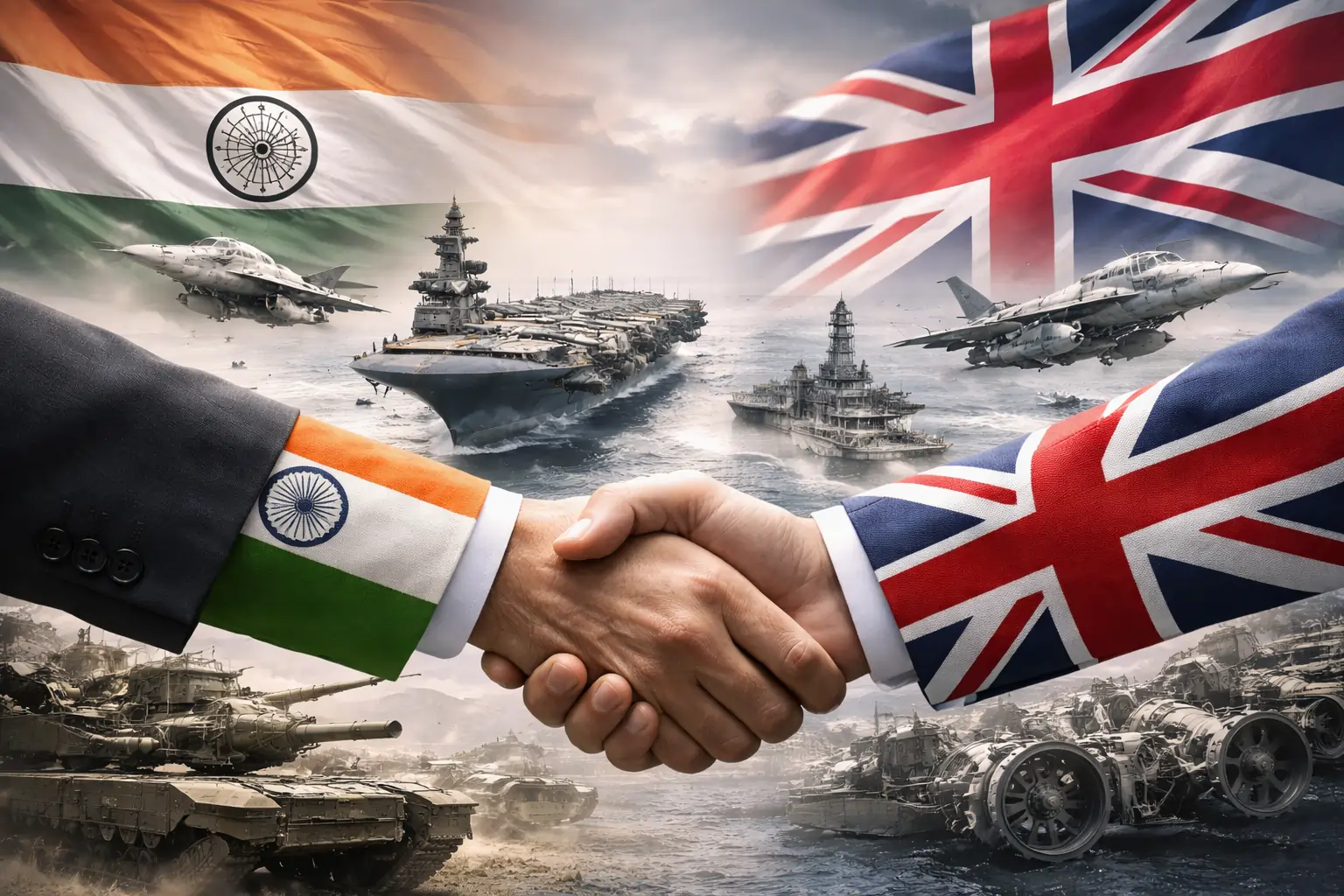
For India, United Kingdom therefore becomes an important partner, both in trade as well as in defense cooperation. Last year in June, UK and India signed a major trade agreement, during a meeting between Indian PM Narendra Modi and British PM Sir Keir Starmer. The agreement was aimed at creating new employment opportunities, helping the crisis laden British economy and market, with leveraging the Tariffs imposed by US President Donald Trump by increasing the trade volume. While the world focused on the trade deal, the two states signed another bilateral agreement which is highly important in geopolitical context. During the occasion the two states signed a renewing agreement of the Comprehensive Strategic Partnership (CSP). The CSP agreement between India and UK has been in place since 2021 and is revised given the geopolitical milieu and requirements. The agreement is aimed at enhancing bilateral cooperation between the two states in areas such as defense, security, economy as well as climate change.
Existing Collaboration
An important point to understand here is that India holds significant important for the west in the region, especially when it comes to the Indo Pacific region and the Indian Ocean.
In June 2025, the Kier Starmer led labour government in the UK’s strategic defense review of the year (SDR) announced a NATO first, but not a NATO only policy. The review recognized the importance of India as a strategic partner in the Indo Pacific region as well as a global partner, calling for deepening defense cooperation. Furthermore, the National Security Strategy of June 2025 emphasized this intent, stating “India is a country with which the United Kingdom seeks strengthened strategic partnerships.”
Since 2024, the two states are working on deepening the cooperation in defense and security which officially started with the watershed agreement of UK–India Technology Security Initiative (TSI) signed when the UK’s foreign secretary David Lammy visited India. The agreement was aimed at developing cooperation in emerging sectors of economy and emerging technologies such as quantum, artificial intelligence, semiconductors as well as in minerals. In 2025 February the two states signed UK’s Defence Partnership-India (DP-I) at the Aero India 2025. The main aim of the agreement was to further boost defense and security cooperation and to support the Indian domestic market’s ambition of self-reliance known as Atmanirbhar Bharat (a self-reliant India). Similarly in order to achieve the goal of joint production, the two states signed UK–India defence-industrial roadmap in April 2025 to jointly produce, design and develop defense equipments.
Indian PM Narendra Modi visited UK in July 2025, when the two states launched the India UK Vision 2035, with the aim of achieving the potential of the strategic cooperation between the two countries. The agreement in principle is an enhancement of the Comprehensive Strategic Partnership agreement between the two countries, with Vision 2035 pulling defense and security to the core of the partnership between the two states. In addition to this, Vision 2035 calls for a deepened cooperation on advanced and emerging technologies. The vision calls for development of complex weapon systems under two programs;
- EPCP (Electric Propulsion Capability Partnership)
- JEACT (Jet Engine Advanced Core Technologies)
The vision 2035 also adds a shared call for deepening cooperation in fields such as emerging technologies, underwater systems, direct energy weapons, and cyber resilience.
What’s important to understand here is that the two states are now cooperating beyond the industrial arena and especially wit the Vision 2035, the cooperation has extended into the military arena. The October 2025 visit of Sir Keir Starmer to India resulted in announcement of furthering cooperation on military equipments, joint training exercises as well an added focus on capacity building. During the 2025 deployment of British Carrier Group on an 8 months global mission focused on Indo-Pacific, the two states participated in the Exercise Konkan. Konkan exercises marked the first instance when the Carrier Strike Groups of UK and India participated in joint exercises. Konkan is primarily a naval exercise, but its 2025 chapter involved anti air and anti-submarine warfare, highlighting the deepened cooperation between the two countries.
Challenges And Way Forward
Despite the agreements, the data however shows that UK accounts for only 4% of the total imports of India, with states such as France, Russia United States and Israel leading the figures between 2019 and 2023. These statistics were collected by the UK India Business Council in its April 2025 report. The reports further indicate that the last major sale of UK’s defense equipment to India was the sale of Advanced Air to Air Missiles worth of 400 million dollars. Similarly, the second last sale of UK to India was Hawk Jet Trainers, a deal pf 1 billion dollars, seen almost 15 years ago.
However, there are certain factors which cannot be ignored while analyzing this situation. First are the close defense relations of New Delhi with Moscow, where the former participated in the Russia Belarus Zapad exercises conducted in September 2025. Its not to mention that the relations between Moscow and London saw another low since its war on Ukraine, and therefore India’s participation in the exercises was seen with concerns in UK. Similarly, there are some market-oriented constraints such as the lack of flexibility in Indian market and past failures by UK’s defense companies in fulfilling contract requirements and obligations. Similarly, the lack of flexibility, when it comes to procurement in India has also served as an important factor in constraining the ability of UK’s small and medium sized enterprises as they lack the time, resources and capacity to compete.
Concluding it we can hope that the strategic partnership between the two states is materialized in effective cooperation and material sharing beyond the industrial arena towards military equipments. The need of the hour is to resolve the market constraints so the British companies can effectively participate in the market. Similarly, B2B partnerships between the firms and enterprises can further build a truly comprehensive strategic partnership between the two states, energized by government support.








Leave a comment