














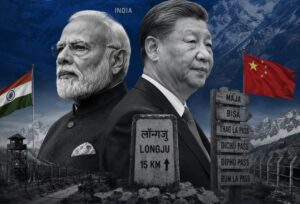

As 2026 progresses, New Delhi’s air is heavy with state-sponsored triumphalism in addition to winter smog. The BJP-led government recently announced a projected GDP growth rate of 7.4%, which the party’s powerful PR apparatus immediately weaponized. The message is clear, from TV studios to the IT cell’s unrelenting WhatsApp groups: Acche Din are now a statistical fact rather than a promise.
A stroll through the neighborhood mandis or a look at the bleeding stock tickers, however, reveals a completely different picture, despite the government’s celebration of its “fastest-growing economy” moniker. Data and dignity are being dangerously separated. While the spreadsheets look beautiful in the Ministry of Finance, the ground reality for the average Indian is one of quiet desperation. It’s time to look past the “7.4%” curtain and see the economy for what it actually is.
The Market Doesn’t Lie, Slogans Do
It was difficult to ignore the irony. The Sensex chose to plummet while the government was congratulating itself on the growth numbers. Trillions of dollars were lost in a nearly 2,000-point crash that was caused by changes in international tariffs and a significant withdrawal of Foreign Portfolio Investors (FPIs). Foreign investors withdrew more than ₹7,000 crore in just the first two days of January 2026.
Why are the sailors leaving India if it really is the world’s economic beacon? In order to prevent the rupee from collapsing, the Reserve Bank of India had to spend close to $12 billion. This is the behavior of a fragile economy supported by emergency interventions, not that of a strong, self-assured economy.
The “Invisible” Growth
The GDP figure is merely an abstract noun to the average person. The “growth” in the real world is evaporating rather than trickling down. While the cost of basic necessities like healthcare, education, and pulses keeps rising, salaries have remained stubbornly stagnant for years.
Even middle-class people are plagued by a persistent sense of job insecurity. The prospect of a “prosperous future” is less real than the fear of a “pink slip.” Why are household savings at a record low when the economy is expanding at a rate of more than 7%? Why are families taking out loans to maintain their kitchens? For the person making the bill payments, the math just doesn’t add up.
Statistical Gymnastics: The Math of Convenience
To avoid difficult questions, the government frequently hides behind the GDP calculation’s technical complexity. The regime has mastered statistical gymnastics by employing faulty deflators and an out-of-date base year (2011–12). India’s data quality has reportedly received a “C” rating from the IMF.
An inflated growth figure that only exists on paper results from using the Wholesale Price Index (WPI) rather than the Producer Price Index (PPI) to account for inflation. We are using a 2011 ruler to measure an economy in 2026. It’s an easy way to create success without having to deliver it.
The Two Indias: Luxury Cars and Empty Plates
Nowhere is the failure of this growth model more evident than in the widening chasm between the elite and the masses. India has become a tale of two countries. In one India, the top 1% is thriving. Sales of Rolls-Royces, luxury penthouses, and Swiss watches are at an all-time high.
In the other India, the one inhabited by 1.3 billion people, there is a structural collapse of demand. Economist Ashoka Mody has rightly pointed out that India’s consumption is “paper-thin.” We are a nation of 1.45 billion people, but our economy behaves like a tiny nation of 150 million consumers. The rest are simply spectators to a wealth creation process they aren’t invited to.
The Job Crisis: The Ultimate Reality Check
The most damning indictment of the “7.4% growth” narrative is the employment scene. When 1.2 crore people apply for 10,000 railway jobs, or when PhD holders compete to become office peons, the “fastest-growing economy” label feels like a cruel joke.
The government claims unemployment is low, but that’s only because they use the flawed ILO definition, where working one hour a week counts as being “employed.” This ignores the millions of “discouraged workers” who have stopped looking for jobs altogether and the millions more trapped in “disguised unemployment” on farms.
Manufacturing: The Broken Engine
The “Make in India” slogan, launched with much fanfare over a decade ago, has largely failed to move the needle. Manufacturing as a share of GDP is stuck at 17%, the same as it was before the slogans began. Instead of becoming a global factory, we have become a nation dependent on Chinese imports for everything from electronics to APIs for our medicines.
Domestic corporations are too scared to invest. Corporate investment has shrunk from 19% of GDP in 2016 to 14% today. If Indian billionaires aren’t confident enough to put their money into Indian factories, why should anyone else be?
Demand Truth, Not Tables
Selective data points or IT cell trolls cannot write India’s economic narrative. Growth that doesn’t boost wages, generate jobs, or offer security isn’t progress; it’s just a public relations ploy.
These optimistic forecasts must no longer be taken at face value. It’s time to demand a success metric that takes into account citizens’ well-being rather than just how thick a government report is. Until the “7.4” shows up in the average person’s pocket, it is merely a myth created to win elections rather than to construct a country. The long lines for menial jobs and the empty pockets are signs of the truth. It’s time for the government to look at people instead of charts.









Leave a comment