














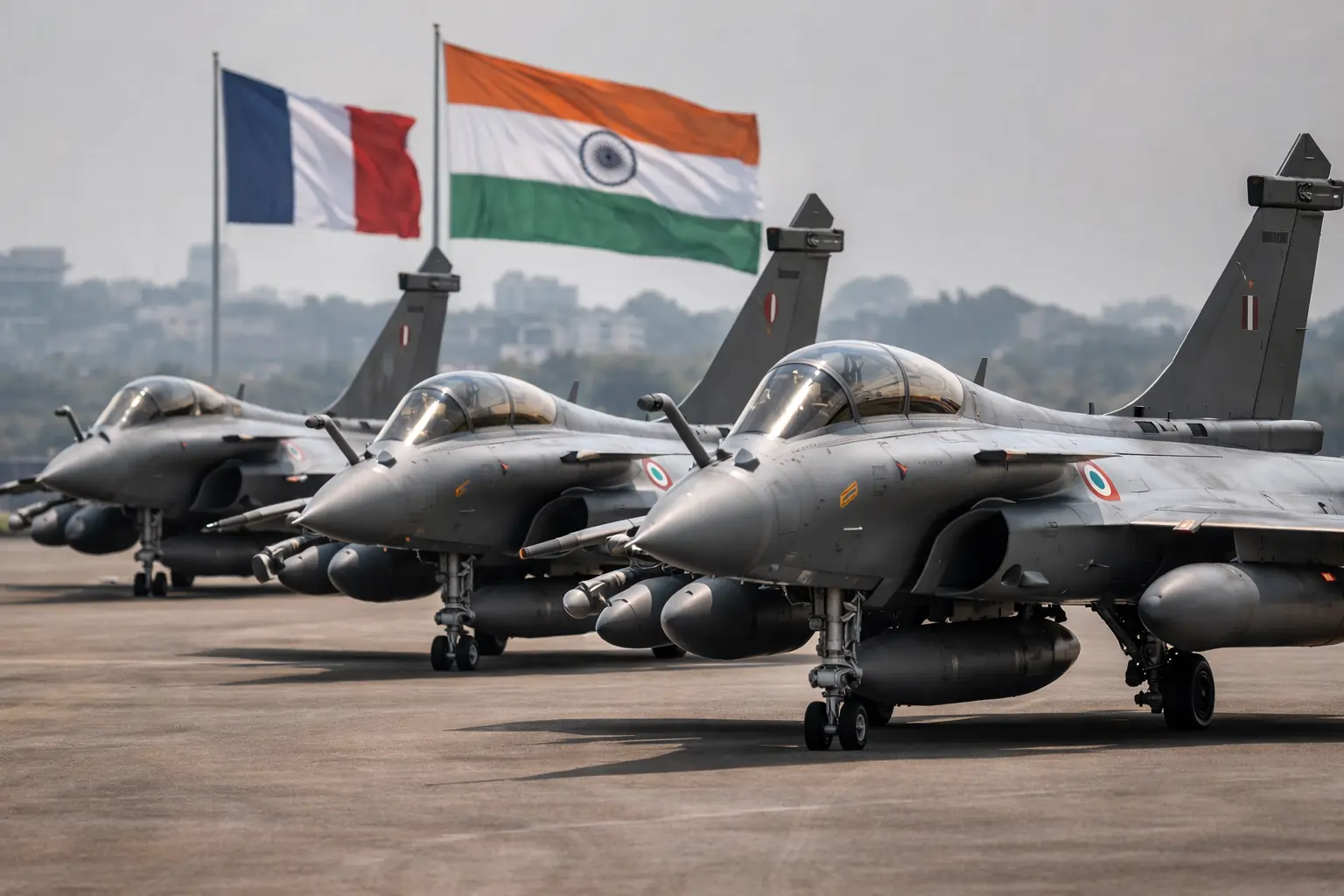
Negotiations between India and France for the procurement of 114 Dassault Rafale fighter jets have entered a decisive phase, with both nations seeking to finalize a framework before French President Emmanuel Macron’s high-profile visit to India in February 2026. The discussions, centered on the Indian Air Force’s (IAF) long-standing Multi-Role Fighter Aircraft (MRFA) requirement, represent a strategic pivot toward fleet standardization. Facing a critical depletion of its combat strength now hovering at approximately 29 squadrons against a sanctioned 42 the IAF has intensified its push for a direct Government-to-Government (G2G) deal.
Strategic Context and Industrial Synergy
While President Macron’s visit is ostensibly focused on an Artificial Intelligence summit, defense industrial cooperation has emerged as the primary subtext. The proposed deal aims to build upon the existing infrastructure established by the 2016 purchase of 36 Rafales and the April 2025 contract for 26 Rafale Marine jets for the Indian Navy. A central pillar of the new agreement is a massive “Make in India” component. Key industrial milestones include:
- Fuselage Production: Tata Advanced Systems Limited (TASL) and Dassault are currently establishing a facility in Hyderabad, expected to produce 24 fuselages annually by FY 2028.
- Engine Partnership: A joint venture between HAL and Safran for an engine production plant in Hyderabad.
- Maintenance Hub: The establishment of a major MRO (Maintenance, Repair, and Overhaul) center near the upcoming Noida International Airport in Jewar.
Officials suggest these initiatives could eventually resulting in 60% of the Rafale’s manufacturing value being localized in India, providing a technological bridge until the indigenous Advanced Medium Combat Aircraft (AMCA) matures.
The Shadow of May 2025 and the ‘Rafale Failure’ Narrative
The discussions surrounding the procurement of 114 jets are set against the backdrop of the controversial “Four-Day Conflict” of May 2025 (Operation Sindoor). This conflict has triggered divided opinions on the Rafale’s operational capabilities and effectiveness vis-a-vis the Pakistan Chinese Integrated Air Defense (I-CAD) network.
The Conflict of Operational Capabilities
The May 2025 conflict resulted in a myriad of reports highlighting significant “electronic warfare (EW) latency” within the Indo Air Force (IAF) Rafale fleet. Small Wars Journal and several other defense analysts suggested that 36 of the IAF’s original fleet of 36 Rafale`s were still equipped with gallium arsenide (GaAs) based RBE 2 radars systems, which they claim are not fully operational against Pakistan’s advanced Chinese manufactured jamming systems. On April 29 2025, a sortie involving a quartet of Rafale was, allegedly, terminated due to the presence of overwhelming EM (electromagnetic) jamming atop the Pakistan J-10C fighters.
The ‘Downing’ Controversy
The IAF Rafale loss on May 7, 2025, remains the most controversial topic of discussion. Pakistan, alongside claiming to have down three Rafale’s with PL-15 missiles, asserts that one of these Rafale’s was a “shot down” by them. Representative of Dassault, Eric Trappier, later stated that “of these, only one was lost (based on) operationally, on technical failure” (not enemy fire) at high altitude. Yet, the psychological impact cannot be fell. The conflict showed that the Rafale, despite being a “beast” on paper with its Meteor missiles, “can’t be “beast” on paper” when it comes to fighting “less-“systemically” and “more “systemically” fragmented networks. Pakistan integrating ground-based HQ-9 systems with AEW&C and J-10Cs created a “system-of systems” that temporarily eroded India’s platform-centric military superiority.
Lessons Regarding the 114-Jet Deal
How the 2025 scenario “failure” has reshaped the current 114-jet negotiations: “three” influences.
- Mandating Rafale F5 Standards: India is reportedly now proposing the Rafale F5 standard with new SPECTRA electronic warfare suite and GaN radars for the new order to counter advanced jamming.
- Prioritizing F5 Standards: The IAF has understood that Rafale F5 Standards, with new SPECTRA electronic warfare suite and GaN radars for the new order to counter advanced jamming, “must be paired” with effective datalinks, to be effective. Therefore, the new deal includes “joint communication protocols” to avoid the latency suffered in May 2025.
- Strategically, it’s Blunt: The 2025 losses have, perhaps paradoxically, increased the urgency for the deal. The IAF views the 114-jet order as a means to achieve the “mass” needed to breach sophisticated adversaries, abandoning the traditional silver bullet strategy” with small, expensive batches.
Rafale faced a sobering “reality check” in the 2025 skirmishes, both New Delhi and Paris are betting that deeper industrial integration and rapid technological upgrades will ensure the aircraft remains the cornerstone of South Asian air dominance for the next decade.









Leave a comment