















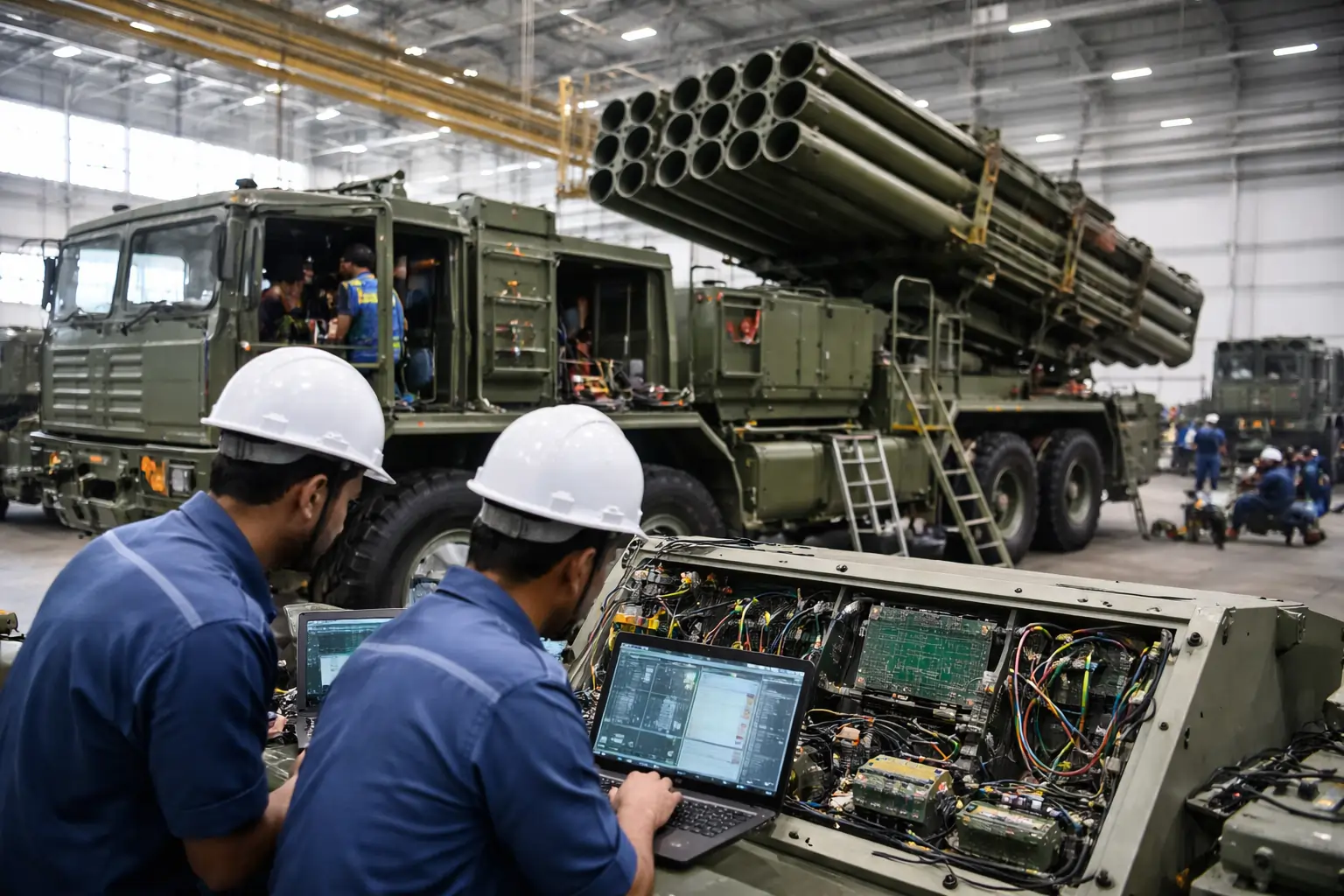
The Indian Army’s Corps of Electronics and Mechanical Engineers (EME) has finalized a contract with Larsen & Toubro (L&T) to overhaul the aging Pinaka Multi-Rocket Launcher System (MRLS). While the deal is framed as a maintenance necessity, it underscores a persistent reliance on retrofitting decades-old hardware to bridge gaps in frontline artillery.
The Pinaka system, which dates back to development cycles initiated in the 1980s, has faced a fragmented operational history. Despite various range extensions from the original 38 km to the 120 km guided versions the existing fleet suffers from significant technical obsolescence. The current contract aims to swap out failing electronics and mechanical sub-systems that have reached the end of their functional life.
A Patchwork Execution Strategy
The modernization will proceed through a fragmented, two-phase process that highlights the Army’s lack of independent maintenance depth:
Phase 1 (Pilot Phase): A joint venture between L&T and the 510 Army Base Workshop (ABW) will attempt to modernize a single launcher and command post. This phase is effectively a laboratory experiment to see if modern digital systems can be successfully integrated into the legacy chassis.
Phase 2 (Fleet-Wide Rollout): If the pilot succeeds, the Army’s own workshops will attempt to scale these upgrades across the fleet. However, the Army remains tethered to L&T for the supply of critical spares, technical supervision, and quality oversight, ensuring that the private sector maintains a tight grip on the platform’s lifecycle.
The Cost of Obsolescence
The decision to invest in the “sustenance” of the Pinaka fleet, rather than pursuing a total replacement with next-generation platforms, reveals several structural vulnerabilities in the current military-industrial framework.
- The “Band-Aid” Doctrine By opting for an overhaul of the existing Pinaka units, the military is choosing an incremental approach that arguably prioritizes short-term cost savings over long-term technological parity. Patching up 20-year-old frames with modern sensors often results in “Frankenstein” systems that lack the seamless integration of purpose-built modern artillery. This strategy risks leaving units under-equipped compared to adversaries who are deploying natively digital, high-mobility systems.
- Institutional Vendor Lock-In This contract solidifies a monopoly for L&T (and its frequent partner Tata) over the Pinaka platform. By making the Army’s Base Workshops dependent on a single private entity for spares and technical knowledge, the government loses leverage in future pricing negotiations. This “vendor lock-in” creates a fiscal trap where the cost of maintaining obsolete equipment can eventually exceed the price of procuring new, more capable systems.
- Persistent Bureaucratic Inertia The shift towards “lifecycle-based maintenance” is a late admission of the failures of previous maintenance models. For years, the artillery units have dealt with “reactive repairs,” leading to lower operational availability. The fact that a pilot program is required in 2026 just to determine if the launchers can be reliably upgraded suggests that the technical documentation and internal expertise within the Army remain insufficient for a major power.
- Supply Chain Fragility While the Pinaka is marketed as an indigenous solution, the “modern electronics” being swapped into these units are often dependent on global semiconductor and sensor supply chains. Without a truly independent domestic manufacturing base for these high-end components, the “upgraded” Pinaka remains vulnerable to international trade disruptions and sanctions, regardless of how much domestic steel is used in the chassis.
In summary, the L&T deal ensures that the Pinaka remains functional, but it also highlights a military caught in a cycle of retrofitting the past rather than inventing the future.













Leave a comment