



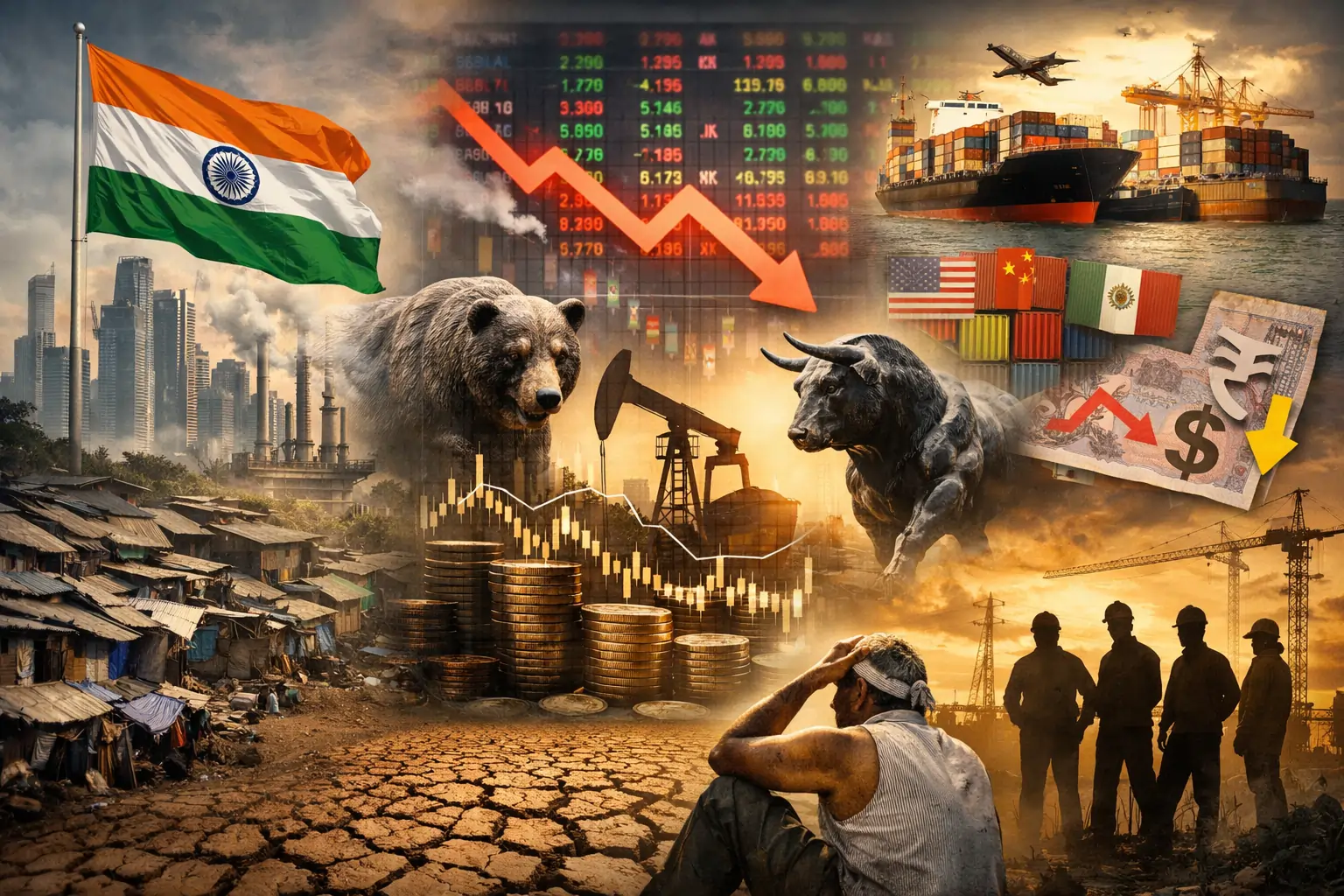
India closed 2025 with numbers that, on paper, many economies would envy. GDP growth remained above 7 percent, inflation collapsed to historic lows, interest rates softened, and macro indicators projected resilience in a turbulent global environment. Yet beneath this surface stability lay a political economy marked by unresolved structural weaknesses, rising external dependence, and an increasingly fragile growth model.
This was not a year of collapse. Nor was it a year of transformation. It was a year where India absorbed shocks better than expected but failed to convert resilience into broad-based economic confidence. The gap between headline performance and lived economic reality widened further.
Headline Growth and the Illusion of Momentum
India remained among the fastest-growing major economies in 2025. Real GDP expanded by 8.2 percent in Q2 FY26 and 7.8 percent in Q1, pushing first-half growth close to 8 percent, according to National Statistics Office data. The International Monetary Fund projected India to remain on track to become the world’s third-largest economy by 2030, with nominal GDP crossing $6.6 trillion.
The government framed this as validation of policy continuity. Narendra Modi publicly described the growth numbers as proof of reform-led expansion. Yet growth quality remained the central concern. Over the past three decades, India’s trend growth has hovered between 6 and 7 percent, regardless of government. Sustained periods above that level, such as FY03-08, coincided with global upcycles and domestic investment booms. Replicating that environment has proven elusive.
A World Bank assessment earlier in 2025 was blunt. To reach high-income status by 2047, India would need to grow at an average 7.8 percent for over two decades, a threshold it has never sustained structurally.
Low Inflation, Soft Rates, and a Consumption Paradox
Inflation collapsed dramatically in 2025. Retail CPI fell to 0.25 percent in October, the lowest print since the current series began, before inching up to 0.71 percent in November. For the full fiscal year, inflation averaged close to 2 percent, well below the Reserve Bank of India’s target.
The Reserve Bank of India responded with one of its most aggressive easing cycles since 2019. The repo rate was cut by 125 basis points, reaching 5.25 percent. Liquidity conditions loosened, borrowing costs declined, and financial conditions appeared supportive.
Yet this “Goldilocks” macro phase failed to trigger a decisive consumption revival. Rural demand remained relatively robust, aided by agricultural output and welfare transfers. Urban consumption, however, continued its uneven recovery. High-end spending and government capex sustained momentum post-pandemic, but both showed signs of fatigue by late 2025.
The paradox was clear. Inflation was low, taxes were rationalised, and interest rates were supportive. Yet households remained cautious, reflecting stagnant wage growth, job insecurity, and rising inequality.
Private Investment: The Missing Engine
The most persistent weakness in India’s political economy under the current dispensation remains private investment. Despite repeated claims of improving “animal spirits,” greenfield investments have failed to scale.
Capacity utilisation hovered between 75 and 77 percent, below the 80 percent-plus threshold firms typically require to commit large capital. Non-food credit growth improved, and corporate balance sheets were healthier than a decade ago. But demand visibility remained weak.
Entrepreneurs, speaking privately, continued to point to a familiar constraint. Without durable consumption growth, investing at scale made little commercial sense. This investment hesitation fed back into employment creation, reinforcing the cycle of subdued demand. The inability to crowd in private investment has become the defining limitation of the NDA’s economic strategy.
Fiscal Reforms and Their Distributional Costs
2025 did see a burst of legislative activity. GST was rationalised into a simplified two-slab structure of 5 percent and 18 percent, easing compliance and lowering prices on a range of essentials. Income tax relief raised the effective zero-tax threshold to 12.75 lakh for salaried individuals under the new regime.
Financial sector reforms opened insurance to 100 percent foreign ownership, relaxed norms for banks and pension funds, and amended nuclear liability rules to attract private capital. Some long-standing Quality Control Orders were revoked, offering relief to small manufacturers.
Yet these reforms carried distributional trade-offs. Amendments to labour codes diluted employment protections. Allocations for MGNREGA were curtailed in real terms, weakening the rural safety net. Reform momentum existed, but it remained skewed towards capital facilitation rather than labour security.
External Shocks and Strategic Vulnerability
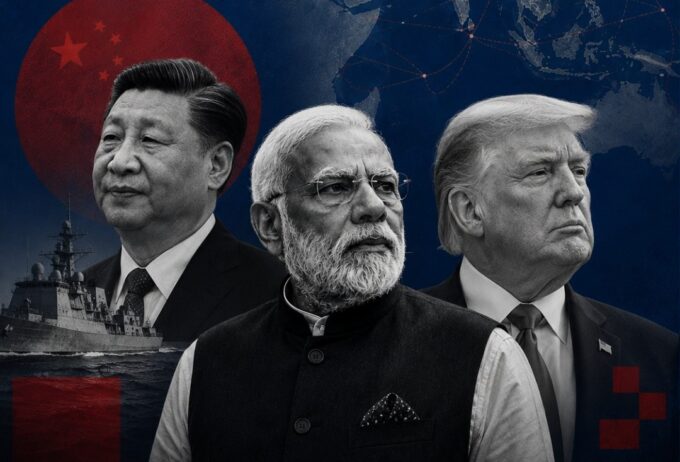
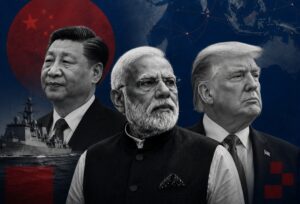
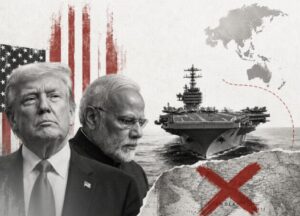
Externally, 2025 exposed the limits of India’s economic autonomy. The return of Donald Trump brought punitive tariffs. Indian goods faced duties rising to 50 percent by late August, alongside penalties linked to India’s Russian oil purchases.
India entered the year expecting insulation from the tariff war. It ended the year facing its highest effective tariffs into the US, even higher than China. Merchandise exports suffered through mid-year, recovering only partially due to tariff-exempt categories such as pharmaceuticals and electronics.
Services exports faced a parallel squeeze. H-1B visa fees were raised sharply, enhanced vetting was introduced, and immigration became an explicit trade lever. For an economy where services account for nearly 50 percent of exports, this represented a structural vulnerability.
Mexico’s decision to impose blanket tariffs of up to 50 percent on non-FTA countries added another shock. Nearly 75 percent of India’s $5.75 billion exports to Mexico are expected to be affected, according to the Global Trade Research Initiative.
Rupee Stress and Capital Flight
The Indian rupee emerged as one of the worst-performing emerging market currencies in 2025. It slid from around *85 per dollar to beyond ₹91 within months, reflecting dollar strength, trade pressures, and persistent capital outflows.
Foreign institutional investors sold equities worth over 2.3 lakh crore during the year, the largest annual outflow on record. Net Fll outflows stood at approximately 1.58 lakh crore, despite strong domestic macro fundamentals.
Stock markets touched record highs mid-year but ended 2025 on a softer note. The Nifty gained around 10 percent annually, yet momentum faded as foreign selling intensified and earnings growth slowed. The contradiction was stark. Domestic indicators suggested stability, but foreign capital voted with its feet.
Russia, Oil, and the Cost of Imbalance
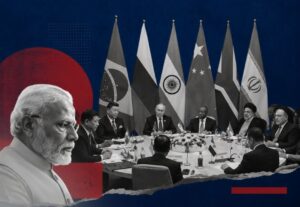
India-Russia trade crossed $68 billion in FY25, driven overwhelmingly by crude oil imports. India imported over 1.7 million barrels per day of Russian oil in November 2025, benefiting from steep discounts.
Yet exports to Russia remained below $5 billion, creating massive rupee surpluses with limited use. While the government projected this as strategic diversification, it increasingly resembled dependence without leverage. Western sanctions and shifting energy flows are already forcing a gradual rebalancing, exposing India to renewed price volatility.
Labour, Capital, and the Distribution Question
Perhaps the most unresolved issue in India’s political economy is the distribution of growth gains. As capital productivity rises and automation accelerates, labour’s share of output remains under pressure.
Employment generation has lagged output expansion. Informalisation persists. New labour codes represent a tentative step, but far from sufficient to harness India’s demographic profile. Without sustained wage growth and job security, consumption-led growth will remain constrained.
This imbalance lies at the heart of India’s growth dilemma. Output expands, markets rally intermittently, but economic confidence remains shallow.
2025 will not be remembered as a year of economic failure. India absorbed global shocks better than many peers and avoided macro instability. But it will also not be remembered as a year of economic confidence. Growth remained dependent on government spending, tax relief, and favourable monetary conditions. Private investment hesitated. Consumption remained uneven. External vulnerabilities widened. Capital flows turned fickle.
India enters 2026 with respectable numbers but unresolved questions. Can demand become self-sustaining. Can investment revive without state scaffolding. Can labour compete in an economy increasingly tilted towards capital. Political economy, ultimately, is not about surviving a year. It is about shaping incentives for the next decade. On that front, 2025 offered reassurance, not answers.