











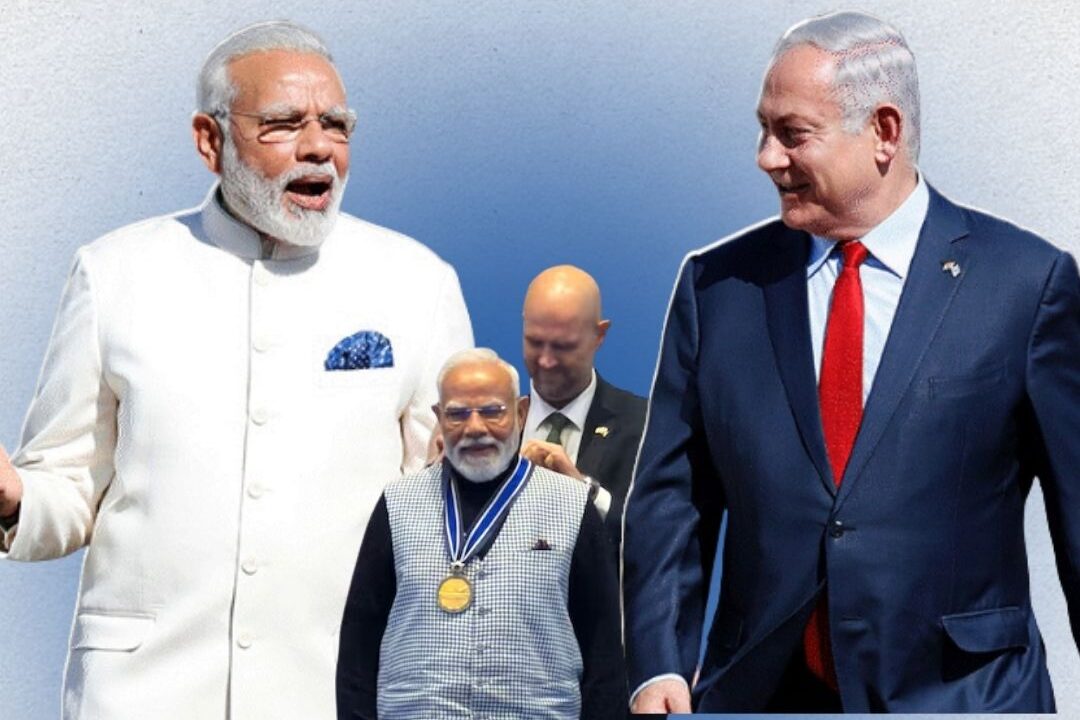
Prime Minister Narendra Modi’s visit to Israel was widely criticized because it unfolded against the backdrop of Israel’s ongoing war in Gaza. While much of the world continues to debate the scale of destruction and civilian casualties in the occupied Palestinian territory, Modi’s public messaging in Jerusalem focused almost entirely on solidarity with Israel. For critics, the timing of the visit and the tone of his remarks signaled not diplomatic balance, but political alignment.
In his discussions with Benjamin Netanyahu, Modi underscored friendship, strategic collaboration, and a mutual commitment to combat terrorism. He did not explicitly address the humanitarian crisis in Gaza. The silence has emerged as the central controversy of the trip, prompting inquiries into whether India’s longstanding pro-Palestine stance has been supplanted by strategic considerations.
The following is a systematic analysis of the visit, highlighting its revelations, omissions, and actual accomplishments.
The optics of the visit were impactful and intentional. Modi spoke at the Knesset, toured Yad Vashem, and consistently characterized India–Israel relations as a connection between “two ancient civilizations.” The imagery of warmth embraces, standing ovations, ceremonial honors projected unmistakable closeness.
Symbolism is significant in diplomacy. It indicates a hierarchy of priorities. By prominently prioritizing Israel amidst global condemnation, India indicated that its strategic alliance with Tel Aviv supersedes reputational concerns in certain segments of the Global South. However, symbolism may also obscure intricacy. Public solidarity does not inherently result in unrestricted policy alignment. Nor does it eliminate the structural constraints that regulate defense and technology collaboration. The symbolism was striking; however, the underlying systems remain constrained.
Technological Advancements Lacking Sovereignty
Contrary to media conjecture, no accord reached during the visit encompassed the acquisition or transfer of Israel’s Iron Dome or its successor, Iron Beam.
The Iron Dome was created with significant financial support and technological collaboration from the United States. Consequently, export or re-export necessitates American regulatory authorization. The transfer of core architecture, source codes, or production rights is stringently regulated under US export regulations. Israel is unable to unilaterally transfer specific categories of sensitive defense technology without the oversight of Washington. This is not a matter of political will but legal structure.
Iron Beam, an advanced directed-energy laser system, exhibits heightened sensitivity. Its proliferation would generate strategic apprehensions extending well beyond bilateral diplomacy.
Consequently, while political rhetoric implies proximity, structural realities delineate the limits.
Defense: Convergence Without Complete Alignment
India is the foremost purchaser of arms from Israel, with defense serving as the cornerstone of their partnership. Collaboration encompasses drones, missile systems, radar, surveillance platforms, and cybersecurity technologies.
During this visit, both leaders underscored the enhancement of collaboration in emerging technologies, encompassing artificial intelligence, quantum research, and essential minerals. These sectors are forward-looking and offer substantial long-term strategic significance.
India’s defense architecture is constructed around a multi-layered, long-range air defense system designed for its extensive geography and diverse threat vectors. The Iron Dome, primarily engineered for short-range rocket interception in confined territorial settings, does not entirely correspond with India’s fundamental doctrinal requirements. This elucidates why the visit yielded frameworks for collaboration instead of attention-grabbing equipment agreements.
Defense, Not Distance
India often cites “strategic autonomy” as a cornerstone of its foreign policy. Contemporary defense ecosystems exhibit profound interdependence. Advanced military platforms encompass multinational supply chains, licensing agreements, and regulatory frameworks.
The lack of Iron Dome exemplifies this tension.
India may pursue enhanced defense self-reliance and diversified partnerships; however, advanced systems associated with U.S.–Israel collaboration are constrained by American export control regulations. No diplomatic cordiality can supersede those legal frameworks.
This structural dependency does not undermine the partnership; rather, it delineates its boundaries.
Dehyphenation and Its Implications
India’s strategy exemplifies what analysts refer to as “Dehyphenation”, the dissociation of relations with Israel from its policy towards Palestine. Critics contend that, in practice, the equilibrium has unequivocally tilted in favor of Israel.
Previous Indian administrations prioritized rhetorical and diplomatic support for Palestinian statehood while discreetly enhancing relations with Israel. Modi has rendered the relationship explicit and unrepentant. This transparency indicates assurance. It also indicates a need for recalibration.
New Delhi regards Israel as a partner in high technology, an ally in intelligence, and a conduit to emerging multilateral frameworks such as IMEC and I2U2. Strategic advantage seems to surpass concerns regarding reputation.
The expense of that recalibration is diplomatic unease in segments of the Global South, where solidarity with Palestine continues to hold political significance.
Modi’s visit to Israel was both emblematic and foundational. It strengthened political unity, broadened cooperation frameworks, and promoted technological alliances. Simultaneously, it exposed the stringent limitations of defense interdependence and regulatory supervision.
The critique regarding Gaza underscores the ethical and diplomatic strain inherent in India’s developing stance towards the Middle East. The lack of significant arms transfers highlights those strategic alliances function within institutional constraints.
The visit ultimately illustrates that diplomacy functions on two levels: overt symbolism and covert systems. While headlines may emphasize embraces and declarations, enduring alignment is determined by legal frameworks, doctrinal compatibility, and geopolitical structures.
India and Israel have strengthened their relationship significantly. However, proximity does not eliminate limitations — and symbolism does not supersede structures.









Leave a comment