








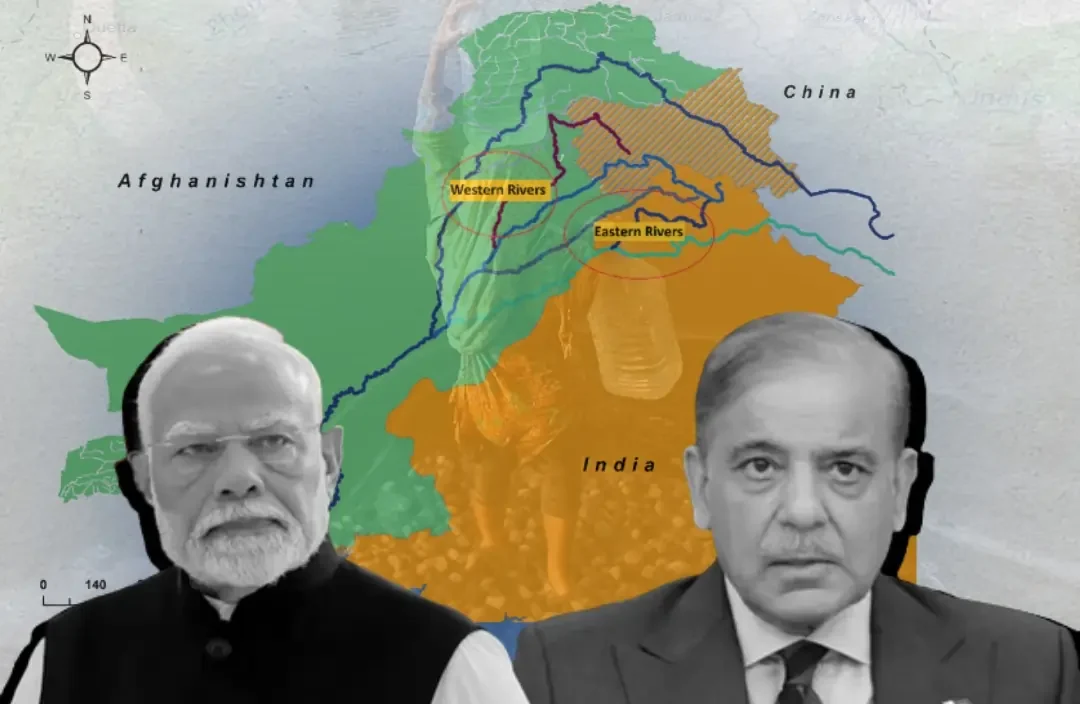
Let’s get one thing straight before the prime-time anchors start banging their desks again. When PM Modi declared
“Blood and water will not flow together,”
he was not announcing a new strategic weapon against Pakistan. He was, with considerable fanfare, taking credit for completing an irrigation dam that Indira Gandhi had laid the foundation stone for in 1982-forty-three years ago. A dam, incidentally, on a river that was legally India’s since 1960. This is where Modi’s much-celebrated “water war” against Pakistan actually begins and ends: in a 23- kilometre stretch of the Ravi River between two structures that India already controlled, on water India already owned, utilizing rights India already had under a treaty signed before most sitting MPs were born.
The Shahpur Kandi Dam, budgeted at ₹3,394.49 crore and expected to be operational by March 31, 2026, is being presented to the Indian public as a decisive act of retribution following the Pahalgam terror attack of April 22, 2025, which killed 26 civilians. India suspended the Indus Waters Treaty the very next day. News channels erupted. Senior officials vowed that “not even a drop” would reach Pakistan. The optics were magnificent. The reality is considerably less so.
What the Ravi River Actually Is – and Who Always Owned It
The 1960 Indus Waters Treaty, brokered by the World Bank, divided the six rivers of the Indus Basin between India and Pakistan. Pakistan received the three western rivers, Indus, Jhelum, and Chenab – which carry roughly 80% of the basin’s total flows. India received the three eastern rivers, Ravi, Beas, and Sutlej, comprising the remaining 20%. The Ravi was India’s river. Fully. Legally. Indisputably. Since September 19, 1960.
The project document for Shahpur Kandi itself states plainly: “Complete River Ravi has been given to India in IWT.” The only reason any water was reaching Pakistan at all was the absence of adequate storage infrastructure on the Indian side – a gap that the Shahpur Kandi project is now closing. This is not weaponization. This is belated plumbing. Important plumbing, certainly. Strategic revolution, it is not.
As Congress leader Jairam Ramesh pointed out in his July 30 rebuttal of Jaishankar’s Rajya Sabha speech, “Without the three Eastern Rivers being exclusively with India – the Bhakra Nangal dam complex, key to the Green Revolution, would not have become a reality. The transformative and long Rajasthan Canal would not have been possible. The Ravi-Beas link would not have been possible.” Ramesh’s point cuts deep: the eastern rivers were not Nehru’s charity to Pakistan. They were the backbone of India’s post-independence agricultural transformation. Calling that arrangement “communal appeasement,” as Jaishankar did, is a rewriting of engineering history for political convenience.
The Numbers That the News Anchors Won’t Tell You
The Shahpur Kandi Dam stands 55.5 metres high, includes a 7.7-kilometre hydel channel, and will generate 206 MW of power while irrigating approximately 92,500 acres – 12,500 in Punjab and 80,000 in Jammu and Kashmir’s Kathua and Samba districts. These are genuinely useful numbers for Indian farmers.
Now compare them to the upstream Ranjit Sagar Dam, commissioned in 2001, which has a storage capacity of 1.9 million acre-feet and generates 600 MW. Shahpur Kandi’s storage capacity is 0.08 million acre-feet- roughly 4.2% of Ranjit Sagar’s. It sits 11 kilometres downstream of Ranjit Sagar and 12 kilometres upstream of the century-old Madhopur Headworks. As technical assessments bluntly note, these two existing structures already have “sufficient storage and regulation capability to manage River Ravi flows.” Shahpur Kandi enhances an already managed system. It does not transform one.
Hydrological records confirm that Ravi flows into Pakistan had already diminished dramatically after Ranjit Sagar was commissioned 24 years ago. The river was already functionally under India’s control before any politician thought to hold a press conference about it.
The World Is Watching and It Is Not Impressed
While Indian television celebrated the “water weapon,” the Permanent Court of Arbitration quietly issued its June 27, 2025 ruling affirming that it retains jurisdiction over the Indus Waters Treaty and that no party may unilaterally suspend participation. World Bank President Ajay Banga was equally direct: “There is no provision in the treaty to allow it to be suspended. The way it was drawn up, it either needs to be gone or it needs to be replaced by another one.”
Daanish Mustafa, Professor of Critical Geography at King’s College London, told Al Jazeera that the fixation with water control “is almost comical,” noting that the three eastern rivers – Ravi, Beas, Sutlej – “are in any case only for India’s use under the IWT.” India’s neighbors have also taken note. As the Center for Strategic and International Studies observed, India’s willingness to walk away from an established multilateral water treaty has “set alarm bells ringing in Dhaka and Kathmandu.” Bangladesh and Nepal, who have long negotiated with India over shared rivers from a position of structural disadvantage, now have fresh evidence for their deepest anxieties about Indian hydrological intent.
What India Actually Gave Up – and What It Actually Kept
Here is the irony that Jaishankar’s rhetoric carefully avoids: India’s ability to meaningfully reduce flows on the western rivers – Indus, Jhelum, Chenab, the rivers that actually sustain Pakistan’s agriculture – is constrained by geography, infrastructure, and international law. India lacks the storage capacity on those rivers to withhold flows without harming its own downstream users in Jammu and Kashmir. The Permanent Court of Arbitration is watching. The World Bank is watching. Beijing, which has its own upstream leverage on the Indus, is certainly watching.
What India can do and has done – is halt hydrological data sharing with Pakistan, which deprives Lahore of flood warnings during monsoon. That is genuinely consequential, if not particularly honourable. And accelerating the Shahpur Kandi Dam is legitimate utilization of a legal right that should have been exercised decades ago.
What India cannot do is pretend that finalizing a domestic irrigation project between two existing structures on a river it has owned since 1960 constitutes a grand strategic masterstroke. Technical assessments are unambiguous on this point: recent media projections about downstream impact on Pakistan carry more “optical value and gaining political mileage” than actual hydrological consequence.
Infrastructure Is Not Strategy
The Shahpur Kandi Dam will irrigate drought-prone land in Kathua and Samba. It will light up homes in Punjab. It will, eventually, reduce the trickle of surplus water that crossed into Pakistan because India lacked the infrastructure to retain it. All of this is legitimate, overdue, and worth completing.
What it is not – and what no press conference or Rajya Sabha speech can make it — is a water weapon. India is claiming sovereignty over a river it already sovereignly possessed, using infrastructure conceived in 1979, laid in stone in 1982, declared a national project in 2008, and finally completed in 2025. The chest-thumping is not matched by the engineering. The Ravi has been flowing toward Indian fields since the day Nehru and Ayub Khan signed the IWT. Nothing changed in April 2025 except the volume of political noise surrounding infrastructure that was always going to be built.
India has real tools and real leverage in its neighborhood. Using them well requires honest public communication about what those tools actually are- and what they are not. Mistaking a plumbing project for a precision strike may satisfy a prime-time news cycle. It does not constitute foreign policy.













Leave a comment