





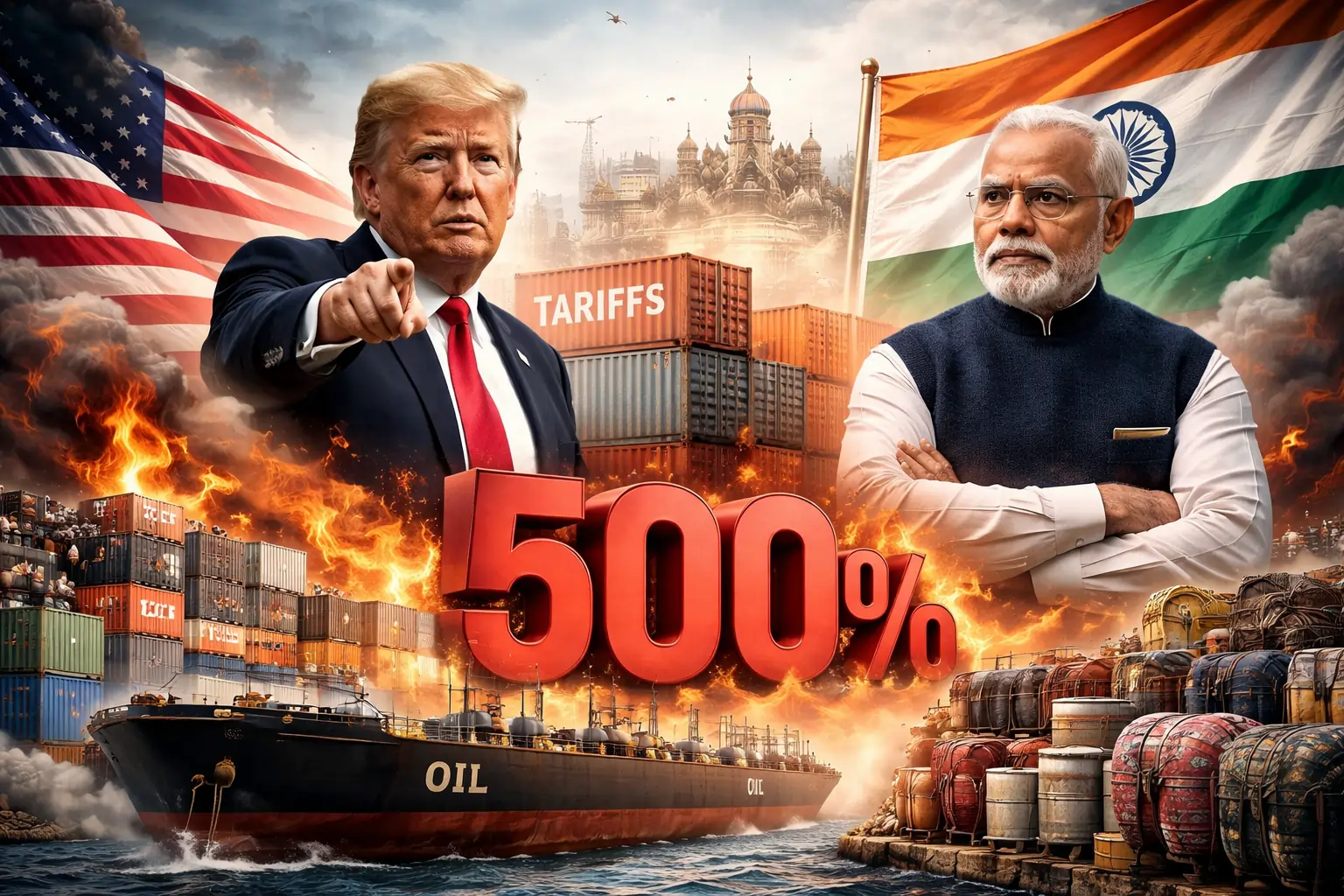
U.S. President Donald Trump has endorsed a controversial sanctions bill aimed at countries that continue economic engagement with Russia, notably through discounted oil imports, placing India and China squarely in the crosshairs of American trade policy.
The “Sanctioning Russia Act of 2025” (S.1241), introduced in the U.S. Senate by Republican Senator Lindsey Graham and co-sponsored by Senator Richard Blumenthal, empowers the U.S. executive branch to levy punitive tariffs – up to 500% on imports from countries that knowingly import Russian petroleum, uranium, or other strategic exports.
According to the U.S. Senate version of the bill, these tariffs are linked to Russia’s refusal to negotiate a peace settlement in the Ukraine conflict. Should Moscow continue military operations or violate negotiated accords, the tariff penalties would be triggered automatically.
Senator Graham and other supporters argue that India, China, and Brazil remain significant buyers of discounted Russian crude, helping to finance Moscow’s ongoing war effort against Ukraine.
“This bill will allow President Trump to punish those countries who buy cheap Russian oil fueling Putin’s war machine,” Graham said in a recent post, underscoring the punitive intent behind the legislation.
India historically relied on Russian crude for around 35-40% of its energy imports, a strategy New Delhi maintains was essential for affordable energy and economic growth in the face of global volatility. Yet under current broad U.S. policy, India has already been subject to elevated tariffs. In August 2025, Washington doubled duty rates on Indian exports to the U.S. to 50%, citing India’s sustained Russian oil purchases – an unprecedented 50% tariff burden on India’s largest export market. This higher tariff regime has reportedly contributed to a widening trade deficit for India, with preliminary figures for October 2025 showing a deficit of $41.68 billion, significantly larger than a year earlier, in part because exports to the U.S. were hit by punitive duties.
For a deeper analysis of how discounted Russian energy reshaped India’s trade balance and long-term economic exposure, read more:
Domestic & Diplomatic Pushback in New Delhi
India’s leadership has rejected claims that its oil imports finance conflict, emphasizing strategic autonomy and the imperative of energy security for a population of 1.4 billion. As External Affairs Minister S. Jaishankar stated earlier, New Delhi maintains its right to make sovereign decisions in its national interest despite external pressure.
In diplomatic outreach, India has sought to ease tensions over tariffs; Indian Ambassador Vinay Mohan Kwatra reportedly pressed Senator Graham in late 2025 to roll back the earlier 25% duties, arguing that New Delhi had already cut back on Russian oil purchas.
But Washington’s stance appears to have hardened, linking potential tariff escalation directly to India’s energy import patterns. President Trump has publicly acknowledged tensions with Prime Minister Narendra Modi over the issue, noting that Delhi was “not happy” with the tariffs but suggesting they were necessary to leverage Indian cooperation. The Times of India
Economic & Strategic Implications
Economic experts warn that a 500% tariff regime could be devastating for exporters heavily reliant on the U.S. market, from textiles and pharmaceuticals to machinery and gems & jewellery -sectors that collectively account for a considerable portion of India’s nearly $86.5 billion in annual exports to the U.S.
Such duties could give competing exporters from Southeast Asia and other regions an opportunity to capture market share that India might lose. Moreover, rerouting trade away from U.S. markets could trigger broader supply chain disruptions and increase costs for Indian businesses engaged in bilateral commerce.
India now faces a multifaceted challenge: balancing its long-term objectives of energy security and economic growth with escalating pressure from the United States to align with Western sanctions on Russia. With tariff threats of up to 500% looming, New Delhi must navigate not just a trade crisis but a broader diplomatic dilemma – safeguarding national interest gainst the backdrop of great power rivalries, global energy volatility, and an increasingly transactional U.S. Toreign policy.
The coming weeks will be crucial as the Sanctioning Russia Act proceeds toward a Congressional vote. For India, the outcome could redefine not just trade dynamics with the U.S. but its standing as a sovereign global power committed to strategic autonomy in an era of heightened geopolitical tension.







Leave a comment