









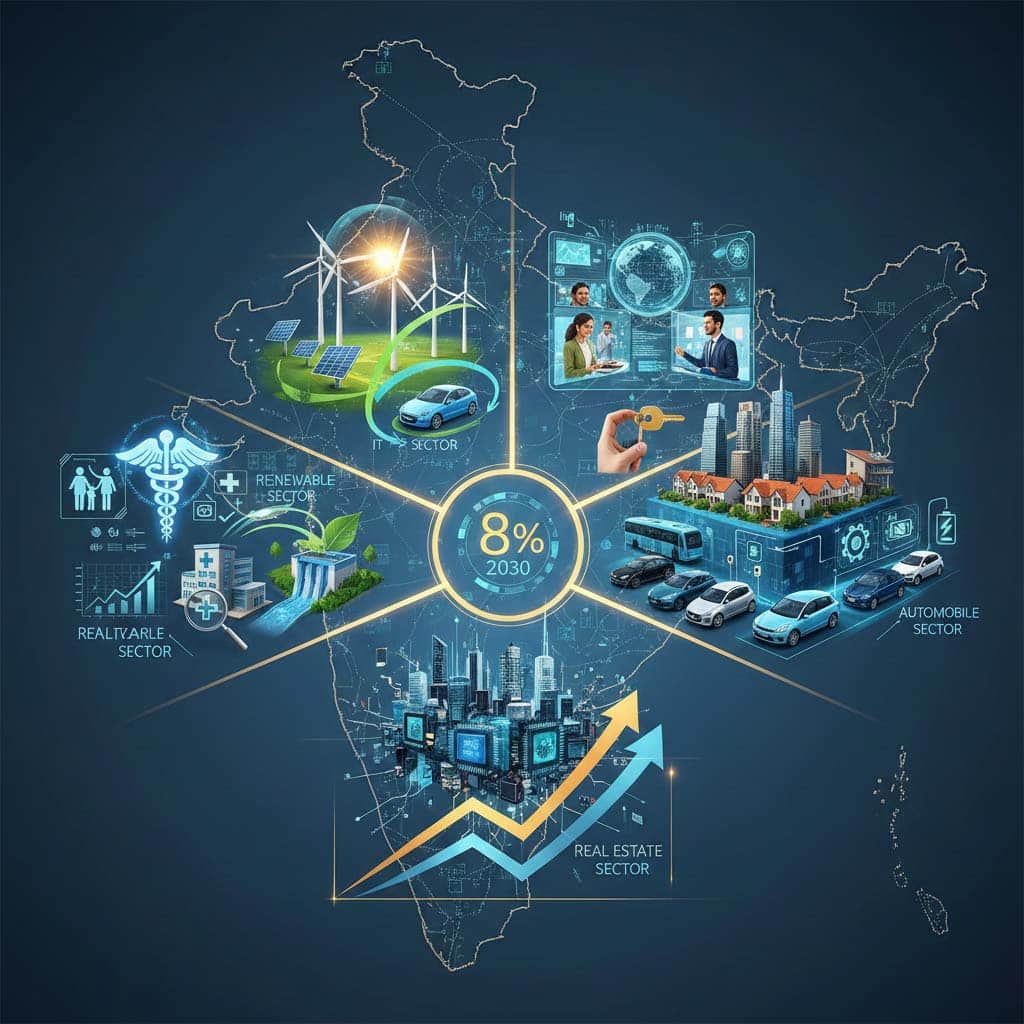
According to the data-based predictions by the Asian Development Bank, Indian economy is poised to witness a growth rate of 8% in the coming years until 2030. This growth is projected on the basis of the increasing public investments in infrastructure development and a boost in private sector in the country. Being a country of 1.8 billion people, India is becoming a favorable market for investments in private sector.
In this article we will explore the sectors of the Indian economy which have been projected to perform exceptionally in the year 2026.
Following are the sectors of Indian economy which are expected to play a crucial role in the fiscal year 2026:
1.Healthcare Sector
Being a population of aged people, India’s demand for healthcare services is on the top of mountain with an increase in chronic illnesses and growth in disposable income.
COVID-19 has also added fuel to fire by bringing attention towards improvement of healthcare services and infrastructure of the country, resulting in fostering investment opportunities.
The Governmental agency, Ayushman Bharat is offering health insurance to 100 million citizens, striving to improve the healthcare industry of India. Moreover, the government is producing investment opportunities, better healthcare services and healthcare budget as well.
The healthcare industry of India is giving the industry’s businesses new development potential through cutting-edge technology like telemedicine, electronic medical records, and digital health platforms.
The significant increase of health insurance market of India in recent years is making its way through people purchase health insurance coverage. Additionally, as the more insurance providers are joining the health insurance market, it is highly a chance to be more competitive.
Regardless of that, the healthcare industries and insurance market in India are providing chances for augmentation and expansion in coming years. For expansion of their market share and opening up of new business possibilities, the business in these industries may use the increased demand for the health insurance penetration, technological advancements, governmental efforts, healthcare products and services.
According to the Asian Development Bank, India’s economy is projected to grow 8% annually until 2030, driven by public infrastructure investments and a booming private sector. For a deeper look at India’s economic growth and challenges, Read More.
The companies worth considering in the healthcare sector are as follows:
- Apollo Hospitals Enterprise
- Cipla
- Dr Reddy’s Laboratories
- Divi’s Laboratories
- Sun Pharmaceutical Industries
2. Renewable Sector
India’s objective is to achieve the significant renewable energy capacity of 450 GW by the year 2030. Encompassing, 10 GW of biofuels, 14O GW of wind power, 280 GW of solar power, and 5 GW of small hydropower of renewable energy capacity. The nation of India has made essential progress from expansion of renewable energy sector in recent years.
For the promotion of solar energy, the construction of ultra-mega solar parks, strategic position of solar rooftop programs are the two major steps started by Indian Government. The building of offshore wind energy projects by government is encouraging the wind energy usage.
In addition to solar and wind power, the bioenergy and small hydropower are the additional renewable energy resources used by Indian Government for welfare of masses.
In spite of that, the renewable energy industry of India is quickly expanding in coming years because of the favorable government policies, increasing demand for clean energy, and decreasing costs for renewable energy technology.
3. IT SECTOR
India has played an exceptionally important role when it comes to the IT sector in the global IT markets as well as the IT jobs industry. This is primarily because of the large work force available in India particularly skillful youth specializing in the IT sector. According to the government estimates, the IT sector exports are poised to reach around 210-220 billion dollars.
Many international IT sector companies aren’t just shifting or outsourcing their businesses to India, rather the primary aim is to significantly transfer core IT functions including leadership and R&D, to creating a strategic innovation hub in India. This is primary because of the availability of massive workforce and talent pools, growing trend of adoption of digital tools and technology. The ultimate aim of these initiatives is to create Global Capability Centers (GCCs) in India, which can play a crucial role, when it comes to handling critical and high stakes work. The success of projects of global giants like Slack, Zoom, Freshworks, Pinterest and LinkedIn have proved that offshore hirings from India greatly benefitted the projects handlings, were coast effective, and the difference of time-zones make it easy for overseas workers to work in night on hybrid basis.
India has over 5 million professionals working in the field of IT, while 1.5 million new graduates enter the field every year. Similarly, India is a cost friendly market for the global IT giants as hiring offshores reduces the costs by 50%.
4. Real Estate Sector
Indian real estate market has been recently witnessing a sharp decline, as a result of ongoing recession in the international markets, which led to a decrease in demand. However, investors and real estate gurus have found an innovative solution to the crisis. First the government reforms in the sector have created hopes for the recovery in the sector. These include; Pradhan Mantri Awas Yojana (PMAY) or better known as the Affordable Housing Scheme under which the central government will provide subsidies to the weaker and lower income sections of the public to avail loans and mortgages to invest in real estate sector. The real estate regulatory authority, better known as RERA was established in 2016, under the RERA act which regulates the real estate sector, promoting the transparent and fair practices, thereby ensuring the interests of both consumers and the market elites. The expanding urban population, the growing demand for affordable housing and the robust reform process initiated by the government authorities create room for optimistic attitude towards growth in the said sector.
5.Automobile Sector
Indian automobile industry is one of the largest sectors of the economy contributing to 7% of the country’s GDP. With a workforce of millions, revenue efficiency and contribution to the nation’s GDP, automobile sector is one of the most crucial sectors of Indian economy. The sector has faced a decrease in demands, as the local and international markets move towards electric vehicles, Indian automobile sector is also updating itself to the newer trends. The FAME plan of Indian government is aimed at helping automobile giants to expand towards the electric vehicle industry.
Conclusion
For an investor, a robust and energetic market is the best destination to invest, and India’s growing sectors make it favorable for investments. It is although important for investors to understand that without the knowledge of the local market trends, a favorable investment can also backfire. Indian government and private sector should play a role here in boosting investor’s confidence by facilitating the investment process and market knowledge.