





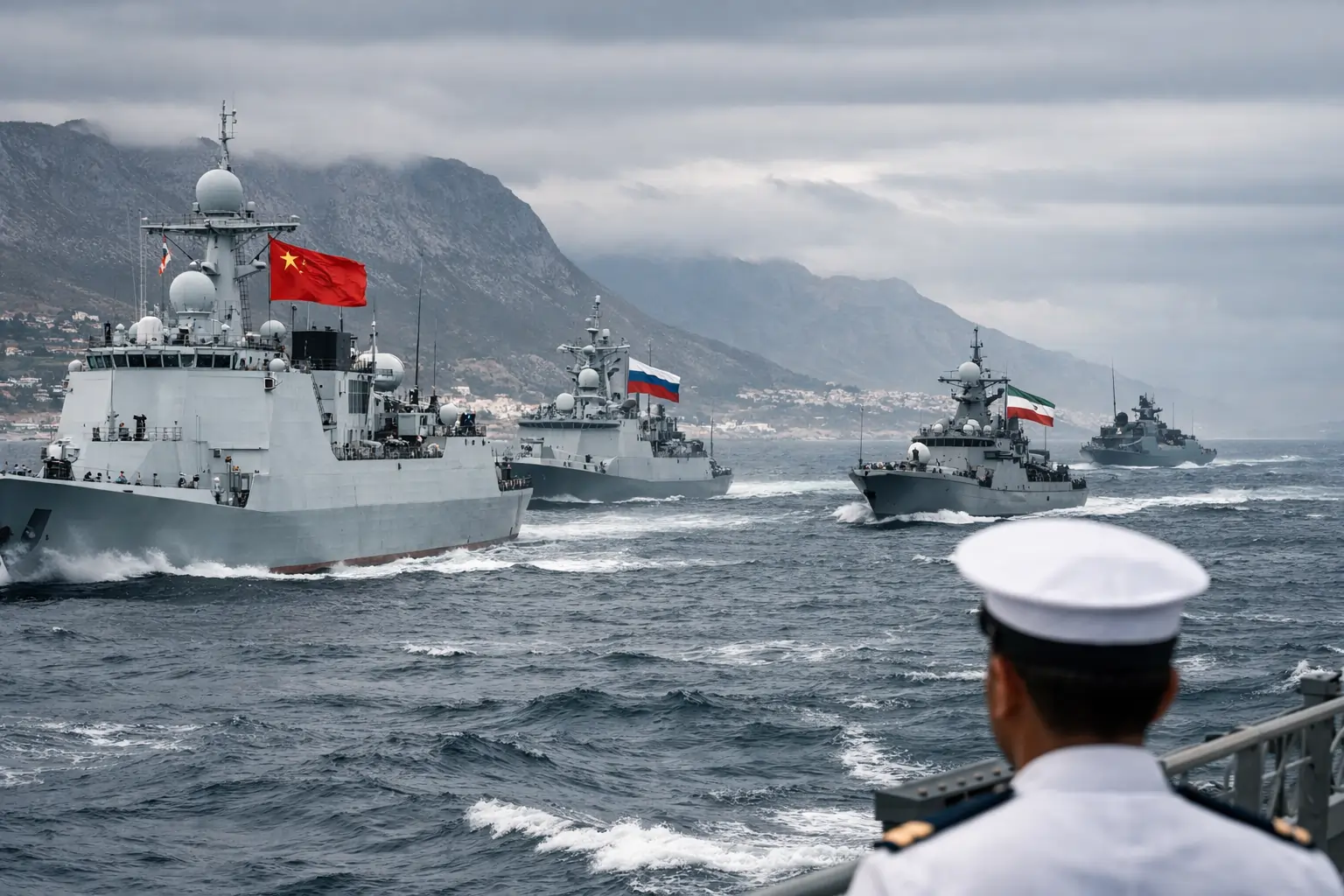
As the “Will for Peace 2026” naval exercises kick off in the choppy waters of Simon’s Town, the world is witnessing a striking image: Chinese destroyers, Russian corvettes, and Iranian vessels standing in a unified front against a backdrop of Western hegemony. But there is a glaring, embarrassing void in this display of Global South solidarity. India, a founding father of the BRICS bloc and a self-proclaimed “VishwaGuru”, is nowhere to be found.
India’s decision to opt out of these crucial drills isn’t a masterstroke of “strategic autonomy.” It is a transparent act of geopolitical cowardice. By ghosting its own alliance, India has signaled to the world that its foreign policy is no longer drafted in New Delhi, but is subject to a veto from the Oval Office.
The Price of a Smile from Mar-a-Lago
Let’s be clear: India’s absence is a desperate, knee-jerk attempt to remain in Donald Trump’s “good books.” Since Trump’s return to power, the Indian establishment has been gripped by a paralyzing fear of the “Tariff Man.” With the White House already slapping 50 percent tariffs on Indian goods and threatening a catastrophic 500 percent hike, New Delhi has chosen to play the role of the submissive suitor rather than a sovereign power.
While South Africa stands firm against Washington’s bullying despite its own economic vulnerabilities, India has folded. By skipping the drills, New Delhi thinks it can buy a reprieve from Trump’s protectionist wrath. It is a delusional strategy. Trump has already withdrawn the U.S. from the India-led International Solar Alliance and continues to lambast New Delhi for its Russian oil ties. To think that skipping a naval exercise will sate a “transactional” president who views India as a “trade abuser” is more than a miscalculation, it’s a humiliation.
The Death of Strategic Autonomy
For decades, Indian diplomats have preached the gospel of “multi-alignment.” We were told India could be a bridge between the East and the West. But in Simon’s Town, that bridge has collapsed. Even Brazil, under constant U.S. pressure, had the diplomatic spine to show up as an observer. India, however, chose total disappearance.
By refusing to participate, India is effectively ceding the leadership of the Global South to China on a silver platter. Every time India retreats from a BRICS initiative to appease Washington, it reinforces the narrative that the bloc is merely a vehicle for Beijing and Moscow. If India truly fears Chinese dominance within BRICS, the solution is to show up and lead, not to run away and hide. Instead, New Delhi has chosen to be a “pawn” in a game it helped create, paralyzed by the fear of a Trump tweet.
A Betrayal of the BRICS Mandate
The “Will for Peace” drills are a response to an increasingly volatile maritime environment, highlighted by the recent U.S. seizure of a Russian-linked tanker and the blatant abduction of Nicolas Maduro. At a time when the West is weaponizing the global financial and maritime commons, BRICS was supposed to offer an alternative.
India’s exit is a betrayal of that foundational promise. It tells South Africa, Iran, and the UAE that when the pressure is on, India will prioritize its desperate hope for a trade deal over its commitments to its partners. It is a signal to the Global South that India’s friendship is conditional, available only if Washington gives the green light.
India’s absence from the 2026 wargames will not earn it a seat at the high table in Washington; it will only earn it a reputation for unreliability. You cannot lead the Global South while looking over your shoulder to see if the American President is frowning.
Strategic autonomy is dead if it can be dismantled by the threat of a tariff. By opting out, India hasn’t balanced its ties; it has surrendered them. It has traded its dignity for a seat in Trump’s waiting room, a room where the door remains firmly locked, and the tariffs keep rising regardless of how many “wargames” India skips.
Some commentators argue that India’s decision reflects caution rather than capitulation, framing BRICS as an economic forum rather than a military bloc. This view is outlined in “The Middle Path: Why India Chose to Sit Out the ‘Will for Peace 2026’ Naval Exercises” published by IndiaDecode. However, in an era where symbolism and presence matter as much as policy, India’s absence still projects retreat, not restraint. Read more





Leave a comment