







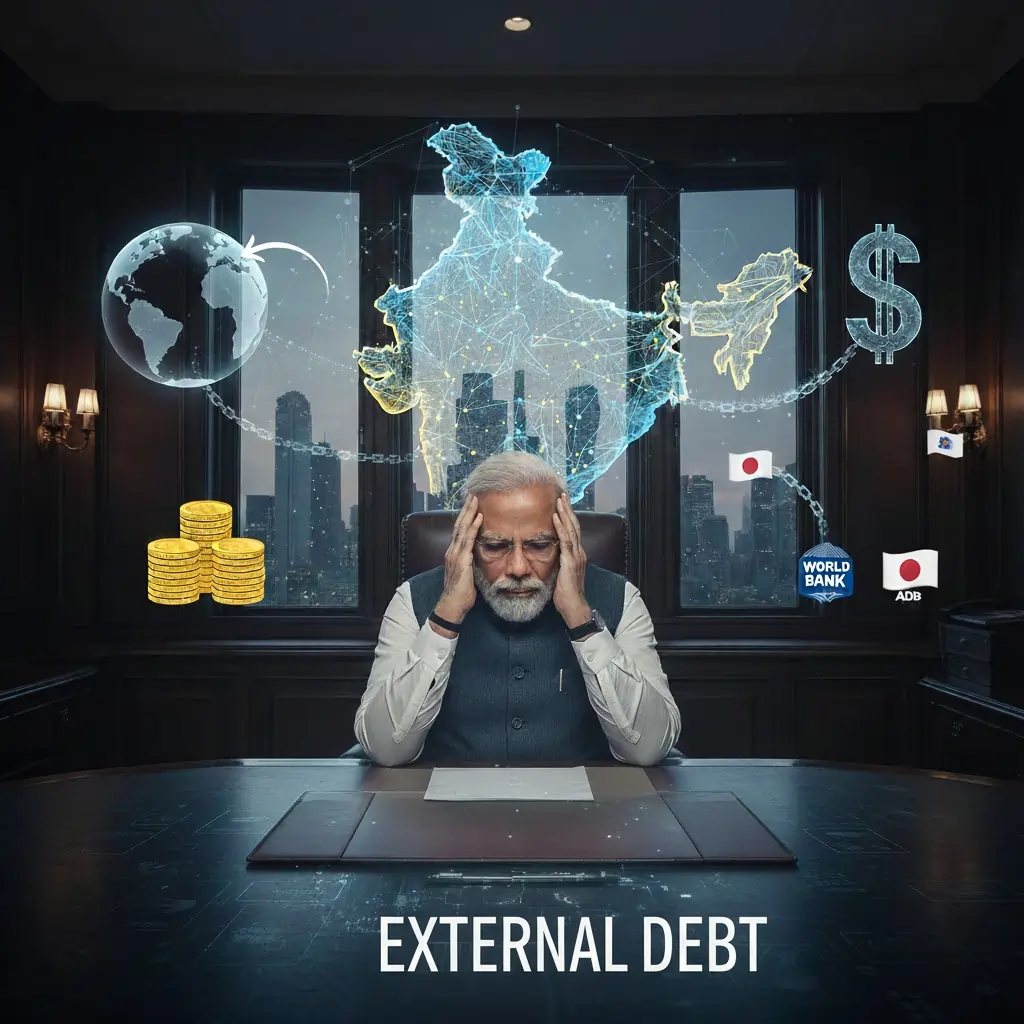
India is almost always presented with two disparate narratives: world’s fastest growing major economy, worldwide sophisticated and growing, web of international debt. Amidst the celebratory rhetoric of ‘Viksit Bharat’ (Developed India) lies an uncelebrated balance sheet crisis. India’s external debt, as of early 2024, stands at a record high $663.8 billion; up $39.7 billion from 2022. Indian government has settled with the idea that it is a manageable situation, yet the debt’s structural composition raises questions of fiscal autonomy and enduring solvency.
For official data and analysis of India’s external liabilities and composition, Reserve Bank of India figures show external debt at record highs with commercial borrowings, NRI deposits and currency effects shaping the profile. read more — India’s External Debt Hits $747.2 Billion at June‑End 2025 (NDTV report)
The Anatomy of the Burden: Who Really Owns India?
Modern India’s debt profile differs from the 1991 balance of payments crisis primarily with respect to the typical creditors. Instead of the debt being concentrated around sovereign and multilateral institutions, it is largely believed to be private. External Commercial Borrowings (ECBs) continue to be the single largest component of India’s external debt, accounting for approx. 34% of it. This denotes the total amount of capital obtained by Indian companies from overseas banks and capital markets.
While external commercial borrowing (ECB) gives companies access to less expensive financing than what is available on the domestic market, it also makes the Indian economy vulnerable to international interest rate volatility. When the US Federal Reserve increases its rates, it makes servicing the debt pricier. Additionally, Non-Resident Indian (NRI) deposits, which are viewed as a “patriotic cushion” but are also a liability, account for 23.5% of the debt. These deposits are sensitive to interest rate changes and can turn into “hot money” that can be withdrawn at any moment in times of global crisis.
The Currency Trap and the Rupee’s Vulnerability
India’s tremendous external debt also has an equally huge drawback: its currency composition. 54-55% of India’s external debt is in USD. This creates a “valuation effect” that is detrimental to India’s interests. India can avoid borrowing more money, but any depreciation of the Rupee will increase the debt liability in domestic currency terms.
Over the past two fiscal years, the Rupee has steadily continued its falls against global currencies. The combination of a currency in free-fall and dollar-denominated debt creates a pincer movement for a debtor country with a weakening currency. Some critics, for instance, state that India’s Foreign Exchange Reserves (US $680 billion) appear sufficient to cover the debt, however, the coverage ratio shows that the safety net is stretched to cover a short-term debt that is close to 19% of the total.
Multilateral Reliance versus Strategic Autonomy
India continues to be one of the largest borrowers from the World Bank and the Asian Development Bank (ADB). For 2024, multilateral debt is about $70 billion with these loans, which, being cheaper with longer repayment terms, often carry a price in the form of structural reforms and policy conditionality.
In addition, bilateral debt (or debt directly contracted with other countries) is also mostly from Japan, and is the result of huge infrastructure works like the Bullet Train and disparate metro rails. Although these partnerships are termed ‘friend-shoring’ they bind India for a considerable time to a single overseas power for its technology and finance, which does complicate the total strategic autonomy narrative.
The Paradox: The Borrower as a Lender
In what could be touted as a case of South-South Cooperation, India also plays the role of a creditor, lending over $30 billion in Lines of Credit (LoC) to more than 65 nations in Africa, Asia, and Latin America. From a soft power perspective, this is remarkable, however, from an economic perspective, this is an absurdity. India is, in effect, borrowing at commercial rates and then lending to the poorer nations at concessional rates. While this may buy India some votes at the UN and it may open some of India’s markets to her contractors, there is a huge domestic opportunity cost in not spending that borrowed money to improve India’s own primary health care and rural education. This is one of the more contentious issues in the debate among development economists.
Is the Debt Sustainable?
The government highlights the Debt to GDP ratio. The ratio is around 18.7% to 19% for external debt. By global standards, this is indeed lower than many emerging markets. However, this figure is misleading if total public debt (internal + external) is 82% of GDP.
The debt service ratio measures how much of the country’s export revenues go toward paying down principal and interest on debt. If global demand drops and India’s exports do not grow, the country’s debt burden will limit social public spending.
India is not in a “debt trap” like the ones facing its subcontinent neighbors, but it is on a precarious fiscal path. Shifting from concessional multilateral debt to unpredictable commercial debt, over-dependence on NRI deposits, and the overall exposure to the US dollar, are structural weaknesses that have to be addressed.
Any disruption in remittances directly weakens India’s ability to absorb external debt shocks. [read more]
Excerpt: “India’s global labour footprint is built on vulnerability, not protection.” (IndiaDecode)
To ensure that the foundation of India’s growth is not sand, the state has to move away from the ‘borrow-to-build’ paradigm and concentrate on the trade deficit and the Rupee. Borrowing, to an extent, is necessary, but when it is used to finance an unsustainable infrastructure or to cover up fiscal irresponsibility, it excessively burdens the next generation. India’s economic sovereignty does not lie in how much it can borrow, but in how fast it can reach the point where it doesn’t have to.